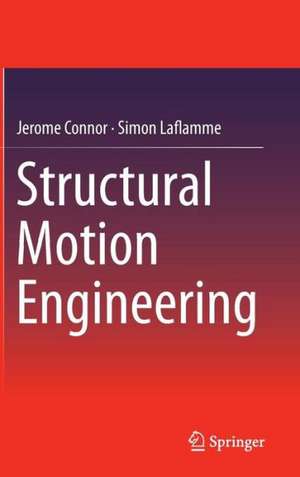
Structural Motion Engineering
Autor Jerome Connor, Simon Laflammeen Limba Engleză Hardback – 18 iul 2014
Preț: 1190.96 lei
Preț vechi: 1452.39 lei
-18%
Puncte Express: 1786
Carte tipărită la comandă
Livrare economică 07-21 septembrie
Livrare prin curier în România Termenul estimat este afișat lângă disponibilitate.
Transport gratuit pentru acest produs Plată online sau ramburs, în funcție de opțiunile comenzii.
Retur gratuit în 14 zile Comandă securizată și suport în română.
Specificații
ISBN-13: 9783319062808
ISBN-10: 3319062808
Pagini: 636
Ilustrații: XIII, 619 p. 397 illus., 84 illus. in color.
Dimensiuni: 155 x 235 x 41 mm
Greutate: 1.06 kg
Ediția:2014
Editura: Springer International Publishing
Colecția Springer
Locul publicării:Cham, Switzerland
ISBN-10: 3319062808
Pagini: 636
Ilustrații: XIII, 619 p. 397 illus., 84 illus. in color.
Dimensiuni: 155 x 235 x 41 mm
Greutate: 1.06 kg
Ediția:2014
Editura: Springer International Publishing
Colecția Springer
Locul publicării:Cham, Switzerland
V-ar putea interesa
-
 From Calculus to Chaos: An Introduction to DynamicsDavid Acheson-31%Preț: 361.86 lei522.97 lei
 -
 Elementary Fluid DynamicsD. J. Acheson-25%Preț: 556.33 lei744.93 lei
 -
 -9%Preț: 1068.10 lei1173.74 lei
 -
 Dynamic Stability of StructuresWei-Chau Xie-11%Preț: 428.56 lei481.53 lei
 -
 Concepts in Submarine DesignRoy Burcher-11%Preț: 468.15 lei526.02 lei
 -
 Pipe Stress EngineeringAsme Press-23%Preț: 806.86 lei1047.87 lei
 -
 Sliding Mode Control and ObservationYuri Shtessel-54%Preț: 381.68 lei828.52 lei
 -
 -23%Preț: 445.44 lei578.50 lei
 -
 -27%Preț: 811.51 lei1111.65 lei
 -
 Formulas for Dynamics, Acoustics and VibrationRobert D Blevins-9%Preț: 870.15 lei956.21 lei
 -
 -27%Preț: 776.70 lei1063.97 lei
 -
 Engineering Vibroacoustic AnalysisStephen A. Hambric-9%Preț: 887.64 lei975.43 lei
 -
 Time Series with Mixed SpectraTa-Hsin Li-18%Preț: 1282.73 lei1564.30 lei
 -
 Vibration Simulation Using MATLAB and ANSYSMichael R. Hatch-18%Preț: 1501.85 lei1831.52 lei
 -
 THEORY & PRACTICE OF HYDRODYNAMIC..(V20)Chakrabarti Subrata KPreț: 388.06 lei
Public țintă
Professional/practitionerCuprins
Introduction.- Part 1. Passive Control.- Optimal Stiffness Distribution–Static Loading.- Optimal Stiffness/Damping for Dynamic Loading.- Optimal Passive Damping Distribution.- Tuned Mass Damper Systems.- Base Isolation Systems.- Part 2. Active and Semi-Active Control.- Applications of Active Control.- Structural Control Dynamics.- Linear Control.- Advanced Control Theory.
Notă biografică
Dr. Jerome Connor is Professor of Civil Engineering at the Massachusetts Institute of Technology. Dr. Simon Laflamme is Assistant Professor of Civil, Construction, and Environmental Engineering at Iowa State University.
Textul de pe ultima copertă
This innovative volume provides a systematic treatment of the basic concepts and computational procedures for structural motion design and engineering for civil installations. The authors illustrate the application of motion control to a wide spectrum of buildings through many examples. Topics covered include optimal stiffness distributions for building-type structures, the role of damping in controlling motion, tuned mass dampers, base isolation systems, linear control, and nonlinear control. The book's primary objective is the satisfaction of motion-related design requirements, such as restrictions on displacement and acceleration. The book is ideal for practicing engineers and graduate students.
This book also:
· Broadens practitioners' understanding of structural motion control, the enabling technology for motion-based design
· Provides readers the tools to satisfy requirements of modern, ultra-high strength materials that lack corresponding stiffness, where the motion requirements control the design
· Equips engineers and designers to adapt to more-excitable, contemporary structures that experience more structural motion under service loading
· Explains the severe design constraints attending structures such as micro-device and semiconductor manufacturing centers in which the environment must be virtually motion free
· Illustrates motion-based energy absorption mechanisms as a cost-effective alternative over inelastic deformation to dissipate energy and control structural response · Features nearly 400 figures
This book also:
· Broadens practitioners' understanding of structural motion control, the enabling technology for motion-based design
· Provides readers the tools to satisfy requirements of modern, ultra-high strength materials that lack corresponding stiffness, where the motion requirements control the design
· Equips engineers and designers to adapt to more-excitable, contemporary structures that experience more structural motion under service loading
· Explains the severe design constraints attending structures such as micro-device and semiconductor manufacturing centers in which the environment must be virtually motion free
· Illustrates motion-based energy absorption mechanisms as a cost-effective alternative over inelastic deformation to dissipate energy and control structural response · Features nearly 400 figures