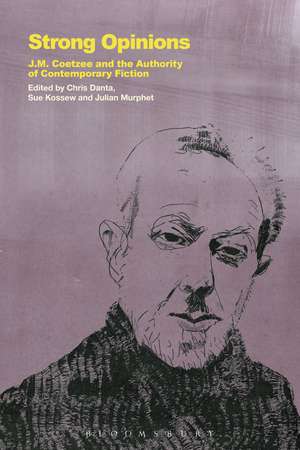
Strong Opinions: J.M. Coetzee and the Authority of Contemporary Fiction
Editat de Dr. Chris Danta, Prof. Sue Kossew, Julian Murpheten Limba Engleză Paperback – 23 mai 2013
Preț: 276.10 lei
Puncte Express: 414
Carte tipărită la comandă
Livrare economică 07-21 decembrie
Livrare prin curier în România Termenul estimat este afișat lângă disponibilitate.
Transport gratuit de la 400.00 lei Plată online sau ramburs, în funcție de opțiunile comenzii.
Retur gratuit în 14 zile Comandă securizată și suport în română.
Specificații
ISBN-13: 9781623569587
ISBN-10: 1623569583
Pagini: 192
Ilustrații: black & white illustrations
Dimensiuni: 154 x 232 x 12 mm
Greutate: 0.27 kg
Editura: Bloomsbury Publishing
Colecția Bloomsbury Academic
Locul publicării:New York, United States
ISBN-10: 1623569583
Pagini: 192
Ilustrații: black & white illustrations
Dimensiuni: 154 x 232 x 12 mm
Greutate: 0.27 kg
Editura: Bloomsbury Publishing
Colecția Bloomsbury Academic
Locul publicării:New York, United States
V-ar putea interesa
-
 Selected DiariesVirginia Woolf-17%Preț: 78.63 lei95.25 lei
 -
 Selected EssaysVirginia Woolf-18%Preț: 58.90 lei72.15 lei
 -
 Margaret Storm Jameson: A LifeJennifer Birkett-19%Preț: 369.40 lei453.95 lei
 -
 Margaret AtwoodMarion Wynne-DaviesPreț: 251.89 lei
 -
 Carol Ann DuffyDeryn Rees-JonesPreț: 198.91 lei
 -
 -17%Preț: 125.95 lei152.64 lei
 -
 Annie Proulx's The Shipping News: A Reader's GuideAliki Varvogli-17%Preț: 126.24 lei152.79 lei
 -
 Irvine Welsh's Trainspotting: A Reader's GuideRobert Morace-17%Preț: 126.24 lei152.79 lei
 -
 Bret Easton Ellis's American Psycho: A Reader's GuideJulian Murphet-18%Preț: 153.77 lei187.38 lei
 -
 Carol Shields's The Stone Diaries: A Reader's GuideAbby Werlock-12%Preț: 126.24 lei143.42 lei
 -
 Zadie Smith's White TeethClaire Squires-18%Preț: 126.38 lei154.21 lei
 -
 Arundhati Roy's The God of Small ThingsDr Julie Mullaney-17%Preț: 126.34 lei152.85 lei
 -
 Hemingway's Cuban SonVillarrealPreț: 224.86 lei
 -
 Modernism: Evolution of an IdeaProfessor Sean Latham-24%Preț: 206.26 lei271.43 lei
 -
 Jonathan Franzen: The Comedy of RageProfessor Philip Weinstein-44%Preț: 219.16 lei390.46 lei
 -
 Gather Together In My NameDr Maya Angelou-26%Preț: 53.20 lei71.66 lei
Cuprins
Acknowledgements
Contributors
Introduction
J.M. Coetzee: the Janus Face of Authority
Chris Danta
Part One: Place
1. J.M. Coetzee's Australian Realism
Elleke Boehmer
2. "[I]n Australia you start zero": the Escape from Place in J.M. Coetzee's Late Novels
Melinda Harvey
3. J.M. Coetzee and Patrick White: Explorers, Settlers, Guests
Maria López
Part Two: Form
4. Coetzee's Opinons
Paul Patton
5. Diary of a Bad Year: Parrhesia, Opinion, and Novelistic Form
Julian Murphet
6. Realism and Intertextuality in Coetzee's Foe
Anthony Uhlmann
Part Three: Limits
7. The Trope of Following in J. M. Coetzee's Slow Man
Mike Marais
8. Literary Migration: Shifting Borders in Coetzee's Australian Novels
Sue Kossew
9. The Melancholy Ape: Coetzee's Fables of Animal Finitude
Chris Danta
10. Silence as Heterotopia in Coetzee's Fiction
Bill Ashcroft
Bibliography
Index
Contributors
Introduction
J.M. Coetzee: the Janus Face of Authority
Chris Danta
Part One: Place
1. J.M. Coetzee's Australian Realism
Elleke Boehmer
2. "[I]n Australia you start zero": the Escape from Place in J.M. Coetzee's Late Novels
Melinda Harvey
3. J.M. Coetzee and Patrick White: Explorers, Settlers, Guests
Maria López
Part Two: Form
4. Coetzee's Opinons
Paul Patton
5. Diary of a Bad Year: Parrhesia, Opinion, and Novelistic Form
Julian Murphet
6. Realism and Intertextuality in Coetzee's Foe
Anthony Uhlmann
Part Three: Limits
7. The Trope of Following in J. M. Coetzee's Slow Man
Mike Marais
8. Literary Migration: Shifting Borders in Coetzee's Australian Novels
Sue Kossew
9. The Melancholy Ape: Coetzee's Fables of Animal Finitude
Chris Danta
10. Silence as Heterotopia in Coetzee's Fiction
Bill Ashcroft
Bibliography
Index
Recenzii
A clearly focussed and helpful contribution to the demanding and as yet barely embarked-upon task of coming to terms with Coetzee's most recent writings.
The essays in Strong Opinions, written by some of the top scholars in the field of Coetzee studies, work in productive ways to examine how Coetzee's writing, particularly his post-apartheid and Australia-era works, perform a position that not only questions the role of literature as authority but also deconstruct the very idea that literary authority is possible. These essays call to attention Coetzee's explicitly self-conscious act of story telling as his works navigate and negotiate specific locales, both literal and figurative. And this collection, like the works that it examines, astutely pushes the limits of what literature and literary analysis can do and asks that we, as readers, explore a tenuous duality in Coetzee's fiction: the public duty of the writer to his audience and the private- and perhaps transcendent-duty of the artist to his conscience.
The essays in Strong Opinions, written by some of the top scholars in the field of Coetzee studies, work in productive ways to examine how Coetzee's writing, particularly his post-apartheid and Australia-era works, perform a position that not only questions the role of literature as authority but also deconstruct the very idea that literary authority is possible. These essays call to attention Coetzee's explicitly self-conscious act of story telling as his works navigate and negotiate specific locales, both literal and figurative. And this collection, like the works that it examines, astutely pushes the limits of what literature and literary analysis can do and asks that we, as readers, explore a tenuous duality in Coetzee's fiction: the public duty of the writer to his audience and the private- and perhaps transcendent-duty of the artist to his conscience.