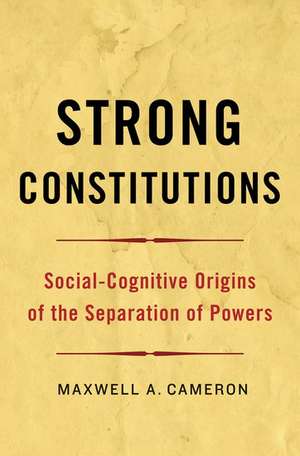
Strong Constitutions: Social-Cognitive Origins of the Separation of Powers
Autor Maxwell Cameronen Limba Engleză Hardback – 11 iul 2013
Găsim în această monografie, publicată de Oxford University Press, o reevaluare ambițioasă a unui concept care, deși fundamental pentru democrație, a rămas deseori cantonat în analize juridice rigide. Maxwell Cameron propune în Strong Constitutions o perspectivă inedită: separarea puterilor nu este doar un aranjament instituțional, ci un rezultat al evoluției socio-cognitive facilitate de scris și tipar. Autorul demonstrează cum capacitatea statelor de a coordona acțiuni colective complexe depinde de utilizarea textelor — coduri legale, constituții și documente — pentru a delimita competențele agențiilor guvernamentale.
Structura argumentației depășește modelul clasic weberian al coerciției. Reținem distincția pe care Maxwell Cameron o face între puterea de a lua decizii, puterea deliberativă de a genera legi legitime și puterea judiciară de a le aplica. Această diviziune nu fragilizează statul, ci, dimpotrivă, îi oferă o reziliență sporită prin rezolvarea problemelor de coordonare lingvistică și comunicațională. În contextul actual, marcat de comunicarea electronică instantanee, textul explorează dacă fundamentele alfabetizate ale constituționalismului mai pot susține echilibrul puterilor.
Comparabil cu The Three Branches de Christoph Moellers în rigurozitatea cu care tratează teoria politică, Strong Constitutions se diferențiază prin ancorarea sa în sociologia comunicării. În timp ce Christoph Moellers se concentrează pe aplicarea principiului în dreptul internațional și european, Maxwell Cameron caută originile cognitive ale acestui fenomen, oferind o explicație despre cum mediile de comunicare modelează însăși arhitectura statului modern.
Preț: 583.85 lei
Preț vechi: 879.20 lei
-34%
Carte tipărită la comandă
Livrare economică 10-16 decembrie
Specificații
ISBN-10: 0199987440
Pagini: 272
Dimensiuni: 236 x 160 x 28 mm
Greutate: 0.55 kg
Editura: Oxford University Press
Colecția OUP USA
Locul publicării:New York, United States
V-ar putea interesa
-
 Social ContractJ. Locke-23%Preț: 625.47 lei812.30 lei
 -
 A New Handbook of Political ScienceRobert E. Goodin-30%Preț: 661.92 lei947.10 lei
 -
 -19%Preț: 285.10 lei350.84 lei
 -
 On Complicity and CompromiseChiara Lepora-27%Preț: 339.93 lei466.09 lei
 -
 -20%Preț: 523.56 lei654.96 lei
 -
 -32%Preț: 2062.24 lei3027.86 lei
 -
 Why We Need a New Welfare StateGøsta Esping-Andersen-29%Preț: 502.64 lei706.00 lei
 -
 Justice and Legitimacy in UpbringingMatthew Clayton-32%Preț: 961.19 lei1408.93 lei
 -
 Migrant Citizenship from BelowK. ShinozakiPreț: 390.17 lei
 -
 The United States ConstitutionJ. Vile-18%Preț: 933.23 lei1138.09 lei
 -
 -15%Preț: 418.85 lei492.76 lei
 -
 Information and Revolutions in Military AffairsEmily O. Goldman-15%Preț: 421.01 lei495.30 lei
 -
 Gender and Radical Politics in India: Magic Moments of Naxalbari (1967-1975)Mallarika Sinha RoyPreț: 462.43 lei
 -
 Preț: 470.03 lei
 -
 Archaeology and State Theory: Subjects and Objects of PowerBruce Routledge-16%Preț: 272.31 lei323.08 lei
 -
 Political Polarization in American PoliticsJohn Sides-17%Preț: 120.79 lei145.18 lei
 -
 -26%Preț: 279.17 lei379.61 lei
 -
 Methodologie, Methoden, ForschungsdesignAchim HildebrandtPreț: 266.12 lei
 -
 Chanakya - A BiographyNarender SharmaPreț: 298.89 lei
 -
 Global ChinaPak-Nung Wong-18%Preț: 914.17 lei1114.85 lei
De ce să citești această carte
Această carte este esențială pentru studenții și cercetătorii din domeniul științelor politice care doresc să înțeleagă fundamentele invizibile ale statului de drept. Cititorul va câștiga o perspectivă nouă asupra modului în care tehnologia informației — de la alfabet la internet — influențează stabilitatea instituțiilor democratice. Este o recomandare solidă pentru cei care caută o analiză teoretică profundă a modului în care limbajul și textele scrise permit funcționarea puterii în societate.
Despre autor
Maxwell Cameron este un distins profesor de științe politice, recunoscut pentru contribuțiile sale în domeniul politicii comparative și al teoriei constituționale. Expertiza sa se concentrează pe funcționarea instituțiilor democratice și pe provocările contemporane ale guvernării. Prin lucrarea de față, publicată la Oxford University Press, autorul își consolidează reputația de cercetător capabil să creeze punți interdisciplinare între politologie, sociologie și studiile cognitive, oferind un cadru teoretic robust pentru analiza separării puterilor în era digitală.