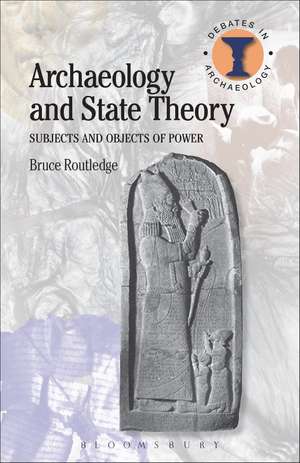
Archaeology and State Theory: Subjects and Objects of Power: Debates in Archaeology
Autor Bruce Routledgeen Limba Engleză Paperback – 21 mai 2015
Din seria Debates in Archaeology
- 10%
 Preț: 182.10 lei
 - 16%
 Preț: 182.76 lei
 - 32%
 Preț: 630.54 lei
 - 16%
 Preț: 267.08 lei
 - 20%
 Preț: 183.24 lei
 - 29%
 Preț: 183.72 lei
 - 20%
 Preț: 182.65 lei
 - 17%
 Preț: 176.83 lei
 - 16%
 Preț: 267.89 lei
 - 20%
 Preț: 183.98 lei
 - 29%
 Preț: 182.85 lei
 - 17%
 Preț: 182.85 lei
 - 26%
 Preț: 183.24 lei
 - 17%
 Preț: 184.38 lei
 - 16%
 Preț: 272.36 lei
 - 29%
 Preț: 182.27 lei
 - 26%
 Preț: 187.75 lei
 - 16%
 Preț: 267.08 lei
 - 17%
 Preț: 183.42 lei
 - 20%
 Preț: 183.04 lei
 - 16%
 Preț: 197.31 lei
 - 29%
 Preț: 183.72 lei
 - 24%
 Preț: 278.11 lei
 - 20%
 Preț: 183.34 lei
 - 20%
 Preț: 183.72 lei
 - 20%
 Preț: 187.85 lei
 - 15%
 Preț: 162.07 lei
 - 17%
 Preț: 175.86 lei
 - 26%
 Preț: 183.34 lei
 - 20%
 Preț: 185.54 lei
 - 17%
 Preț: 183.52 lei
 - 26%
 Preț: 183.72 lei
 -
 Preț: 183.24 lei
 - 17%
 Preț: 183.24 lei
 - 17%
 Preț: 183.52 lei
 - 17%
 Preț: 154.02 lei
 - 33%
 Preț: 614.10 lei
 - 17%
 Preț: 183.98 lei
 - 20%
 Preț: 182.85 lei
 - 32%
 Preț: 598.10 lei
 - 25%
 Preț: 188.84 lei
 - 25%
 Preț: 177.70 lei
Preț: 272.31 lei
Preț vechi: 323.08 lei
-16%
Puncte Express: 408
Carte tipărită la comandă
Livrare economică 05-19 decembrie
Livrare prin curier în România Termenul estimat este afișat lângă disponibilitate.
Transport gratuit de la 400.00 lei Plată online sau ramburs, în funcție de opțiunile comenzii.
Retur gratuit în 14 zile Comandă securizată și suport în română.
Specificații
ISBN-13: 9781474237130
ISBN-10: 1474237134
Pagini: 208
Dimensiuni: 136 x 214 x 14 mm
Greutate: 0.42 kg
Editura: Bloomsbury Publishing
Colecția Bloomsbury Academic
Seria Debates in Archaeology
Locul publicării:London, United Kingdom
ISBN-10: 1474237134
Pagini: 208
Dimensiuni: 136 x 214 x 14 mm
Greutate: 0.42 kg
Editura: Bloomsbury Publishing
Colecția Bloomsbury Academic
Seria Debates in Archaeology
Locul publicării:London, United Kingdom
V-ar putea interesa
-
 Master of WarSuzanne SimonsPreț: 104.62 lei
 -
 AnglerBarton GellmanPreț: 144.82 lei
 -
 Preț: 289.02 lei
 -
 The Origins of Political OrderFrancis FukuyamaPreț: 154.31 lei
 -
 -15%Preț: 538.02 lei632.97 lei
 -
 Preț: 232.77 lei
 -
 The Cambridge Companion to MachiavelliJohn M. NajemyPreț: 276.72 lei
 -
 Imperialism and Global Political EconomyAlex CallinicosPreț: 174.92 lei
 -
 The Politics of Military OccupationPeter M R Stirk-16%Preț: 207.74 lei248.44 lei
 -
 Border PoliticsNick Vaughan-Williams-16%Preț: 183.02 lei219.07 lei
 -
 Preț: 542.22 lei
 -
 The Age of Deception: Nuclear Diplomacy in Treacherous TimesMohamed ElbaradeiPreț: 57.45 lei
 -
 The Triple PackageJed Rubenfeld-28%Preț: 87.66 lei120.98 lei
 -
 Confronting EmpireEqbal AhmadPreț: 111.92 lei
 -
 Preț: 241.49 lei
Recenzii
It is a book rich in theoretical insights, supported via empirical case studies. The book represents a welcome addition to the bibliography ... It is a must-read for all readers interested in state-formation.
With this volume, Bruce Routledge has given archaeologists one of the most important works yet published on political archaeology . More successfully than any other author I know, Routledge confronts archaeology's state theory bugbear and promotes a coherent blueprint for future studies of early complex polities that promises to be seminal . Routlege expresses the hope that his work, though imperfect, will open the door to a better political archaeology . Routledge has indeed opened this door and that Archaeology and State Theory will become a foundational text for future archaeological approaches to complex polities.
With this volume, Bruce Routledge has given archaeologists one of the most important works yet published on political archaeology . More successfully than any other author I know, Routledge confronts archaeology's state theory bugbear and promotes a coherent blueprint for future studies of early complex polities that promises to be seminal . Routlege expresses the hope that his work, though imperfect, will open the door to a better political archaeology . Routledge has indeed opened this door and that Archaeology and State Theory will become a foundational text for future archaeological approaches to complex polities.