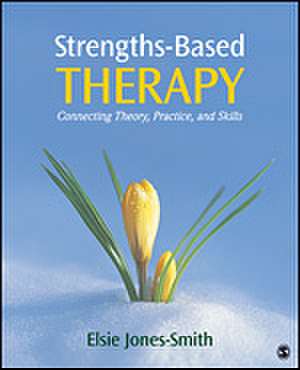
Strengths-Based Therapy: Connecting Theory, Practice and Skills
Autor Elsie Jones-Smithen Limba Engleză Electronic book text – 20 mar 2014
Preț: 516.96 lei
Preț vechi: 561.91 lei
-8%
Puncte Express: 775
Indisponibil temporar
Doresc să fiu notificat când acest titlu va fi disponibil:
Se trimite...
Specificații
ISBN-13: 9781452292816
ISBN-10: 1452292817
Pagini: 480
Dimensiuni: 187 x 232 mm
Ediția:1
Editura: SAGE Publications
Colecția Sage Publications, Inc
Locul publicării:Thousand Oaks, United States
ISBN-10: 1452292817
Pagini: 480
Dimensiuni: 187 x 232 mm
Ediția:1
Editura: SAGE Publications
Colecția Sage Publications, Inc
Locul publicării:Thousand Oaks, United States
V-ar putea interesa
-
 -27%Preț: 753.56 lei1031.43 lei
-
 Art Therapy, Research and Evidence-based PracticeAndrea Gilroy-5%Preț: 689.24 lei725.52 lei
-
 Family TherapyRoger Lowe-5%Preț: 407.99 lei429.47 lei
-
 Dance Movement TherapyBonnie Meekums-5%Preț: 463.55 lei487.94 lei
-
 An Introduction to DramatherapyDorothy Langley-5%Preț: 609.28 lei641.35 lei
-
 Brief Gestalt TherapyGaie Houston-5%Preț: 750.07 lei789.55 lei
-
 Irvin D. YalomRuthellen JosselsonPreț: 155.82 lei
-
 Cognitive Behavior Therapy and Eating DisordersChristopher G. Fairburn-5%Preț: 436.97 lei459.97 lei
-
 Preț: 345.29 lei
Recenzii
This
is
an
interesting
book
which
encourages
the
reader
to
look
at
potential
problems
and
situations
from
a
positive
perspective
and
also
from
different
cultural
and
social
perspectives...The
concepts
in
this
book
apply
equally
well
to
teachers,
parents
and
students.
A
strength-based
approach
has
much
to
offer
as
part
of
a
whole
school
approach
to
developing
a
positive
culture.
Cuprins
Part
I
Chapter 1: Strengths-Based Therapy
Chapter 2: Human Strengths Theory: The Neuroscience and Relational
Chapter 3: Strengths across Cultures
Chapter 4: The Strengths-Based Therapy Model
Chapter 5: Strengths-Based Assessment
Part II
Strengths-Based Recovery: Introduction to Part II, Practice
Chapter 6: Strengths-Based Therapy and Families
Chapter 7: Strengths-Based Therapy and Recovery in Mental Health
Chapter 8: Strengths-Based Therapy, Addiction, and a Harm Reduction Approach
Chapter 9: Strengths-Based School Counseling
Chapter 10: Strengths-Based Therapy: “At-Risk or “At-Promise”
Chapter 11: Strengths-Based Therapy in Correctional Settings
Chapter 12: Strengths-Based Therapy and Older Adults
References
Index
Descriere
Using
cutting-edge
research,
this
text
lays
a
theoretical
foundation
to
help
students
and
practitioners
understand
the
grounding
and
theory
behind
strengths-based
therapy
and
then
presents
a
model
for
use
with
a
variety
of
client
types/settings.
Notă biografică
Dr. Elsie Jones-Smith is a licensed psychologist, a certified school psychologist, and the President of the Strengths-Based Institute. She holds two Ph.D. degrees, one in clinical psychology from Michigan State University and the other in counselor education from the University at Buffalo. She is a Fellow in two divisions of the American Psychological Association, Division 17, the Society of Counseling Psychology, and Division 45, the Society for the Psychological Study of Culture, Ethnicity, and Race. She is a Diplomate in counseling psychology (ABPP), a Fellow of the Academy of Counseling Psychology, and a prior Distinguished Visitor for the American Psychological Association.
Dr. Jones-Smith has extensive experience in strengths-based therapy, graduate level teaching, program evaluation (Head Start, Title -Chapter 1), tests construction, and psychological consultation with schools. Her clinical orientation is strengths-based. She has currently expanded her clinical work to include cultural neuroscience.She is the author of six books, including the recently published Culturally Diverse Counseling: Theories and Practice (Sage, 2019). Second Edition of Theories of Counseling and Psychotherapy: An Integrative Approach (2016) with Sage Publications (which presents a chapter on Neuroscience and describes it as the Fifth Force in psychology); Spotlighting the Strengths of Every Single Student: Why U.S. Schools Need a New, Strengths-Based Approach (2011, ABC-CLIO (2011); and Nurturing Nonviolent Children: A Guide for Parents, Educators, and Counselors (Praeger, 2008).
Two of her articles ("The Strengths-Based Counseling Model" (which was nominated as the outstanding article in TCP for 2006) and "Ethnic Minorities: Life Stress, Social Support and Mental Health Issues" (1985) have been cited by The Counseling Psychologist as major contributions to the field of psychology. She has served on numerous editorial boards, including The Counseling Psychologist (TCP), The Journal of Counseling Psychology, and Counselor Education and Supervision.
Dr. Jones-Smith has developed and published two theories in psychology: Strengths-Based Therapy and Ethnic Identity Development. In addition, she has developed a strengths-based educational approach for working with youth in schools and several instruments that measure ethnic identity development, students' strengths, and teachers' strengths.