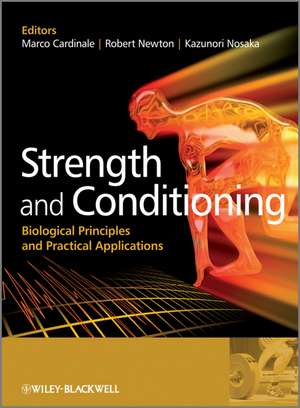
Strength and Conditioning
Editat de Marco Cardinale, Robert Newton, Kazunori Nosakaen Limba Engleză Paperback – 11 ian 2011
În analiza literaturii de specialitate dedicate performanței sportive, observăm că volumul Strength and Conditioning, editat de Kazunori Nosaka, Marco Cardinale și Robert Newton, se poziționează ca o alternativă riguroasă la manuale precum Strength and Conditioning for Sports Performance de Ian Jeffreys. Dacă lucrarea lui Jeffreys este adesea utilizată pentru o introducere generală în domeniu, volumul de față, publicat de John Wiley & Sons, Inc., oferă un avantaj competitiv prin integrarea profundă a bazei biologice și a biomecanicii, fiind orientat către o abordare clinică și bazată pe dovezi. Ne-a atras atenția organizarea metodologică în patru secțiuni distincte. Prima parte fundamentează teoretic aspectele biologice, element esențial pentru a înțelege secțiunea a doua, dedicată răspunsurilor fiziologice la programele de forță și condiționare. Găsim în această carte un echilibru între teorie și practică pe care puține manuale îl ating; de exemplu, spre deosebire de Conditioning for Strength and Human Performance de T. Jeff Chandler, care pune accent pe fluxul informațional pentru antrenori, lucrarea de față insistă pe strategiile de monitorizare și evaluare, oferind ghiduri concrete pentru scrierea programelor de antrenament. Un element distinctiv care ridică valoarea academică a acestui titlu este secțiunea finală. Aceasta examinează forța și condiționarea nu doar ca instrumente de performanță, ci și ca metode de reabilitare și adaptare pentru persoanele cu dizabilități. Cele 496 de pagini sunt susținute de ilustrații alb-negru și tabele care sintetizează datele complexe din biomecanică și cinetică. Este un instrument clinic indispensabil pentru cei care doresc să depășească nivelul empiric al antrenamentului sportiv.
Preț: 620.11 lei
Preț vechi: 652.75 lei
-5%
Carte disponibilă
Livrare economică 23 octombrie-06 noiembrie
Livrare express 08-14 octombrie pentru 63.45 lei
Specificații
ISBN-10: 0470019190
Pagini: 496
Ilustrații: black & white illustrations, black & white tables, figures
Dimensiuni: 200 x 260 x 29 mm
Greutate: 1.03 kg
Editura: Wiley
Locul publicării:Chichester, United Kingdom
V-ar putea interesa
-
 Oxford Handbook of CardiologyPunit RamrakhaPreț: 287.67 leiRecomandat
 -
 -18%Preț: 130.79 lei159.17 lei
 -
 -17%Preț: 130.89 lei158.65 leiRecomandat
 -
 Strength and Conditioning for Sports PerformanceIan Jeffreys-8%Preț: 620.13 lei674.06 lei
 -
 Sports Rehabilitation and Injury PreventionEarle Abrahamson-5%Preț: 480.62 lei505.92 lei
 -
 Sport Psychology for CoachesDamon BurtonPreț: 309.88 lei
 -
 Preț: 170.94 lei
 -
 Sports Science: A complete introductionSimon Rea-26%Preț: 106.54 lei143.61 lei
 -
 The Strength Training Anatomy WorkoutFrederic Delavier-5%Preț: 169.96 lei178.91 lei
 -
 NSCA's Essentials of Tactical Strength and ConditioningBrent A. Alvar-5%Preț: 661.23 lei696.03 lei
 -
 -5%Preț: 378.62 lei398.55 leiRecomandat
 -
 NSCA's Guide to Program DesignMargaret T. JonesPreț: 448.13 lei
 -
 Science and Development of Muscular StrengthTimothy J. Suchomel-15%Preț: 428.50 lei504.13 lei
 -
 -32%Preț: 374.81 lei547.72 lei
 -
 ACSM's Foundations of Strength Training and ConditioningNicholas Ratamess, Jr.-24%Preț: 620.37 lei815.59 lei
 -
 Concurrent Aerobic and Strength TrainingMoritz Schumann-5%Preț: 946.61 lei996.42 lei
Public țintă
Students, Researchers, Sports ProfessionalsDe ce să citești această carte
Această carte este esențială pentru studenții la kinetoterapie și profesioniștii din medicina sportivă care caută o fundamentare științifică a antrenamentului. Cititorul câștigă acces la metodologii avansate de monitorizare a performanței și înțelege mecanismele biologice ale adaptării musculare. Este recomandată celor care doresc să implementeze programe de forță sigure, inclusiv în contextul recuperării medicale.
Descriere scurtă
Notă biografică
Robert Newton is the editor of Strength and Conditioning: Biological Principles and Practical Applications, published by Wiley.
Kazunori Nosaka is the editor of Strength and Conditioning: Biological Principles and Practical Applications, published by Wiley.
Cuprins
List of Contributors.
Section 1 Strengthand Conditioning Biology.
1.1 Skeletal Muscle Physiology (Valmor Tricoli).
1.1.1 Introduction.
1.1.2 Skeletal muscle macrostructure.
1.1.3 Skeletal muscle microstructure.
1.1.4 Contraction mechanism.
1.1.5 Muscle fibre types.
1.1.6 Muscle architecture.
1.1.7 Hypertrophy and hyperplasia.
1.1.8 Satellite cells.
1.2 Neuromuscular Physiology (Alberto Rainoldi and Marco Gazzoni).
1.2.1 The neuromuscular system.
1.2.2 Muscle fatigue.
1.2.3 Muscle function assessment.
1.3 Bone Physiology (Jörn Rittweger).
1.3.1 Introduction.
1.3.2 Bone anatomy.
1.3.3 Bone biology.
1.3.4 Mechanical functions of bone.
1.3.5 Adaptive processes in bone.
1.3.6 Endocrine involvement of bone.
1.4 Tendon Physiology (Nicola Maffulli, Umile Giuseppe Longo, Filippo Spiezia and Vincenzo Denaro).
1.4.1 Tendons.
1.4.2 The musculotendinous junction.
1.4.3 The osteotendinous junction.
1.4.4 Nerve supply.
1.4.5 Blood supply.
1.4.6 Composition.
1.4.7 Collagen formation.
1.4.8 Cross-links.
1.4.9 Elastin.
1.4.10 Cells.
1.4.11 Ground substance.
1.4.12 Crimp.
1.5 Bioenergetics of Exercise (R.J. Maughan).
1.5.1 Introduction.
1.5.2 Exercise, energy, work, and power.
1.5.3 Sources of energy.
1.5.4 The tricarboxylic acid (TCA) cycle.
1.5.5 Oxygen delivery.
1.5.6 Energy stores.
1.5.7 Conclusion.
1.6 Respiratory and Cardiovascular Physiology (Jeremiah J. Peiffer and Chris R. Abbiss).
1.6.1 The respiratory system.
1.6.2 The cardiovascular system.
1.6.3 Conclusion.
1.7 Genetic and Signal Transduction Aspects of Strength Training (Henning Wackerhage, Arimantas Lionikas, Stuart Gray and Aivaras Ratkevicius).
1.7.1 Genetics of strength and trainability.
1.7.2 Signal transduction pathways that mediate the adaptation to strength training.
1.8 Strength and Conditioning Biomechanics (Robert U. Newton).
1.8.1 Introduction.
1.8.2 Biomechanical concepts for strength and conditioning.
1.8.3 The force-velocity-power relationship.
1.8.4 Musculoskeletal machines.
1.8.5 Biomechanics of muscle function.
1.8.6 Body size, shape, and power-to-weight ratio.
1.8.7 Balance and stability.
1.8.8 The stretch-shortening cycle.
1.8.9 Biomechanics of resistance machines.
1.8.10 Machines vs free weights.
1.8.11 Conclusion.
Section 2 Physiological adaptations to strength and conditioning.
2.1 Neural Adaptations to Resistance Exercise (Per Aagaard).
2.1.1 Introduction.
2.1.2 Effects of strength training on mechanical muscle function.
2.1.3 Effects of strength training on neural function.
2.1.4 Conclusion.
2.2 Structural and Molecular Adaptations to Training (Jesper L. Andersen).
2.2.1 Introduction.
2.2.2 Protein synthesis and degradation in human skeletal muscle.
2.2.3 Muscle hypertrophy and atrophy.
2.2.4 What is the significance of satellite cells in human skeletal muscle?
2.2.5 Concurrent strength and endurance training: consequences for muscle adaptations.
2.3 Adaptive Processes in Human Bone and Tendon (Constantinos N. Maganaris, Jörn Rittweger and Marco V. Narici).
2.3.1 Introduction.
2.3.2 Bone.
2.3.3 Tendon.
2.3.4 Conclusion.
2.4 Biomechanical Markers and Resistance Training (Christian Cook and Blair Crewther).
2.4.1 Introduction.
2.4.2 Testosterone responses to resistance training.
2.4.3 Cortisol responses to resistance training.
2.4.4 Dual actions of testosterone and cortisol.
2.4.5 Growth hormone responses to resistance training.
2.4.6 Other biochemical markers.
2.4.7 Limitations in the use and interpretation of biochemical markers.
2.4.8 Applications of resistance training.
2.4.9 Conclusion.
2.5 Cardiovascular Adaptations to Strength and Conditioning (Andy Jones and Fred DiMenna).
2.5.1 Introduction.
2.5.2 Cardiovascular function.
2.5.3 Cardiovascular adaptations to training.
2.5.4 Cardiovascular-related adaptations to training.
2.5.5 Conclusion.
2.6 Exercise-induced Muscle Damage and Delayed-onset Muscle Soreness (DOMS) (Kazunori Nosaka).
2.6.1 Introduction.
2.6.2 Symptoms and markers of muscle damage.
2.6.3 Relationship between DOMS and other indicators.
2.6.4 Factors influencing the magnitude of muscle damage.
2.6.5 Muscle damage and training.
2.6.6 Conclusion.
2.7 Alternative Modalities of Strength and Conditioning: Electrical Stimulation and Vibration (Nicola A. Maffiuletti and Marco Cardinale).
2.7.1 Introduction.
2.7.2 Electrical-stimulation exercise.
2.7.3 Vibration exercise.
2.8 The Stretch-Shortening Cycle (SSC) (Anthony Blazevich).
2.8.1 Introduction.
2.8.2 Mechanisms responsible for performance enhancement with the SSC.
2.8.3 Force unloading: a requirement for elastic recoil.
2.8.4 Optimum MTU properties for SSC performance.
2.8.5 Effects of the transition time between stretch and shortening on SSC performance.
2.8.6 Conclusion.
2.9 Repeated-sprint Ability (RSA) (David Bishop and Olivier Girard).
2.9.1 Introduction.
2.9.2 Limiting factors.
2.9.3 Ergogenic aids and RSA.
2.9.4 Effects of training on RSA.
2.9.5 Conclusion.
2.10 The Overtraining Syndrome (OTS) (Romain Meeusen and Kevin De Pauw).
2.10.1 Introduction.
2.10.2 Definitions.
2.10.3 Prevalence.
2.10.4 Mechanisms and diagnosis.
2.10.5 Prevention.
2.10.6 Conclusion.
Section 3 Monitoring strength and conditioning progress.
3.1 Principles of Athlete Testing (Robert U. Newton and Marco Cardinale).
3.1.1 Introduction.
3.1.2 General principles of athlete testing.
3.1.3 Maximum strength.
3.1.4 Ballistic testing.
3.1.5 Reactive strength tests.
3.1.6 Eccentric strength tests.
3.1.7 Conclusion.
3.2 Speed and Agility Assessment (Warren Young and Jeremy Sheppard).
3.2.1 Speed.
3.2.2 Agility.
3.2.3 Conclusion.
3.3 Testing Anaerobic Capacity and Repeated-sprint Ability (David Bishop and Matt Spencer).
3.3.1 Introduction.
3.3.2 Testing anaerobic capacity.
3.3.3 Testing repeated-sprint ability.
3.3.4 Conclusion.
3.4 Cardiovascular Assessment and Aerobic Training Prescription (Andy Jones and Fred DiMenna).
3.4.1 Introduction.
3.4.2 Cardiovascular assessment.
3.4.3 Aerobic training prescription.
3.4.4 Conclusion.
3.5 Biochemical Monitoring in Strength and Conditioning (Michael R. McGuigan and Stuart J. Cormack).
3.5.1 Introduction.
3.5.2 Hormonal monitoring.
3.5.3 Metabolic monitoring.
3.5.4 Immunological and haematological monitoring.
3.5.5 Practical application.
3.6 Body Composition: Laboratory and Field Methods of Assessment (Arthur Stewart and Tim Ackland).
3.6.1 Introduction.
3.6.2 History of body composition methods.
3.6.3 Fractionation models for body composition.
3.6.4 Biomechanical imperatives for sports performance.
3.6.5 Methods of assessment.
3.6.6 Profiling.
3.6.7 Conclusion.
3.7 Total Athlete Management (TAM) and Performance Diagnosis (Robert U. Newton and Marco Cardinale).
3.7.1 Total athlete management.
3.7.2 Performance diagnosis.
3.7.3 Conclusion.
Section 4 Practical applications.
4.1 Resistance Training Modes: A Practical Perspective (Michael H. Stone and Margaret E. Stone).
4.1.1 Introduction.
4.1.2 Basic training principles.
4.1.3 Strength, explosive strength, and power.
4.1.4 Conclusion.
4.2 Training Agility and Change-of-direction Speed (CODS) (Jeremy Sheppard and Warren Young).
4.2.1 Factors affecting agility.
4.2.2 Organization of training.
4.2.3 Change-of-direction speed.
4.2.4 Perceptual and decision-making factors.
4.2.5 Training agility.
4.2.6 Conclusion.
4.3 Nutrition for Strength Training (Christopher S. Shaw and Kevin D. Tipton).
4.3.1 Introduction.
4.3.2 The metabolic basis of muscle hypertrophy.
4.3.3 Optimal protein intake.
4.3.4 Acute effects of amino acid/protein ingestion.
4.3.5 Conclusion.
4.4 Flexibility (William A. Sands).
4.4.1 Definitions.
4.4.2 What is stretching?
4.4.3 A model of effective movement: the integration of flexibility and strength.
4.5 Sensorimotor Training (Urs Granacher, Thomas Muehlbauer, Wolfgang Taube, Albert Gollhofer and Markus Gruber).
4.5.1 Introduction.
4.5.2 The importance of sensorimotor training to the promotion of postural control and strength.
4.5.3 The effects of sensorimotor training on postural control and strength.
4.5.4 Adaptive processes following sensorimotor training.
4.5.5 Characteristics of sensorimotor training.
4.5.6 Conclusion.
Section 5 Strength conditioning special cases.
5.1 Strength and Conditioning as a Rehabilitation Tool (Andreas Schlumberger).
5.1.1 Introduction.
5.1.2 Neuromuscular effects of injury as a basis for rehabilitation strategies.
5.1.3 Strength and conditioning in retraining of the neuromuscular system.
5.1.4 Conclusion.
5.2 Strength Training for Children and Adolescents (Avery D. Faigenbaum).
5.2.1 Introduction.
5.2.2 Risks and concerns associated with youth strength training.
5.2.3 The effectiveness of youth resistance training.
5.2.4 Physiological mechanisms for strength development.
5.2.5 Potential health and fitness benefits.
5.2.6 Youth strength-training guidelines.
5.2.7 Conclusion.
5.3 Strength and Conditioning Considerations for the Paralympic Athlete (Mark Jarvis, Matthew Cook and Paul Davies).
5.3.1 Introduction.
5.3.2 Programming considerations.
5.3.3 Current controversies in Paralympic strength and conditioning.
5.3.4 Specialist equipment.
5.3.5 Considerations for specific disability groups.
5.3.6 Tips for more effective programming.
Index.