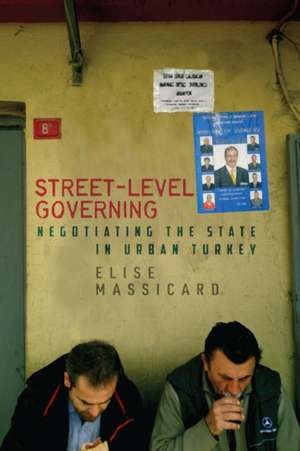
Street-Level Governing
Autor Elise Massicarden Limba Engleză Paperback – 7 iun 2022
As Elise Massicard shows, muhtars exist at the intersection of everyday life and the exercise of power. Their position offers a personalized point of contact between citizens and state institutions, enabling close oversight of the citizenry, yet simultaneously projecting the sense of an accessible state to individuals. Challenging common theories of the state, Massicard outlines how the position of the muhtar throws into question an assumed dichotomy between domination and social resistance, and suggests that considerations of circumvention and accommodation are normal attributes of state-society functioning.
Preț: 246.09 lei
Puncte Express: 369
Carte tipărită la comandă
Livrare economică 04-18 decembrie
Livrare prin curier în România Termenul estimat este afișat lângă disponibilitate.
Transport gratuit de la 400.00 lei Plată online sau ramburs, în funcție de opțiunile comenzii.
Retur gratuit în 14 zile Comandă securizată și suport în română.
Specificații
ISBN-13: 9781503631854
ISBN-10: 1503631850
Pagini: 344
Dimensiuni: 150 x 226 x 24 mm
Greutate: 0.48 kg
Editura: Stanford University Press
ISBN-10: 1503631850
Pagini: 344
Dimensiuni: 150 x 226 x 24 mm
Greutate: 0.48 kg
Editura: Stanford University Press
Notă biografică
Elise Massicard is Research Professor at the Centre national de la recherche scientifique / Centre for International Studies, Sciences Po. She is the author of The Alevis in Turkey and Europe: Identity and Managing Territorial Diversity (2012).
Cuprins
1. An Incompletely Formed Institution
2. How the Muhtarl¿k Fuels the Production of Notables
3. The Muhtars' Changing Role
4. The Residents' Champion
5. Ambivalent Interface with the Official Order
6. Enacting Context-Dependent Roles
7. Working within and Modulating Institutional Constraints
8. The Muhtarl¿ks' Waning Autonomy
Conclusion
2. How the Muhtarl¿k Fuels the Production of Notables
3. The Muhtars' Changing Role
4. The Residents' Champion
5. Ambivalent Interface with the Official Order
6. Enacting Context-Dependent Roles
7. Working within and Modulating Institutional Constraints
8. The Muhtarl¿ks' Waning Autonomy
Conclusion