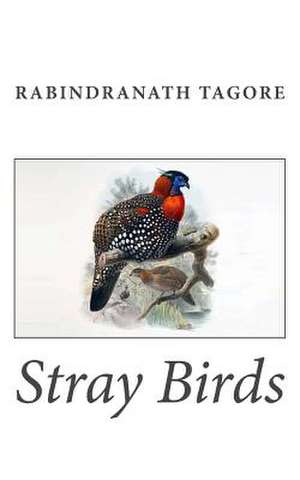
Stray Birds
Autor Rabindranath Tagoreen Limba Engleză Paperback
Preț: 40.70 lei
Puncte Express: 61
Carte tipărită la comandă
Livrare economică 18 noiembrie-02 decembrie
Livrare prin curier în România Termenul estimat este afișat lângă disponibilitate.
Transport gratuit de la 400.00 lei Plată online sau ramburs, în funcție de opțiunile comenzii.
Retur gratuit în 14 zile Comandă securizată și suport în română.
Specificații
ISBN-13: 9781494820428
ISBN-10: 1494820420
Pagini: 44
Dimensiuni: 127 x 203 x 2 mm
Greutate: 0.05 kg
Editura: CREATESPACE
ISBN-10: 1494820420
Pagini: 44
Dimensiuni: 127 x 203 x 2 mm
Greutate: 0.05 kg
Editura: CREATESPACE
V-ar putea interesa
-
 Selected Poems of Rabindranath TagoreRabindranath Tagore-20%Preț: 72.23 lei90.76 lei
 -
 Pablo Neruda: A Passion for LifeAdam FeinsteinPreț: 97.82 lei
 -
 The Book of QuestionsPablo NerudaPreț: 74.16 lei
Notă biografică
Rabindranath Tagore (1861-1941) was an Indian poet, composer, philosopher, and painter from Bengal. Born to a prominent Brahmo Samaj family, Tagore was raised mostly by servants following his mother¿s untimely death. His father, a leading philosopher and reformer, hosted countless artists and intellectuals at the family mansion in Calcutta, introducing his children to poets, philosophers, and musicians from a young age. Tagore avoided conventional education, instead reading voraciously and studying astronomy, science, Sanskrit, and classical Indian poetry. As a teenager, he began publishing poems and short stories in Bengali and Maithili. Following his father¿s wish for him to become a barrister, Tagore read law for a brief period at University College London, where he soon turned to studying the works of Shakespeare and Thomas Browne. In 1883, Tagore returned to India to marry and manage his ancestral estates. During this time, Tagore published his Manasi (1890) poems and met the folk poet Gagan Harkara, with whom he would work to compose popular songs. In 1901, having written countless poems, plays, and short stories, Tagore founded an ashram, but his work as a spiritual leader was tragically disrupted by the deaths of his wife and two of their children, followed by his father¿s death in 1905. In 1913, Tagore was awarded the Nobel Prize in Literature, making him the first lyricist and non-European to be awarded the distinction. Over the next several decades, Tagore wrote his influential novel The Home and the World (1916), toured dozens of countries, and advocated on behalf of Dalits and other oppressed peoples.