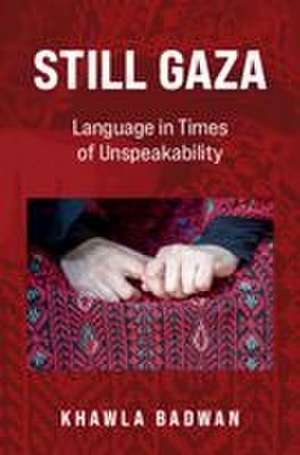
Still Gaza
Autor Khawla Badwanen Limba Engleză Paperback – 31 ian 2027
Preț: 188.11 lei
Precomandă
Puncte Express: 282
Carte nepublicată încă
Livrare prin curier în România Precomanda se expediază când titlul devine disponibil.
Transport gratuit de la 400.00 lei Plată online sau ramburs, în funcție de opțiunile comenzii.
Retur gratuit în 14 zile Comandă securizată și suport în română.
Doresc să fiu notificat când acest titlu va fi disponibil:
Se trimite...
Specificații
ISBN-13: 9781009869072
ISBN-10: 1009869078
Pagini: 244
Editura: Cambridge University Press & Assessment
ISBN-10: 1009869078
Pagini: 244
Editura: Cambridge University Press & Assessment
Notă biografică
Khawla Badwan is a Palestinian scholar of language, culture, education and social justice. She is Reader in Applied Linguistics at Manchester Metropolitan University, where she co-leads the Manchester Centre for Research in Linguistics. Her publications include Language in a Globalised World: Social Justice Perspectives on Mobility and Contact (2021).
Cuprins
Foreword; Prologue; 1. Applied linguistics with Gaza; 2. Still Gaza; 3. Aphasic being with Gaza; 4. The shattering of language with Gaza; 5. Linguistic rebellion for Gaza; 6. Poetic praxis for Gaza: methodology of witnessing; 7. Moving forward with Gaza.