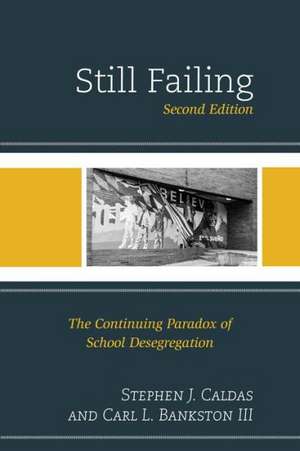
Still Failing: The Continuing Paradox of School Desegregation
Autor Stephen J. Caldas, Carl L. Bankston, IIIen Limba Engleză Paperback – 19 dec 2014
Historical antecedents showing how and why American schooling became racially segregatedSocial capital theory to explain school and community segregationThe legal history of all important supreme court cases, congressional laws and presidential executive orders related to school segregation and desegregationEasy-to-read and interpret graphs and figuresThe most up-to-date school population and census information
Preț: 254.48 lei
Preț vechi: 339.94 lei
-25%
Puncte Express: 382
Carte tipărită la comandă
Livrare economică 06-20 iunie
Specificații
ISBN-13: 9781610489638
ISBN-10: 1610489632
Pagini: 176
Ilustrații: 20 BW Illustrations
Dimensiuni: 152 x 229 x 8 mm
Greutate: 0.18 kg
Ediția:2nd edition
Editura: Bloomsbury Publishing
Colecția Rowman & Littlefield
Locul publicării:New York, United States
ISBN-10: 1610489632
Pagini: 176
Ilustrații: 20 BW Illustrations
Dimensiuni: 152 x 229 x 8 mm
Greutate: 0.18 kg
Ediția:2nd edition
Editura: Bloomsbury Publishing
Colecția Rowman & Littlefield
Locul publicării:New York, United States
Cuprins
Contents
Chapter 1 - School Desegregation: Irrelevant Public Policy?
The Continuing Racial and Socioeconomic Segregation of American Schools
Resegregation by the Numbers
Failure of Will or Failure of Command and Control?
Redistributing Children's "Social Capital"
The Fallacy of "Diversity"
Unintended Consequences
A Noble, Misguided Vision
Blinders of Moral Commitment
Chapter 2 - How Did We Get Here?
The Long Legal Road
The Genesis of Civil Rights
The Paradox of Slavery in Free Market Society
Reconstruction and the Origins of "Affirmative" Protection of Group Rights
Retreat from Reconstruction and the Protection of Group Rights
Plessy v. Ferguson and "Separate but Equal"
The Era of Jim Crow and American "Apartheid"
Black Grass Roots Resistance to "Separate but Equal"
The Earthquake of Brown I
Grass Roots Civil Rights Struggle
A Return to Reconstruction
The Desegregation Battle Intensifies
A Sea Change of Civil Rights
Freedom of Choice
"Affirmative" Action
Maximum Federal Involvement
Chapter 3-Desegregation Expansion-and Limits
Setting Limits
Unitary Status and the End of Oversight
The Diversity Doctrine and Supreme Court Schizophrenia
The Future of Desegregation Litigation
Chapter 4 - The Demographic Transformation of America
A Changing Society
Family Structure
Demographic Change: New Student Populations
Hispanic Explosion
The Asian Advantage
The Problem of Poverty
Demographics and School Desegregation
Chapter 5 - It takes "a certain" Kind of Village to Raise a Child
What is Social Capital?
Families, Schools and Communities: Social Capital and School Environments
Social Capital in Child and Parent Interactions
Social Capital in Parent-to-Parent Interactions
Social Capital in Parent and School Interactions
Social Capital in Student-to-Student Interactions
The Power of School Peer Cultures
Chapter 6 - The Power of School Peers and the Power of Community
The Positive Power of Peers
Disruptive School Climates
Schools and the Creation of Community Social Capital
Desegregation and the Destruction of Community Social Capital
Understanding the Importance of Community
Chapter 7 - School Desegregation and the Racial Achievement Gap
A Controversial Topic
Is There Really a Gap?
The SAT/ACT Gap
The High School Gap
The Higher Ed Gap
Why the Continuing Gap?
The Origins of the Black-White Gap
History of Racial Oppression as Cause of the Black/White Achievement Gap
Environmental Hazards and Educational Achievement
School Curriculum
Stereotype Threat
Why the Need for School Racial Integration?
Do Blacks Achieve Better in Majority White Schools?
Is White Achievement Hurt in Majority Black Schools?
Are Standardized Tests Culturally Biased Against Minorities?
The Stubborn Gap
How Can We Close the Gap?
Chapter 8 - A New Perspective of Race and Schooling: Attaining the Dream
New Paradigms
Resistance
Socioeconomic Integration
Strategies that Work
Neighborhood Schools
Strengthening Communities
Public Support for Public Education
Local Control in Minority Communities
Approach Reforms with Caution and Limited Expectations
Let Schools Be Schools
Chapter 1 - School Desegregation: Irrelevant Public Policy?
The Continuing Racial and Socioeconomic Segregation of American Schools
Resegregation by the Numbers
Failure of Will or Failure of Command and Control?
Redistributing Children's "Social Capital"
The Fallacy of "Diversity"
Unintended Consequences
A Noble, Misguided Vision
Blinders of Moral Commitment
Chapter 2 - How Did We Get Here?
The Long Legal Road
The Genesis of Civil Rights
The Paradox of Slavery in Free Market Society
Reconstruction and the Origins of "Affirmative" Protection of Group Rights
Retreat from Reconstruction and the Protection of Group Rights
Plessy v. Ferguson and "Separate but Equal"
The Era of Jim Crow and American "Apartheid"
Black Grass Roots Resistance to "Separate but Equal"
The Earthquake of Brown I
Grass Roots Civil Rights Struggle
A Return to Reconstruction
The Desegregation Battle Intensifies
A Sea Change of Civil Rights
Freedom of Choice
"Affirmative" Action
Maximum Federal Involvement
Chapter 3-Desegregation Expansion-and Limits
Setting Limits
Unitary Status and the End of Oversight
The Diversity Doctrine and Supreme Court Schizophrenia
The Future of Desegregation Litigation
Chapter 4 - The Demographic Transformation of America
A Changing Society
Family Structure
Demographic Change: New Student Populations
Hispanic Explosion
The Asian Advantage
The Problem of Poverty
Demographics and School Desegregation
Chapter 5 - It takes "a certain" Kind of Village to Raise a Child
What is Social Capital?
Families, Schools and Communities: Social Capital and School Environments
Social Capital in Child and Parent Interactions
Social Capital in Parent-to-Parent Interactions
Social Capital in Parent and School Interactions
Social Capital in Student-to-Student Interactions
The Power of School Peer Cultures
Chapter 6 - The Power of School Peers and the Power of Community
The Positive Power of Peers
Disruptive School Climates
Schools and the Creation of Community Social Capital
Desegregation and the Destruction of Community Social Capital
Understanding the Importance of Community
Chapter 7 - School Desegregation and the Racial Achievement Gap
A Controversial Topic
Is There Really a Gap?
The SAT/ACT Gap
The High School Gap
The Higher Ed Gap
Why the Continuing Gap?
The Origins of the Black-White Gap
History of Racial Oppression as Cause of the Black/White Achievement Gap
Environmental Hazards and Educational Achievement
School Curriculum
Stereotype Threat
Why the Need for School Racial Integration?
Do Blacks Achieve Better in Majority White Schools?
Is White Achievement Hurt in Majority Black Schools?
Are Standardized Tests Culturally Biased Against Minorities?
The Stubborn Gap
How Can We Close the Gap?
Chapter 8 - A New Perspective of Race and Schooling: Attaining the Dream
New Paradigms
Resistance
Socioeconomic Integration
Strategies that Work
Neighborhood Schools
Strengthening Communities
Public Support for Public Education
Local Control in Minority Communities
Approach Reforms with Caution and Limited Expectations
Let Schools Be Schools
Recenzii
Still Failing reveals America's daunting reality of the persistent racial gap in academic achievement despite decades of judicial actions on school desegregation. Critical of top-down social engineering, the authors offer an alternative account to explain why desegregation still fails to meet its intended goal, guiding readers toward a better understanding of how race, class, and social networks influence educational outcomes and help them envision a more realistic approach to equal access to educational opportunities.
There are things we think we know that we in fact need to be reminded of now and then. Caldas and Bankston teach us that the way we approached America's race problems in the 1950s and 1960s doesn't apply gracefully to the 2010s, even when it comes to noble-sounding concepts such as desegregation of schools. Still Failing: The Continuing Paradox of School Desegregation points us to how we can get kids of all colors educated in an America long past the stark oppositions of the era of Brown v. the Board of Education.
Caldas and Bankston have done an excellent job in dissecting the ongoing dilemma of school desegregation. They bring solid credentials to the job, having worked on numerous school desegregation cases and authored numerous research studies. They argue, convincingly, that the issue of race is more about economic and family inequality than racial differences, and that coercive policies to bring about racial or socioeconomic balance in schools have been counter-productive. They ask that we "let schools be schools" instead of laboratories for social experiments, and they endorse policies that stress individual family choices for the of type of school program that best serves their children.
There are things we think we know that we in fact need to be reminded of now and then. Caldas and Bankston teach us that the way we approached America's race problems in the 1950s and 1960s doesn't apply gracefully to the 2010s, even when it comes to noble-sounding concepts such as desegregation of schools. Still Failing: The Continuing Paradox of School Desegregation points us to how we can get kids of all colors educated in an America long past the stark oppositions of the era of Brown v. the Board of Education.
Caldas and Bankston have done an excellent job in dissecting the ongoing dilemma of school desegregation. They bring solid credentials to the job, having worked on numerous school desegregation cases and authored numerous research studies. They argue, convincingly, that the issue of race is more about economic and family inequality than racial differences, and that coercive policies to bring about racial or socioeconomic balance in schools have been counter-productive. They ask that we "let schools be schools" instead of laboratories for social experiments, and they endorse policies that stress individual family choices for the of type of school program that best serves their children.