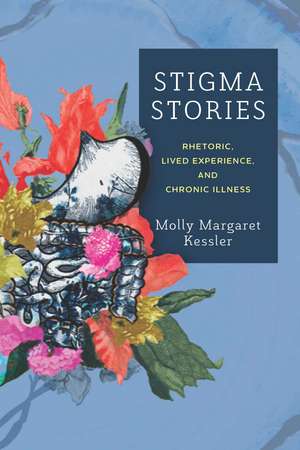
Stigma Stories: Rhetoric, Lived Experience, and Chronic Illness
Autor Molly Margaret Kessleren Limba Engleză Hardback – 12 mai 2022
In Stigma Stories: Rhetoric, Lived Experience, and Chronic Illness, Molly Margaret Kessler focuses on ostomies and gastrointestinal conditions to show how stigma is nearly as central to living with chronic conditions as the conditions themselves. Drawing on a multi-year study that includes participant observations, interviews, and rhetorical engagement with public health campaigns, blogs, social media posts, and news articles, Stigma Stories advocates for a rhetorical praxiographic approach that is attuned to the rhetorical processes, experiences, and practices in which stigma is enacted or countered.
Engaging interdisciplinary conversations from the rhetoric of health and medicine, disability studies, narrative medicine, and sociology, Kessler takes an innovative look at how stigma functions on individual, interpersonal, and societal levels. In doing so, Kessler reveals how stories and lived experiences have much to teach us not only about how stigma functions but also about how it can be dismantled.
Engaging interdisciplinary conversations from the rhetoric of health and medicine, disability studies, narrative medicine, and sociology, Kessler takes an innovative look at how stigma functions on individual, interpersonal, and societal levels. In doing so, Kessler reveals how stories and lived experiences have much to teach us not only about how stigma functions but also about how it can be dismantled.
| Toate formatele și edițiile | Preț | Express |
|---|---|---|
| Paperback (1) | 216.67 lei 6-8 săpt. | |
| Ohio State University Press – 12 mai 2022 | 216.67 lei 6-8 săpt. | |
| Hardback (1) | 845.69 lei 39-44 zile | |
| Ohio State University Press – 12 mai 2022 | 845.69 lei 39-44 zile |
Preț: 845.69 lei
Preț vechi: 1098.29 lei
-23%
Puncte Express: 1269
Preț estimativ în valută:
149.60€ • 175.38$ • 130.14£
149.60€ • 175.38$ • 130.14£
Carte tipărită la comandă
Livrare economică 02-07 martie
Preluare comenzi: 021 569.72.76
Specificații
ISBN-13: 9780814214916
ISBN-10: 0814214916
Pagini: 240
Ilustrații: 1 b&w image
Dimensiuni: 152 x 229 x 23 mm
Greutate: 0.51 kg
Editura: Ohio State University Press
Colecția Ohio State University Press
ISBN-10: 0814214916
Pagini: 240
Ilustrații: 1 b&w image
Dimensiuni: 152 x 229 x 23 mm
Greutate: 0.51 kg
Editura: Ohio State University Press
Colecția Ohio State University Press
Recenzii
“A valuable addition to scholarship that examines chronic conditions....Kessler’s work as a patient-researcher is inspiring and hopeful as RHM scholars continue to examine the ways that disability, stigma, and intersectionality make meaning in health and medicine practices.” —Martha Sue Karnes, Rhetoric of Health & Medicine
“A welcome addition to a lineage of texts that closely examine stories of individuals living with chronic illnesses and conditions.…I, personally, felt comforted by Kessler’s willingness to approach a subject so intimate and so important to many people’s lived experience.” —Michelle Cowan, H-Sci-Med-Tech
“Kessler’s revelations regarding the importance of lived experience to rhetorical studies of health and medicine not only serve the ethical mandate to fight stigmatization but are also significant, insightful, and on the cutting edge of the field.” —Jenell Johnson, author of American Lobotomy: A Rhetorical History
“Kessler’s highly original praxiography on ostomies and GI conditions traces the concept of stigma through stories of lived experiences that reveal the ways stigma is rhetorically perpetuated and challenged. The thought-provoking insights in Stigma Stories will make an invaluable contribution to interdisciplinary conversations about stigma.” —Lora Arduser, author of Living Chronic: Agency and Expertise in the Rhetoric of Diabetes
Notă biografică
Molly Margaret Kessler is Assistant Professor at the University of Minnesota, Twin Cities.
Extras
Given the difficulty in defining and studying stigma and its widespread nature, this book aims to chip away at this complex phenomenon by narrowing in on the stigmatization of chronic GI conditions. I am focused on ostomies and chronic GI conditions in this book for a variety of interrelated reasons. Conditions and experiences related to the digestive system are an ideal case for rhetorically theorizing stigma because these conditions sit on the edge of several boundaries. They are invisible, until they become visible (visually, auditorily, or olfactorily). They occupy the junction of the natural (all living things excrete) and the taboo (but what they excrete is unacceptable). And they enable us to consider how some medical technologies, experiences, and interventions fall within the accepted realm of the normal (contact lenses, cardiac implants, appendectomies) while others (excreting waste into a pouch through an opening on the abdomen) are considered abject.
GI-related stigma is not necessarily the most important or far-reaching stigmatization (though some might argue that it is), but the stigma surrounding digestion and related entities, practices, and biomedicalized conditions is as pervasive as it is pernicious. Seven’s story provides an especially painful and severe example of GI-related stigmatization, but stigma is often micro and mundane. I don’t need to look far or try very hard to demonstrate this. Take, for example, how Western society has developed a range of mitigation euphemisms to avoid directly talking about GI-related things and practices. We say things like going to the bathroom, number two, the porcelain throne, doodoo, potty, ladies’/men’s rooms. This is of course just a handful of examples. Most often, when GI topics must be discussed, we find ways to talk around them, buffering our discursive (and sometime material) proximity.
Don’t get me wrong: this book is not an attempt to dismantle stigma by advocating for a complete abandonment of our polite approach to bathroom topics. I imagine I’m not alone in my preference for saying “I have to go to the bathroom” during a meeting rather than getting any more specific or concrete. This book does look, however, at the practices that enable us to avoid, make invisible, and, in turn, stigmatize GI-related conditions. Specifically, I suggest that this inculcated aversion to all things GI evidences widespread fear, shame, and distaste that often leads to, if not precipitates, stigmatization. GI-related stigma no doubt exists, and it inflicts emotional, social, physical, and mental harm across the GI community. Indeed, it is far-reaching and deep-seated. Accordingly, GI conditions and the lived experiences that accompany them are an important and rich site for studying stigma. My hope in narrowing in on GI-related stigmatization is not only that I can deeply examine and theorize stigma in ways that will help address the specifics of GI-related stigma, but also that this specific contribution will motivate and inform additional research into stigma for other conditions, lived experiences, and identities.
Additionally, I focus on GI-related stigma because it is important to me and to the communities in which I live and that I hope to serve. I know Seven’s story because it was shared widely and mournfully within my personal IBD (inflammatory bowel disease) community. In particular, I live with Crohn’s disease, a chronic autoimmune disease that affects the entire GI tract. As much as I write this book from my academic positionality, I write this book from my identity as a person living with Crohn’s disease and, relatedly, as a person who has faced bullying and stigmatization for it. My teenage years, in particular, are scored by experiences with bullying related to my Crohn’s. My own lived experiences and stories serve as compass, counterpoint (and mostly unwanted) companion as I captured, analyzed, and retold the stories you’ll hear in the coming pages. I work throughout this book to make this undeniable positionality present when it is relevant or has something meaningful to add to various discussions.
GI-related stigma is not necessarily the most important or far-reaching stigmatization (though some might argue that it is), but the stigma surrounding digestion and related entities, practices, and biomedicalized conditions is as pervasive as it is pernicious. Seven’s story provides an especially painful and severe example of GI-related stigmatization, but stigma is often micro and mundane. I don’t need to look far or try very hard to demonstrate this. Take, for example, how Western society has developed a range of mitigation euphemisms to avoid directly talking about GI-related things and practices. We say things like going to the bathroom, number two, the porcelain throne, doodoo, potty, ladies’/men’s rooms. This is of course just a handful of examples. Most often, when GI topics must be discussed, we find ways to talk around them, buffering our discursive (and sometime material) proximity.
Don’t get me wrong: this book is not an attempt to dismantle stigma by advocating for a complete abandonment of our polite approach to bathroom topics. I imagine I’m not alone in my preference for saying “I have to go to the bathroom” during a meeting rather than getting any more specific or concrete. This book does look, however, at the practices that enable us to avoid, make invisible, and, in turn, stigmatize GI-related conditions. Specifically, I suggest that this inculcated aversion to all things GI evidences widespread fear, shame, and distaste that often leads to, if not precipitates, stigmatization. GI-related stigma no doubt exists, and it inflicts emotional, social, physical, and mental harm across the GI community. Indeed, it is far-reaching and deep-seated. Accordingly, GI conditions and the lived experiences that accompany them are an important and rich site for studying stigma. My hope in narrowing in on GI-related stigmatization is not only that I can deeply examine and theorize stigma in ways that will help address the specifics of GI-related stigma, but also that this specific contribution will motivate and inform additional research into stigma for other conditions, lived experiences, and identities.
Additionally, I focus on GI-related stigma because it is important to me and to the communities in which I live and that I hope to serve. I know Seven’s story because it was shared widely and mournfully within my personal IBD (inflammatory bowel disease) community. In particular, I live with Crohn’s disease, a chronic autoimmune disease that affects the entire GI tract. As much as I write this book from my academic positionality, I write this book from my identity as a person living with Crohn’s disease and, relatedly, as a person who has faced bullying and stigmatization for it. My teenage years, in particular, are scored by experiences with bullying related to my Crohn’s. My own lived experiences and stories serve as compass, counterpoint (and mostly unwanted) companion as I captured, analyzed, and retold the stories you’ll hear in the coming pages. I work throughout this book to make this undeniable positionality present when it is relevant or has something meaningful to add to various discussions.
Cuprins
Preface
Acknowledgments
Chapter 1 Studying Stigma: A Rhetorical Approach to Stories and Lived Experience
Rhetoric of Stories, Stigma, Lived Experiences
Studying Stigma Stories
Preview of Chapters
Chapter 2 Listening for Stigma: Praxiographic Solutions and Stigma in Practice
Critiques of Stigma Research
Praxiographic Solutions
Stigma in Practice
An Ethical Case for Engaging Stigma Praxiographically
Chapter 3 Staging Stigma: Ostomies as Worst-Case Scenarios
Leaks, Stigma, and Visceral Publics
Worst-Case Scenarios: Ostomies in Public Health Campaigns
Ostomies on TV: Fear and Disgust in Popular Media
Staging Stigma through Fear
Credibility Enhanced through Stigma
Conclusion
Chapter 4 Protesting Stigma: Disruptive Stories, Temporality, and Ostomies as Lifesavers
Temporality, Disability, and Progressions of Experience
Rejecting Compulsory Nostalgia: Disruptive Ostomy Stories as Protest
Disruptive Stories, Disruptive Timelines
Complicating a Two-Sided Story
Conclusion
Chapter 5 Managing Stigma: Visual Acts of Resistance
Normalcy, Norms, and the Impossibility of Normalization
Displaying Ostomies and Soliciting Stares
Visual Rewards and Risks: Sexualizing Disability
Showing Off Ostomies and Arriving at the Destination of Normal
Conclusion
Chapter 6 Thinking with Stories: Toward Stigma Interventions
The Value of a Praxiographic Approach to Stories
Interventional Insights
Conducting Entangled Research
References
Index
Acknowledgments
Chapter 1 Studying Stigma: A Rhetorical Approach to Stories and Lived Experience
Rhetoric of Stories, Stigma, Lived Experiences
Studying Stigma Stories
Preview of Chapters
Chapter 2 Listening for Stigma: Praxiographic Solutions and Stigma in Practice
Critiques of Stigma Research
Praxiographic Solutions
Stigma in Practice
An Ethical Case for Engaging Stigma Praxiographically
Chapter 3 Staging Stigma: Ostomies as Worst-Case Scenarios
Leaks, Stigma, and Visceral Publics
Worst-Case Scenarios: Ostomies in Public Health Campaigns
Ostomies on TV: Fear and Disgust in Popular Media
Staging Stigma through Fear
Credibility Enhanced through Stigma
Conclusion
Chapter 4 Protesting Stigma: Disruptive Stories, Temporality, and Ostomies as Lifesavers
Temporality, Disability, and Progressions of Experience
Rejecting Compulsory Nostalgia: Disruptive Ostomy Stories as Protest
Disruptive Stories, Disruptive Timelines
Complicating a Two-Sided Story
Conclusion
Chapter 5 Managing Stigma: Visual Acts of Resistance
Normalcy, Norms, and the Impossibility of Normalization
Displaying Ostomies and Soliciting Stares
Visual Rewards and Risks: Sexualizing Disability
Showing Off Ostomies and Arriving at the Destination of Normal
Conclusion
Chapter 6 Thinking with Stories: Toward Stigma Interventions
The Value of a Praxiographic Approach to Stories
Interventional Insights
Conducting Entangled Research
References
Index
Descriere
Reveals the ways stigma is rhetorically perpetuated and dismantled by examining the lived experiences of people with chronic gastrointestinal conditions.