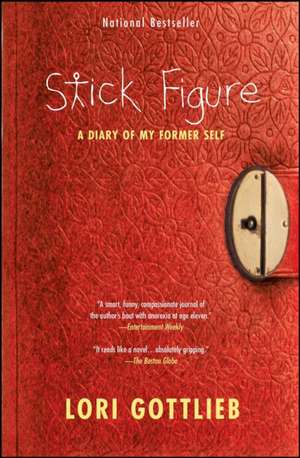
Stick Figure
Autor Lori Gottlieben Limba Engleză Paperback – 17 noi 2009 – vârsta până la 17 ani
„Îmi doresc să fiu cea mai slabă fată din școală, sau poate chiar cea mai slabă de unsprezece ani de pe întreaga planetă”, scrie mica Lori în jurnalul său, sub cerul strălucitor din Beverly Hills. Descoperim aici o scenă în care inocența copilăriei este strivită de presiunea socială a anilor '70, unde desertul este interzis „femeilor adevărate”, iar valoarea unei fete se măsoară în centimetri pierduți. Lori Gottlieb a ales să publice aceste rânduri brute acum pentru a oferi o perspectivă nefiltrată asupra modului în care tulburările alimentare se instalează nu ca o rebeliune, ci ca o dorință disperată de a atinge perfecțiunea cerută de cei din jur. Observăm o structură narativă fascinantă, împărțită pe anotimpuri, care documentează degradarea fizică și psihică prin ochii unui copil precoce. De la capitole precum „Thunder Thighs” la „Do Not Resuscitate”, parcurgem un drum sinuos între umor sec și disperare tăcută. Stilul este tăios și autoironic, amintind de onestitatea brutală din Skinny de S. Glick, însă acolo unde Glick analizează lupta pe parcursul decadelor, Stick Figure se concentrează pe momentul critic al formării identității, capturând vocea autentică a fetiței care încă mai crede că foamea este o virtute. Considerăm că această lucrare reprezintă fundația introspecției pe care Lori Gottlieb o va rafina ani mai târziu în Maybe You Should Talk to Someone. Dacă în scrierile sale recente ea analizează psihicul uman din fotoliul terapeutului, aici ea ocupă poziția vulnerabilă a pacientului, oferind o „poveste de avertizare” despre capcanele așteptărilor sociale. Este o biografie care se citește ca un roman polițist al minții, unde indiciile sunt caloriile numărate frenetic și paharele de apă băute înainte de masă.
Preț: 92.25 lei
Carte disponibilă
Livrare economică 06-20 august
Specificații
ISBN-10: 1439148902
Pagini: 224
Dimensiuni: 147 x 214 x 14 mm
Greutate: 0.19 kg
Editura: Simon&Schuster
De ce să citești această carte
Recomandăm această carte oricărui cititor interesat de psihologia adolescenței și de impactul culturii dietelor. Stick Figure nu este doar o mărturie despre anorexie, ci o analiză socială sclipitoare, scrisă cu un umor care îndulcește tragismul situației. Veți câștiga o înțelegere profundă a modului în care mediul înconjurător modelează stima de sine, totul prin vocea unei fetițe neobișnuit de perspicace.
Despre autor
Lori Gottlieb este un psihoterapeut american de renume și autoarea bestsellerului internațional Maybe You Should Talk to Someone. Cu o carieră jurnalistică solidă, contribuind frecvent la publicații precum The New York Times, The Atlantic și Time, Gottlieb îmbină expertiza clinică cu un talent narativ rar. În Stick Figure, ea revine la propriile rădăcini, transformând jurnalele personale de la vârsta de unsprezece ani într-o lucrare de referință despre imaginea corporală. Experiența sa ulterioară ca terapeut îi permite să ofere acestor memorii timpurii o profunzime și o relevanță care depășesc simplul jurnal intim.
Descriere scurtă
For a girl growing up in Beverly Hills in 1978, the motto "You can never be too rich or too thin" is writ large. Precocious Lori learns her lessons well, so when she's told that "real women don't eat dessert" and "no one could ever like a girl who has thunder thighs," she decides to become a paragon of dieting. Soon Lori has become the "stick figure" she's longed to resemble. But then what? "Stick Figure" takes the reader on a gripping journey, as Lori struggles to reclaim both her body and her spirit.
By turns painful and wry, Lori's efforts to reconcile the conflicting messages society sends women ring as true today as when she first recorded these impressions. "One diet book says that if you drink three full glasses of water one hour before every meal to fill yourself up, you'll lose a pound a day. Another book says that once you start losing weight, everyone will ask, 'How did you do it?' but you shouldn't tell them because it's 'your little secret.' Then right above that part it says, "'New York Times" bestseller.' Some secret."
With an edgy wit and keenly observant eye, "Stick Figure" delivers an engrossing glimpse into the mind of a girl in transition to adulthood. This raw, no-holds-barred account is a powerful cautionary tale about the dangers of living up to society's expectations.
Cuprins
Contents
Part One: Winter 1978
"Who Do You Think You Are, Young Lady?"
Captain of Justice
Power Paragraph
Real Women Don't Eat Dessert
Thunder Thighs
Sex Education
Chameleon
Life, Liberty, and the Pursuit of Happiness
"That's My Girl"
The Lori Monument
Sorry About the Milk Shake, Mr. President
Day of Atonement
Part Two: Spring 1978
Please Help the Hungry
Lactose Intolerant
If You Can Pinch an Inch
Level F, Section Pink
Facts and Figure
Shrink Me
Absolute Delight
Don't Talk with Your Mouth Full
Chewing on Air
"Hello, Angels....It's Charlie"
E Is for Electrolyte
Part Three: Summer 1978
Breck Girl
Fractions
Brownie
Camp Cedars
Nora
Hey, Taxi
Shereen's Jeans
Life without Andy Gibb
Cutting the Fat
Secretary School
North Star
Do Not Resuscitate
Stick Figure
Eggshells
You Can Never Be Too Rich or Too Thin
Epilogue
Acknowledgments
Notă biografică
Recenzii
“It reads like a novel…absolutely gripping.” —Boston Globe
“Compelling…Hopefully, young Gottlieb will stand as a patron saint for girls vulnerable to eating disorders and the adults who should be caring for them.” —Booklist
“Poignant…Gottlieb is dead-on about society’s irrational attitudes towards women’s bodies.” —Washington Post Book World
“Lori Gottlieb’s approach is compassionate, and very, very funny. More than just a book about anorexia, Stick Figure is an entertaining and thoughtful coming-of-age story that deals with an almost universal theme—negotiating the minefields of early adolescence and living to tell the tale.” —Martha Manning, author of Undercurrents
“What happens when a young girl from Beverly Hills trips on the fallacies of family and friends, then gets saturated by society’s worship of the too thin? She almost dies…Gottlieb tells all this with an earnest narration that is funny at times but always tragic. And although Lori steps deeper and deeper into her illness, there is no self-pity. The mood is simply: This is what happened to me.” —Seattle Times
“Lori Gottlieb’s eleven-year-old self is a singular storyteller of unblinking candor and precocious insight. As rife with wry humor as it is lacking in self-pity, this fast-paced chronicle of late-1970s adolescent anorexia is narrated with a light touch, and yet is chilling and poignant in its straightforward simplicity.” —Sarah Saffian, author of Ithaka: A Daughter’s Memoir of Being Found
“Stick Figure stands out as a fresh, edgy take—not just on anorexia but on that perilous time in a girl’s life when she’s no longer a child but not quite an adult.” —Entertainment Weekly
“Undeniably effective.” —Booklist
“[An] authentic voice.” — Francisco Chronicle
“Her descriptions of preteen vulnerability and self-consciousness ring true…her diary offers haunting evidence of what little progress we have made.” —Publishers Weekly
“By turns earnest and funny, hopeful and tragic, eleven-year-old Lori is a latter-day Alice: She takes us through the distorted looking glass that’s held up to young girls and into the harrowing land of eating disorders. There is no other word for it: You will devour this book—and hopefully, keep right on eating.” —Peggy Orenstein, author of School Girls: Young Women, Self-Esteem, and the Confidence Gap
Extras
So whenever I’m trying to talk to adults, they start nodding their heads up and down like they aren’t even listening. Then right when I get to the important part—like how it’ll only take a few seconds for our entire bodies to fry—their nods switch from up and down to side to side. That’s when their eyes get really wide and they turn to my parents and say, “She’s such a unique little girl.” I always feel like saying, “Or maybe you’re just incredibly boring,” but I never do. Adults hate it when you have opinions about things.
Anyway, the whole reason you’re here in the first place is because I was reading The Diary of Anne Frank last week over Christmas vacation. It took me two days, and I cried my head off. Anne thought about a lot of the same things I think about, but no one went around calling her unique. Not once. I couldn’t stop thinking about Anne the whole week, even when I went shopping with Mom today. We were at this store in Beverly Hills where they have all kinds of expensive but tacky stuff that Mom gets a big kick out of. That’s where I saw these fancy diaries with fake gold trim that you could give as gifts. You’re one of them. No offense or anything.
Mom had the store lady put bright pink decorations on your cover, which looks kind of like lipstick. One thing you should know right away about Mom is that she’s madly in love with lipstick. Everywhere she goes, Mom carries around this big purse full of makeup, just in case she suddenly feels like putting more on. I’m not too into makeup because you always have to be careful that you don’t blink too much, or laugh too hard, or scratch your cheeks if they itch, or eat anything that might smudge your gloss. It’s a pain in the butt, if you want my opinion. But all of my friends are starting to get curious about makeup, so now even Mom thinks I’m unique because I couldn’t care less about the whole thing.
I don’t know, sometimes I wonder if maybe I am unique. I mean, I used to be pretty normal, but things are different now that I’m eleven. I know it sounds conceited to say, but when I was in first grade I was really popular. I was best friends with Leslie and Lana, and everyone called us “the three L’s” because we always played together at recess. Except then in second grade, Leslie and Lana ended up in the same homeroom class with all my other friends, and I ended up in Mrs. Collin’s class with no one I knew. Someone said that Mrs. Collin’s class had all the smart kids in it, but the school said they couldn’t “confirm or deny” that. A lot of kids’ dads are lawyers, so my school’s always afraid of getting sued. At least that’s what Uncle Bob said, and he’s a lawyer.
So that’s when all the trouble started. First of all, my long blond hair kept getting darker until it finally turned brown. I know it doesn’t sound that terrible, but one of Mom’s magazines said if you have “dishwater brown” hair, you should take that “boring” hair and make it more “exciting” by dyeing it red or platinum blond. Then next to the article there were these pictures of three different ladies with brown, red, and blond hair. The redhead and the blond lady were smiling like those people on game shows who win trips to Hawaii, but the lady with the brown hair looked like she was about to cry. So now I’m stuck with hair that makes you cry. But that’s just part of what happened to me since second grade. Believe me, it gets a hundred times worse.
--Reprinted from Stick Figure by Lori Gottlieb by permission of Berkley, a member of Penguin Putnam Inc. Copyright © 2001 by Lori Gottlieb. All rights reserved. This excerpt, or any parts thereof, may not be reproduced in any form without permission.
Descriere
From the diaries she kept as an 11-year-old, the author's wry, perceptive account of her near-fatal struggle with anorexia nervosa is told with an unguarded openness not seen since Susanna Kaysen's "Girl Interrupted". Martin Scorsese's company, Carpo Productions, has purchased movie rights to Gottlieb's journal.