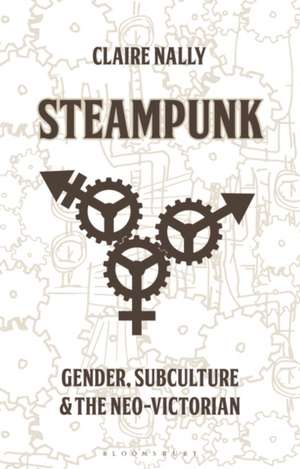
Steampunk: Gender, Subculture and the Neo-Victorian: Library of Gender and Popular Culture
Autor Dr Claire Nallyen Limba Engleză Hardback – 27 iun 2019
In her interdisciplinary book, Claire Nally delves into this contemporary subculture, explaining how the fashion, music, visual culture, literature and politics of steampunk intersect with theories of gender and sexuality. Exploring and occasionally critiquing the ways in which gender functions in the movement, she addresses a range of different issues, including the controversial trope of the Victorian asylum; gender and the graphic novel; the legacies of colonialism; science and the role of Ada Lovelace as a feminist steampunk icon. Drawing upon interviews, theoretical readings and textual analysis, Nally asks: why are steampunks fascinated by our Victorian heritage, and what strategies do they use to reinvent history in the present?
Din seria Library of Gender and Popular Culture
- 39%
 Preț: 657.42 lei
 - 17%
 Preț: 181.96 lei
 - 33%
 Preț: 553.00 lei
 - 33%
 Preț: 550.86 lei
 - 23%
 Preț: 236.89 lei
 - 33%
 Preț: 551.24 lei
 - 33%
 Preț: 550.47 lei
 - 33%
 Preț: 550.86 lei
 - 33%
 Preț: 551.24 lei
 - 34%
 Preț: 543.07 lei
 - 36%
 Preț: 550.36 lei
 - 33%
 Preț: 526.89 lei
 - 29%
 Preț: 160.75 lei
 - 26%
 Preț: 216.72 lei
 - 26%
 Preț: 212.21 lei
 - 36%
 Preț: 581.74 lei
 - 28%
 Preț: 206.57 lei
 - 26%
 Preț: 206.77 lei
 - 25%
 Preț: 249.13 lei
 - 26%
 Preț: 213.08 lei
 - 31%
 Preț: 215.68 lei
 - 17%
 Preț: 193.81 lei
 - 25%
 Preț: 240.44 lei
 - 26%
 Preț: 211.00 lei
 - 24%
 Preț: 234.41 lei
 - 29%
 Preț: 186.12 lei
 - 26%
 Preț: 213.08 lei
 - 19%
 Preț: 191.31 lei
 - 31%
 Preț: 212.78 lei
 - 33%
 Preț: 645.96 lei
 - 20%
 Preț: 241.18 lei
 - 36%
 Preț: 613.50 lei
 - 30%
 Preț: 523.09 lei
 - 25%
 Preț: 249.92 lei
 - 25%
 Preț: 241.24 lei
Preț: 708.60 lei
Preț vechi: 1147.56 lei
-38%
Puncte Express: 1063
Carte tipărită la comandă
Livrare economică 18 noiembrie-02 decembrie
Livrare prin curier în România Termenul estimat este afișat lângă disponibilitate.
Transport gratuit pentru acest produs Plată online sau ramburs, în funcție de opțiunile comenzii.
Retur gratuit în 14 zile Comandă securizată și suport în română.
Specificații
ISBN-13: 9781350113183
ISBN-10: 1350113182
Pagini: 304
Ilustrații: 10 bw illus
Dimensiuni: 138 x 216 x 18 mm
Greutate: 0.5 kg
Editura: Bloomsbury Publishing
Colecția Bloomsbury Academic
Seria Library of Gender and Popular Culture
Locul publicării:London, United Kingdom
ISBN-10: 1350113182
Pagini: 304
Ilustrații: 10 bw illus
Dimensiuni: 138 x 216 x 18 mm
Greutate: 0.5 kg
Editura: Bloomsbury Publishing
Colecția Bloomsbury Academic
Seria Library of Gender and Popular Culture
Locul publicării:London, United Kingdom
Cuprins
Acknowledgements
List of Figures
Introduction
Chapter 1 Steampunk: The Politics of Subversion?
Chapter 2 Doctor Geof and Nick Simpson: Sex, War and Masculinity
Chapter 3 Freak Show Femininities: Emilie Autumn
Chapter 4 Steampunk and the Graphic Novel
Chapter 5 Steampunk Romance: Gail Carriger and Kate McAlister
Conclusion
Bibliography
Index
List of Figures
Introduction
Chapter 1 Steampunk: The Politics of Subversion?
Chapter 2 Doctor Geof and Nick Simpson: Sex, War and Masculinity
Chapter 3 Freak Show Femininities: Emilie Autumn
Chapter 4 Steampunk and the Graphic Novel
Chapter 5 Steampunk Romance: Gail Carriger and Kate McAlister
Conclusion
Bibliography
Index
Recenzii
Claire Nally's Steampunk: Gender, Subculture, and the Neo-Victorian is a welcome addition to a growing and dynamic field that has much to add to academic discussions around culture, gender, art, and history ... [Nally] lays a strong groundwork for steampunk to not only focus on its subversive potential but also to engage in its reestablishment of norms and mores.
Nally's valuable study makes clear that Steampunk is a popular culture phenomenon that, like punk, goth and metal has developed both conservative and progressive forms ... Having read Steampunk: gender, subculture & the neo-Victorian, I am inspired to get my students researching the genre, which is what a serious piece of scholarship should do.
[A] timely and welcome reflection on the possibilities and limitations of the mode ... Steampunk is a helpful reference for teaching and research in multiple humanities disciplines and it also engages with and advances debates in gender studies, adaptation, neo-Victorianism, and the study of (post-)subculture and counterculture.
Nally's study is an important and valuable contribution to the field of steampunk studies, as it expands and reflects on opportunities and dangers integral to the steampunk mode, while also providing a nuanced analysis of material which complements neo-Victorian gender studies in new and productive ways.
Nally's accessible and engaging interdisciplinary study provides a very welcome new perspective on the various repercussions of steampunk.
Looking seriously at material productions-from corsets, to artworks, to e-zines, to graphic novels-she asks questions inspired by intersectional feminism and considers whose identities these reflect, [and] whose interests they serve.
Nally convincingly demonstrates that we need to attend to the particulars of how steampunk is created, received, and even contested, whether in the form of Alan Moore's graphic novels, the multi-genre persona created by Emilie Autumn, or "postfeminist" romance. Her boundary-crossing study thus challenges us to rethink our generalizations about steampunk's joy in anachronism and its fascination with Britain's lost empire.
Nally's valuable study makes clear that Steampunk is a popular culture phenomenon that, like punk, goth and metal has developed both conservative and progressive forms ... Having read Steampunk: gender, subculture & the neo-Victorian, I am inspired to get my students researching the genre, which is what a serious piece of scholarship should do.
[A] timely and welcome reflection on the possibilities and limitations of the mode ... Steampunk is a helpful reference for teaching and research in multiple humanities disciplines and it also engages with and advances debates in gender studies, adaptation, neo-Victorianism, and the study of (post-)subculture and counterculture.
Nally's study is an important and valuable contribution to the field of steampunk studies, as it expands and reflects on opportunities and dangers integral to the steampunk mode, while also providing a nuanced analysis of material which complements neo-Victorian gender studies in new and productive ways.
Nally's accessible and engaging interdisciplinary study provides a very welcome new perspective on the various repercussions of steampunk.
Looking seriously at material productions-from corsets, to artworks, to e-zines, to graphic novels-she asks questions inspired by intersectional feminism and considers whose identities these reflect, [and] whose interests they serve.
Nally convincingly demonstrates that we need to attend to the particulars of how steampunk is created, received, and even contested, whether in the form of Alan Moore's graphic novels, the multi-genre persona created by Emilie Autumn, or "postfeminist" romance. Her boundary-crossing study thus challenges us to rethink our generalizations about steampunk's joy in anachronism and its fascination with Britain's lost empire.