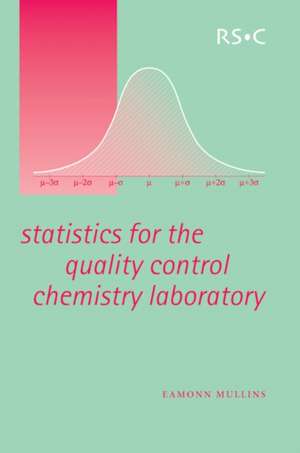
Statistics for the Quality Control Chemistry Laboratory
Autor Eamonn Mullinsen Limba Engleză Paperback – sep 2003
Statistical methods are essential tools for analysts, particularly those working in Quality Control Laboratories. This book provides a sound introduction to their use in analytical chemistry, without requiring a strong mathematical background. It emphasises simple graphical methods of data analysis, such as control charts, which are a key tool in Internal Laboratory Quality Control and which are also a fundamental requirement in laboratory accreditation. A large part of the book is concerned with the design and analysis of laboratory experiments, including sample size determination. Practical case studies and many real datasets, from both QC laboratories and the research literature, are used to illustrate the ideas in action. The aim of Statistics for the Quality Control Chemistry Laboratory is to give the reader a strong grasp of the concept of statistical variation in laboratory data and of the value of simple statistical ideas and methods in thinking about and manipulating such data. It will be invaluable to analysts working in QC laboratories in industry, hospitals and public health, and will also be welcomed as a textbook for aspiring analysts in colleges and universities.
Preț: 380.93 lei
Nou
Puncte Express: 571
Preț estimativ în valută:
67.42€ • 79.06$ • 59.11£
67.42€ • 79.06$ • 59.11£
Carte disponibilă
Livrare economică 06-20 ianuarie 26
Livrare express 20-26 decembrie pentru 45.73 lei
Preluare comenzi: 021 569.72.76
Specificații
ISBN-13: 9780854046713
ISBN-10: 0854046712
Pagini: 474
Ilustrații: index
Dimensiuni: 158 x 239 x 26 mm
Greutate: 0.73 kg
Editura: RSC Publishing
Locul publicării:United Kingdom
ISBN-10: 0854046712
Pagini: 474
Ilustrații: index
Dimensiuni: 158 x 239 x 26 mm
Greutate: 0.73 kg
Editura: RSC Publishing
Locul publicării:United Kingdom
V-ar putea interesa
-
 -35%Preț: 331.42 lei508.31 lei
 -
 Inorganic ChemistryJames E. House-27%Preț: 479.30 lei655.44 lei
 -
 Gas ChromatographyColin Poole-31%Preț: 885.66 lei1278.84 lei
 -
 A Tale of Seven ElementsEric Scerri-27%Preț: 205.41 lei280.15 lei
 -
 Green Analytical Chemistry: Theory and PracticeMiguel de la Guardia-28%Preț: 1191.30 lei1644.21 lei
 -
 -27%Preț: 834.74 lei1143.69 lei
 -
 Introduction to Pharmaceutical Chemical AnalysisSteen Honoré HansenPreț: 562.39 lei
 -
 Preț: 385.34 lei
 -
 Exploring Chemical Analysis: International EditionDaniel C. Harris-32%Preț: 486.02 lei719.45 lei
 -
 Analytical Chemistry for TechniciansJohn Kenkel-35%Preț: 700.60 lei1071.01 lei
 -
 Notes on Statistics and Data Quality for Analytical ChemistsMichael ThompsonPreț: 353.07 lei
 -
 The Cosmic-Chemical BondDavid A WilliamsPreț: 225.71 lei
 -
 -11%Preț: 405.13 lei455.20 lei
Cuprins
Variability in Analytical Measurements; Control Charts in the Analytical Laboratory; Some Important Statistical Ideas; Simple Comparative Studies; Studying Complex Systems; Fitting Equations to Data; The Design and Analysis of Laboratory Studies Re-visited; Assessing Measurement Quality; Subject Index.
Recenzii
Meets the demands of an introduction to statistics applied to quality control. The text can be used for courses or for self-teaching.
Textul de pe ultima copertă
Statistical methods are essential tools for analysts, particularly those working in Quality Control Laboratories. This book provides a sound introduction to their use in analytical chemistry, without requiring a strong mathematical background. It emphasises simple graphical methods of data analysis, such as control charts, which are also a fundamental requirement in laboratory accreditation. A large part of the book is concerned with the design and analysis of laboratory experiments, including sample size determination. Practical case studies and many real databases from both QC laboratories and the research literature, are used to illustrate the ideas in action.
The aim of Statistics for the Quality Control Chemistry Laboratory is to give the reader a strong grasp of the concept of statistical variation in laboratory data and of the value of simple statistical ideas ad methods in thinking about and manipulation such data, It will be invaluable to analysts working in QC laboratories in industry, hospitals and public health, and will also be welcomed as a textbook for aspiring analysts in colleges and universities.
The aim of Statistics for the Quality Control Chemistry Laboratory is to give the reader a strong grasp of the concept of statistical variation in laboratory data and of the value of simple statistical ideas ad methods in thinking about and manipulation such data, It will be invaluable to analysts working in QC laboratories in industry, hospitals and public health, and will also be welcomed as a textbook for aspiring analysts in colleges and universities.
Descriere
This book provides a sound introduction to the use of statistical methods in analytical chemistry, without requiring a strong mathematical background.