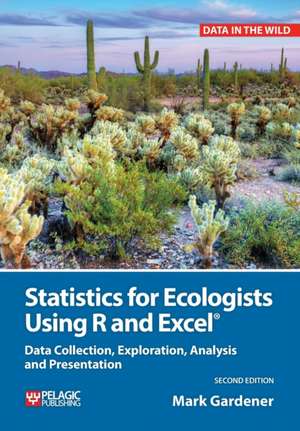
Statistics for Ecologists Using R and Excel: Data in the Wild
Autor Mark Gardeneren Limba Engleză Paperback – 9 ian 2017
Observăm în această a doua ediție a Statistics for Ecologists Using R and Excel o abordare pragmatică a metodologiei cercetării, structurată pe întregul flux de lucru al unui ecolog. Materialul este organizat logic, pornind de la faza critică a planificării proiectului și colectării datelor, trecând prin procesarea acestora și culminând cu analize statistice complexe și prezentarea grafică a rezultatelor. Metodologia propusă de Mark Gardener elimină bariera tehnologică prin utilizarea combinată a Microsoft Excel, familiar majorității studenților, și a mediului R, standardul actual în analiza datelor științifice. Această ediție aduce îmbunătățiri semnificative, în special în ceea ce privește vizualizarea datelor. Un capitol întreg a fost revizuit pentru a acoperi instrumentele de chart-uri din Excel și comenzile grafice din R, oferind soluții pentru crearea unor grafice de nivel profesional. De asemenea, introducerea unui capitol dedicat statisticilor de comunitate și biodiversității face legătura directă cu realitatea muncii de teren. Cartea reprezintă o alternativă viabilă la Choosing and Using Statistics – A Biologists′ Guide 3e pentru cursurile de biostatistică sau ecologie, având avantajul unei integrări mai profunde între spreadsheet-uri și programare, fără a neglija interpretarea biologică a rezultatelor. În contextul operei autorului, lucrarea sintetizează conceptele fundamentale prezentate în Beginning R și Managing Data Using Excel, dar le aplică într-un cadru strict ecologic. Dacă în lucrările anterioare Mark Gardener se concentra pe alfabetizarea digitală în R sau Excel, aici livrează un instrumentar complet pentru „datele indisciplinate” din natură, oferind un echilibru între rigoarea matematică și aplicabilitatea practică.

Preț: 364.32 lei
Carte tipărită la comandă
Livrare economică 27 noiembrie-11 decembrie
Specificații
ISBN-10: 178427139X
Pagini: 418
Dimensiuni: 170 x 244 x 23 mm
Greutate: 0.72 kg
Ediția:Fully revised and updated
Editura: Pelagic Publishing Ltd
Colecția Data in the Wild
Seria Data in the Wild
V-ar putea interesa
-
 Cradle to CradleMichael Braungart-19%Preț: 57.49 lei71.32 lei
 -
 The Revenge of GaiaJames Lovelock-21%Preț: 61.73 lei77.71 lei
 -
 Ecological Methods in Forest Pest ManagementDavid Wainhouse-32%Preț: 697.76 lei1032.21 lei
 -
 DispersalJean Clobert-28%Preț: 456.75 lei634.14 lei
 -
 Symbiotic InteractionsA. E. Douglas-21%Preț: 299.10 lei378.72 lei
 -
 A Rough Ride to the FutureJames LovelockPreț: 77.15 lei
 -
 -9%Preț: 887.58 lei975.36 lei
 -
 The Unified Neutral Theory of Biodiversity and BiogeographyStephen P. Hubbell-19%Preț: 634.43 lei783.25 lei
 -
 Beginning R - The Statistical Programming LanguageMark Gardener-20%Preț: 177.32 lei221.66 lei
 -
 Handbook of Road EcologyRodney van der Ree-23%Preț: 753.70 lei978.83 lei
 -
 Oil and HoneyBill McKibbenPreț: 113.11 lei
 -
 Green PhilosophyRoger Scruton-18%Preț: 90.13 lei109.55 lei
De ce să citești această carte
Recomandăm această carte studenților și cercetătorilor în ecologie care doresc să facă tranziția de la Excel la R într-un mod asistat. Cititorul câștigă competențe duble: stăpânirea fluxului de date în Excel și puterea de calcul a limbajului R. Este un ghid esențial pentru cei care au nevoie de metode statistice clare — de la ANOVA la regresie — aplicate direct pe scenarii de biodiversitate și conservare.
Despre autor
Mark Gardener este un ecolog, lector și scriitor britanic, specializat în ecologia polenizării, cu o vastă experiență de cercetare acumulată în Regatul Unit, Australia și Statele Unite. Deținător al unui doctorat în domeniu, Gardener s-a remarcat prin capacitatea de a preda statistica într-un mod accesibil, fiind convins că datele ecologice de comunitate sunt printre cele mai complexe și provocatoare. Expertiza sa în limbajul R, dobândită în timpul cercetărilor din Australia, l-a transformat într-un promotor al metodelor Open Source în științele vieții, autorul administrând și o platformă educațională dedicată acestor instrumente.
Descriere
This is a book about the scientific process and how you apply it to data in ecology. You will learn how to plan for data collection, how to assemble data, how to analyze data and finally how to present the results. The book uses Microsoft Excel and the powerful Open Source R program to carry out data handling as well as producing graphs.
Statistical approaches covered include: data exploration; tests for difference - t-test and U-test; correlation - Spearman's rank test and Pearson product-moment; association including Chi-squared tests and goodness of fit; multivariate testing using analysis of variance (ANOVA) and Kruskal-Wallis test; and multiple regression. Key skills taught in this book include: how to plan ecological projects; how to record and assemble your data; how to use R and Excel for data analysis and graphs; how to carry out a wide range of statistical analyses including analysis of variance and regression; how to create professional looking graphs; and how to present your results. New in this edition: a completely revised chapter on graphics including graph types and their uses, Excel Chart Tools, R graphics commands and producing different chart types in Excel and in R; an expanded range of support material online, including; example data, exercises and additional notes & explanations; a new chapter on basic community statistics, biodiversity and similarity; chapter summaries and end-of-chapter exercises.
Praise for the first edition:This book is a superb way in for all those looking at how to design investigations and collect data to support their findings. - Sue Townsend, Biodiversity Learning Manager, Field Studies Council[M]akes it easy for the reader to synthesise R and Excel and there is extra help and sample data available on the free companion webpage if needed. I recommended this text to the university library as well as to colleagues at my student workshops on R.
Although I initially bought this book when I wanted to discover R I actually also learned new techniques for data manipulation and management in Excel - Mark Edwards, EcoBloggingA must for anyone getting to grips with data analysis using R and excel. - Amazon 5-star reviewIt has been very easy to follow and will be perfect for anyone. - Amazon 5-star reviewA solid introduction to working with Excel and R.
The writing is clear and informative, the book provides plenty of examples and figures so that each string of code in R or step in Excel is understood by the reader. - Goodreads, 4-star review