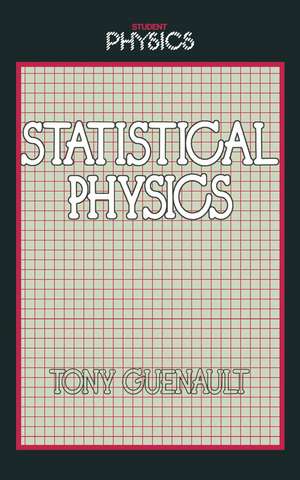
Statistical Physics: Student Physics Series
Autor Tony Guenaulten Limba Engleză Paperback – 28 apr 1988



Preț: 366.82 lei
Puncte Express: 550
Carte tipărită la comandă
Livrare economică 24 noiembrie-08 decembrie
Livrare prin curier în România Termenul estimat este afișat lângă disponibilitate.
Transport gratuit de la 400.00 lei Plată online sau ramburs, în funcție de opțiunile comenzii.
Retur gratuit în 14 zile Comandă securizată și suport în română.
Specificații
ISBN-13: 9780415002592
ISBN-10: 0415002591
Pagini: 200
Ilustrații: X, 186 p. 2 illus.
Dimensiuni: 127 x 203 x 12 mm
Greutate: 0.22 kg
Editura: Springer
Colecția Student Physics Series
Seria Student Physics Series
Locul publicării:Dordrecht, Netherlands
ISBN-10: 0415002591
Pagini: 200
Ilustrații: X, 186 p. 2 illus.
Dimensiuni: 127 x 203 x 12 mm
Greutate: 0.22 kg
Editura: Springer
Colecția Student Physics Series
Seria Student Physics Series
Locul publicării:Dordrecht, Netherlands
V-ar putea interesa
-
 Schaum's Outline of Applied Physics, 4edArthur Beiser; Emeritus-22%Preț: 213.45 lei273.60 lei
 -
 Practical Radiation Protection in HealthcareColin J Martin-11%Preț: 403.03 lei452.85 lei
 -
 Atmospheric Turbulence: a molecular dynamics perspectiveAdrian F. Tuck-31%Preț: 770.43 lei1121.51 lei
 -
 -5%Preț: 635.84 lei669.31 lei
 -
 Numerical Weather and Climate PredictionThomas Tomkins Warner-8%Preț: 614.64 lei668.09 lei
 -
 -9%Preț: 1446.86 lei1589.96 lei
 -
 Webb's Physics of Medical ImagingM Flower-5%Preț: 855.44 lei900.47 lei
 -
 Ecological MicrocosmsRobert J. BeyersPreț: 408.37 lei
 -
 Continuum Mechanics of Anisotropic MaterialsStephen C. CowinPreț: 418.25 lei
 -
 The Manga Guide to PhysicsHideo Nitta-19%Preț: 140.54 lei172.75 lei
 -
 Basic Health Physics – Problems and Solutions 2eJJ Bevelacqua-14%Preț: 960.34 lei1116.67 lei
 -
 Design in Nature: Learning from TreesClaus Mattheck-18%Preț: 859.03 lei1047.60 lei
 -
 Advances in Meteorology, Climatology and Atmospheric PhysicsCostas G. Helmis-24%Preț: 1871.59 lei2462.62 lei
 -
 Atmospheric PhysicsUlrich Schumann-18%Preț: 1300.27 lei1585.69 lei
 -
 Atmospheric PhysicsJulio V. IribarnePreț: 374.23 lei
 -
 Atmospheric AerosolsOlivier Boucher-15%Preț: 730.11 lei858.95 lei
Public țintă
ResearchCuprins
1 Basic ideas.- 1.1 The macrostate.- 1.2 Microstates.- 1.3 The averaging postulate.- 1.4 Distributions.- 1.5 The statistical method in outline.- 1.6 A model example.- 1.7 Statistical entropy and microstates.- 2 Distinguishable particles.- 2.1 The thermal equilibrium distribution.- 2.2 What are ? and ??.- 2.3 A statistical definition of temperature.- 2.4 The Boltzmann distribution and the partition function.- 2.5 Calculation of thermodynamic functions.- 3 Two examples.- 3.1 A spin(math) solid.- 3.2 Localized harmonic oscillators.- 4 Gases: The density of states.- 4.1 Fitting waves into boxes.- 4.2 Other information for statistical physics.- 4.3 An example — helium gas.- 5 Gases: The distributions.- 5.1 Distribution in groups.- 5.2 Identical particles-fermions and bosons.- 5.3 Counting microstates for gases.- 5.4 The three distributions.- 6 Maxwell-Boltzmann gases.- 6.1 The validity of the Maxwell-Boltzmann limit.- 6.2 The Maxwell-Boltzmann distribution of speeds.- 6.3 The connection tothermodynamics.- 7 Diatomic gases.- 7.1 Energy contributions in diatomic gases.- 7.2 Heat capacity of a diatomic gas.- 7.3 The heat capacity of hydrogen.- 8 Fermi-Dirac gases.- 8.1 Properties of an ideal Fermi-Dirac gas.- 8.2 Application to metals.- 8.3 Application to helium-3.- 9 Bose-Einstein Gases.- 9.1 Properties of an ideal Bose-Einstein gas.- 9.2 Application to helium-4.- 9.3 Phoney bosons.- 10 Entropy in other situations.- 10.1 Entropy and disorder.- 10.2 An assembly at fixed temperature.- 10.3 Vacancies in solids.- 11 Phase transitions.- 11.1 Types of phase transition.- 11.2 Ferromagnetism of a spin-½ solid.- 11.3 Real ferromagnetic materials.- 11.4 Order-disorder transformations in alloys.- 12 Two new ideas.- 12.1 Statics or dynamics?.- 12.2 Ensembles-a larger view.- Appendix 1 Some elementary counting problems.- Appendix 2 Some problems with large numbers.- Appendix 3 Some useful integrals.- Appendix 4 Some useful constants.- Appendix 5 Questions.- Appendix 6 Answers to questions.