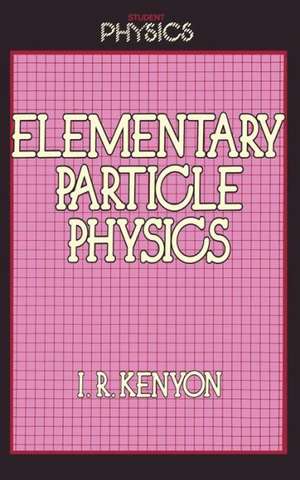
Elementary Particle Physics: Student Physics Series
Autor Ian Kenyonen Limba Engleză Paperback – 22 apr 2012

Preț: 372.43 lei
Puncte Express: 559
Carte tipărită la comandă
Livrare economică 07-21 decembrie
Livrare prin curier în România Termenul estimat este afișat lângă disponibilitate.
Transport gratuit de la 400.00 lei Plată online sau ramburs, în funcție de opțiunile comenzii.
Retur gratuit în 14 zile Comandă securizată și suport în română.
Specificații
ISBN-13: 9789401092913
ISBN-10: 9401092915
Pagini: 332
Ilustrații: XII, 312 p.
Dimensiuni: 127 x 203 x 19 mm
Greutate: 0.36 kg
Ediția:Softcover reprint of the original 1st edition 1987
Editura: Springer
Colecția Student Physics Series
Seria Student Physics Series
Locul publicării:Dordrecht, Netherlands
ISBN-10: 9401092915
Pagini: 332
Ilustrații: XII, 312 p.
Dimensiuni: 127 x 203 x 19 mm
Greutate: 0.36 kg
Ediția:Softcover reprint of the original 1st edition 1987
Editura: Springer
Colecția Student Physics Series
Seria Student Physics Series
Locul publicării:Dordrecht, Netherlands








Public țintă
ResearchCuprins
1 Introduction.- 1.1 Units and notation.- 2 Leptons, quarks and forces.- 2.1 The electron and its neutrino.- 2.2 The heavy leptons.- 2.3 The quark model.- 2.4 Forces.- 3 Experimental techniques.- 3.1 Accelerators and beams.- 3.2 Particle interactions with matter.- 3.3 Bubble chambers.- 3.4 Wire chambers.- 3.5 Scintillation counters.- 3.6 Calorimeters.- 3.7 The UA1 detector.- 3.8 Particle identification.- 3.9 Detectors for neutrino interactions.- 4 QED and the gauge principle.- 4.1 Dirac’s theory of the electron.- 4.2 Feynman diagrams.- 4.3 Electron-positron annihilation.- 4.4 Local gauge invariance.- 5 Symmetries and conservation laws.- 5.1 Quantum requirements.- 5.2 Groups of transformations.- 5.3 Lie groups.- 5.4 Rotation group.- 5.5 Lorentz and Poincaré groups.- 5.6 Internal symmetries.- 5.7 Discrete symmetries.- 5.8 Summary on conservation laws.- 6 Colour and QCD.- 6.1 SU(3) The colour symmetry.- 6.2 The group properties of SU(3).- 6.3 The colour force.- 6.4 Quantum chromodynamics.- 7 The V—A theory of weak interactions.- 7.1 Fermi’s model.- 7.2 The V-A theory.- 7.3 Neutral K-mesons.- 7.4 The Cabibbo hypothesis and its extension.- 8 Electroweak unification.- 8.1 Weak isospin and hypercharge.- 8.2 Electroweak unification based on SU(2)L(?)U(l).- 8.3 The discovery of the weak neutral current.- 8.4 The discovery of the W± and Z0 bosons.- 8.5 Strangeness-changing neutral currents (SCNC).- 8.6 Particle number conservation laws.- 9 Electroweak probes of hadron structure.- 9.1 Deep inelastic electron scattering.- 9.2 Deep inelastic neutrino scattering.- 9.3 The nucleon structure functions.- 9.4 The Drell-Yan process.- 10 Hadronic flavour.- 10.1 Electron-positron annihilation to vector mesons.- 10.2 Flavour symmetries.- 10.3 The determination of meson quantum numbers.- 10.4 The determination of baryon quantum numbers.- 11 Hadron-hadron interactions.- 11.1 Geometric effects.- 11.2 Jet production.- 11.3 Peripheralism and Reggeized exchange.- 12 Ways forward.- 12.1 Grand unification.- 12.2 Supersymmetry.- 12.3 Cosmology.- 12.4 Gravitation.- Appendix A.- Appendix B.- Appendix C.- Appendix D.- Appendix E.- Appendix F.- Appendix G.