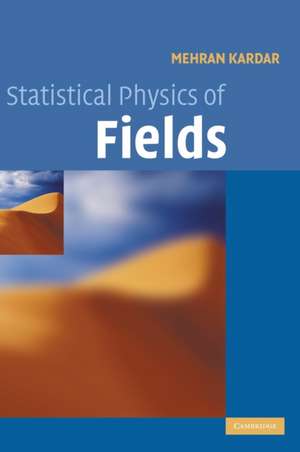
Statistical Physics of Fields
Autor Mehran Kardaren Limba Engleză Hardback – 30 iul 2014
Nivelul de studiu vizat pentru acest volum este cel de masterat avansat sau doctorat în fizică, fiind un text de referință pentru cercetătorii care explorează comportamentul colectiv al sistemelor complexe. Statistical Physics of Fields reprezintă o sinteză riguroasă a cursurilor susținute de profesorul Mehran Kardar la MIT, oferind un cadru teoretic solid pentru înțelegerea invarianței de scală și a universalității prin prisma teoriilor statistice de câmp. Notăm cu interes tranziția fluidă pe care autorul o realizează de la perspectiva discretă a particulelor, dezvoltată în lucrarea sa anterioară, Statistical Physics of Particles, către abordarea continuă a câmpurilor statistice. Primele capitole asigură această punte metodologică, pregătind terenul pentru instrumente analitice complexe precum grupul de renormalizare și teoria perturbațiilor. Subliniem rigoarea pedagogică a volumului, care integrează 115 ilustrații și 65 de exerciții menite să fixeze conceptele de soluții exacte și dinamică non-echilibru. Cititorii familiarizați cu Scaling and Renormalization in Statistical Physics de John Cardy vor aprecia la Mehran Kardar accentul pus pe formularea explicită a teoriilor și pe aplicațiile în medii aleatorii, oferind o structură mai apropiată de formatul unui manual universitar intensiv. În comparație cu Introduction to Statistical Field Theory de Edouard Brézin, care utilizează metoda expansiunii în bucle, volumul de față publicat de Cambridge University Press oferă o perspectivă mai largă asupra fenomenelor de interfață și a drumurilor direcționate, fiind esențial pentru cei care doresc să stăpânească mecanismele fundamentale ale tranzițiilor de fază moderne.
Preț: 688.23 lei
Preț vechi: 773.29 lei
-11%
Carte tipărită la comandă
Livrare economică 01-15 decembrie
Specificații
ISBN-10: 052187341X
Pagini: 370
Ilustrații: 115 b/w illus. 65 exercises
Dimensiuni: 183 x 260 x 24 mm
Greutate: 0.89 kg
Ediția:New.
Editura: Cambridge University Press
Locul publicării:Cambridge, United Kingdom
V-ar putea interesa
-
 Renormalization Methods: A Guide For BeginnersWilliam David McComb-12%Preț: 277.69 lei316.68 lei
 -
 Lectures on Complex NetworksSergey Dorogovtsev-11%Preț: 314.02 lei354.55 lei
 -
 -24%Preț: 669.91 lei882.52 lei
 -
 String Theory and Particle PhysicsLuis E. Ibáñez-11%Preț: 524.42 lei589.23 lei
 -
 Statistical Analysis of Circular DataN. I. FisherPreț: 458.59 lei
 -
 Nonequilibrium Quantum Field TheoryEsteban A. Calzetta-19%Preț: 414.81 lei515.12 lei
 -
 Statistical Physics of ParticlesMehran Kardar-8%Preț: 471.04 lei512.00 lei
 -
 A First Course in String TheoryBarton Zwiebach-8%Preț: 533.80 lei580.22 lei
 -
 The Kerr SpacetimeDavid L. Wiltshire-14%Preț: 1102.72 lei1282.23 lei
 -
 Quantum Field Theory and the Standard ModelMatthew D. Schwartz-8%Preț: 618.69 lei672.49 lei
 -
 Statistical PhysicsA. M. GuenaultPreț: 435.77 lei
De ce să citești această carte
Această lucrare este destinată studenților de la nivel de doctorat și fizicienilor teoreticieni care doresc să aprofundeze mecanica statistică modernă. Cititorul câștigă o înțelegere profundă a modului în care proprietățile universale apar din constituenți simpli, stăpânind grupul de renormalizare. Este un instrument indispensabil pentru cercetarea în fizica materiei condensate, oferind atât rigoare matematică, cât și exerciții aplicate extrase din curriculumul de elită al MIT.
Despre autor
Mehran Kardar este profesor de fizică la MIT, unde desfășoară activități de predare și cercetare în domeniul fizicii statistice de peste două decenii. După studii de licență la Cambridge și un doctorat obținut la MIT, și-a consolidat cariera academică prin poziții de cercetare la instituții de prestigiu precum Harvard, Oxford și Berkeley (ca Miller Fellow). Recunoscut pentru contribuțiile sale teoretice, Kardar este și un pedagog distins, fiind membru Guggenheim. Opera sa este definită prin claritatea cu care tratează fenomenele colective, transformând cursuri universitare de elită în manuale de referință globală.
Descriere scurtă
Cuprins
Recenzii
'Statistical Physics of Particles is the welcome result of an innovative and popular graduate course Kardar has been teaching at MIT for almost twenty years. It is a masterful account of the essentials of a subject which played a vital role in the development of twentieth century physics, not only surviving, but enriching the development of quantum mechanics. Its importance to science in the future can only increase with the rise of subjects such as quantitative biology. Statistical Physics of Fields builds on the foundation laid by the Statistical Physics of Particles, with an account of the revolutionary developments of the past 35 years, many of which were facilitated by renormalization group ideas. Much of the subject matter is inspired by problems in condensed matter physics, with a number of pioneering contributions originally due to Kardar himself. This lucid exposition should be of particular interest to theorists with backgrounds in field theory and statistical mechanics.' David R. Nelson, Harvard University
'If Landau and Lifshitz were to prepare a new edition of their classic Statistical Physics text they might produce a book not unlike this gem by Mehran Kardar. Indeed, Kardar is an extremely rare scientist, being both brilliant in formalism and an astoundingly careful and thorough teacher. He demonstrates both aspects of his range of talents in this pair of books, which belong on the bookshelf of every serious student of theoretical statistical physics. Kardar does a particularly thorough job of explaining the subtleties of theoretical topics too new to have been included even in Landau and Lifshitz most recent Third Edition (1980), such as directed paths in random media and the dynamics of growing surfaces, which are not in any text to my knowledge. He also provides careful discussion of topics that do appear in most modern texts on theoretical statistical physics, such as scaling and renormalization group.' H. Eugene Stanley, Boston University
'This is one of the most valuable textbook I have seen in a long time. Written by a leader in the field, it provides a crystal clear, elegant and comprehensive coverage of the field of statistical physics. I'm sure this book will become 'the' reference for the next generation of researchers, students and practitioners in statistical physics. I wish I had this book when I was a student but I will have the privilege to rely on it for my teaching.' Alessandro Vespignani, Indiana University
'… the first eight chapters of Statistical Physics of Fields are stunning. … Kardar has produced an excellent and unique textbook that will serve our community well for many years.' Physics Today