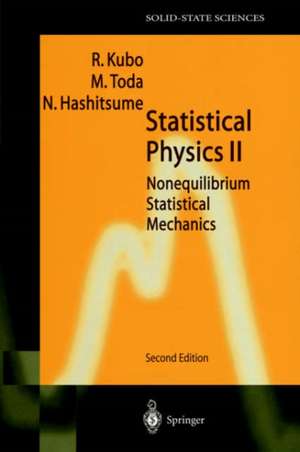
Statistical Physics II: Springer Series in Solid-State Sciences, cartea 31
Autor Ryogo Kubo, Morikazu Toda, Natsuki Hashitsume Traducere de M. Toda, R. Kubo, N. Saito, N. Hashitsumeen Limba Engleză Paperback – 14 noi 1991
Din seria Springer Series in Solid-State Sciences
- 18%
 Preț: 1055.64 lei
 - 18%
 Preț: 961.75 lei
 - 18%
 Preț: 865.62 lei
 - 18%
 Preț: 975.19 lei
 - 18%
 Preț: 1024.56 lei
 - 18%
 Preț: 1256.32 lei
 - 18%
 Preț: 958.47 lei
 - 18%
 Preț: 925.97 lei
 -
 Preț: 373.90 lei
 - 18%
 Preț: 1832.67 lei
 - 15%
 Preț: 666.60 lei
 -
 Preț: 378.19 lei
 - 15%
 Preț: 643.32 lei
 - 15%
 Preț: 637.96 lei
 - 18%
 Preț: 900.69 lei
 - 15%
 Preț: 651.89 lei
 - 15%
 Preț: 655.47 lei
 - 18%
 Preț: 894.17 lei
 - 15%
 Preț: 643.87 lei
 - 15%
 Preț: 654.12 lei
 - 15%
 Preț: 649.35 lei
 - 15%
 Preț: 647.87 lei
 - 15%
 Preț: 658.03 lei
 - 18%
 Preț: 961.62 lei
 - 15%
 Preț: 640.73 lei
 - 23%
 Preț: 1140.33 lei
 - 15%
 Preț: 642.16 lei
 - 15%
 Preț: 652.64 lei
 - 15%
 Preț: 640.49 lei
 - 15%
 Preț: 643.25 lei
 -
 Preț: 379.62 lei
 -
 Preț: 385.99 lei
 -
 Preț: 376.01 lei
 - 15%
 Preț: 641.76 lei
 - 18%
 Preț: 966.98 lei
 - 18%
 Preț: 706.78 lei
 - 15%
 Preț: 643.63 lei
 - 15%
 Preț: 626.68 lei
 - 18%
 Preț: 1269.64 lei
 - 18%
 Preț: 1272.76 lei
 - 18%
 Preț: 983.00 lei
 - 15%
 Preț: 615.84 lei
Preț: 912.74 lei
Preț vechi: 1113.10 lei
-18%
Puncte Express: 1369
Carte tipărită la comandă
Livrare economică 25 noiembrie-09 decembrie
Livrare prin curier în România Termenul estimat este afișat lângă disponibilitate.
Transport gratuit pentru acest produs Plată online sau ramburs, în funcție de opțiunile comenzii.
Retur gratuit în 14 zile Comandă securizată și suport în română.
Specificații
ISBN-13: 9783540538332
ISBN-10: 354053833X
Pagini: 300
Ilustrații: XVI, 279 p.
Dimensiuni: 155 x 235 x 17 mm
Greutate: 0.46 kg
Ediția:Second Edition 1991
Editura: Springer
Colecția Springer Series in Solid-State Sciences
Seria Springer Series in Solid-State Sciences
Locul publicării:Berlin, Heidelberg, Germany
ISBN-10: 354053833X
Pagini: 300
Ilustrații: XVI, 279 p.
Dimensiuni: 155 x 235 x 17 mm
Greutate: 0.46 kg
Ediția:Second Edition 1991
Editura: Springer
Colecția Springer Series in Solid-State Sciences
Seria Springer Series in Solid-State Sciences
Locul publicării:Berlin, Heidelberg, Germany
V-ar putea interesa
-
 Renormalization Methods: A Guide For BeginnersWilliam David McComb-12%Preț: 277.69 lei316.68 lei
 -
 Lectures on Complex NetworksSergey Dorogovtsev-11%Preț: 314.02 lei354.55 lei
 -
 -24%Preț: 669.91 lei882.52 lei
 -
 Environmental PhysicsClare SmithPreț: 430.15 lei
 -
 Mad about Modern PhysicsFranklin PotterPreț: 129.24 lei
 -
 Quantum Theory of SolidsCharles Kittel-27%Preț: 877.95 lei1202.67 lei
 -
 Quarks and LeptonesFrancis Halzen-27%Preț: 1233.23 lei1689.35 lei
 -
 String Theory and Particle PhysicsLuis E. Ibáñez-11%Preț: 524.42 lei589.23 lei
 -
 Statistical Analysis of Circular DataN. I. FisherPreț: 458.59 lei
 -
 Nonequilibrium Quantum Field TheoryEsteban A. Calzetta-19%Preț: 414.81 lei515.12 lei
 -
 Statistical Physics of FieldsMehran Kardar-11%Preț: 688.23 lei773.29 lei
 -
 Statistical Physics of ParticlesMehran Kardar-8%Preț: 470.34 lei511.24 lei
 -
 A First Course in String TheoryBarton Zwiebach-8%Preț: 533.80 lei580.22 lei
 -
 The Kerr SpacetimeDavid L. Wiltshire-14%Preț: 1068.36 lei1242.28 lei
 -
 A Level PhysicsRoger Muncaster-32%Preț: 475.65 lei700.14 lei
 -
 Quantum Field Theory and the Standard ModelMatthew D. Schwartz-8%Preț: 617.78 lei671.51 lei
 -
 Statistical PhysicsA. M. GuenaultPreț: 435.77 lei
 -
 A Modern Course in Statistical PhysicsLinda E. Reichl-14%Preț: 640.19 lei744.41 lei
Public țintă
ResearchCuprins
1. Brownian Motion.- 1.1 Brownian Motion as a Stochastic Process.- 1.2 The Central Limit Theorem and Brownian Motion.- 1.3 The Langevin Equation and Harmonic Analysis.- 1.4 Gaussian Processes.- 1.5 Brownian Motion Modeled by a Gaussian Process.- 1.6 The Fluctuation-Dissipation Theorem.- 2. Physical Processes as Stochastic Processes.- 2.1 Random Frequency Modulation.- 2.2 Brownian Motion Revisited.- 2.3 Markovian Processes.- 2.4 Fokker-Planck Equation.- 2.5 Contraction of Information. Projected Processes.- 2.6 Derivation of Master Equations.- 2.7 Brownian Motion of a Quantal System.- 2.8 Boltzmann Equation.- 2.9 Generalized Langevin Equation and the Damping Theory.- 3. Relaxation and Resonance Absorption.- 3.1 Linear Irreversible Processes.- 3.2 Complex Admittance.- 3.3 Debye Relaxation.- 3.4 Resonance Absorption.- 3.5 Wave Number-Dependent Complex Admittance.- 3.6 Dispersion Relations.- 3.7 Sum Rules and Interpolation Formulas.- 4. Statistical Mechanics of Linear Response.- 4.1 Static Response to External Force.- 4.2 Dynamic Response to External Force.- 4.3 Symmetry and the Dispersion Relations.- 4.4 Fluctuation and Dissipation Theorem.- 4.5 Density Response, Conduction and Diffusion.- 4.6 Response to Thermal Internal Forces.- 4.7 Some Remarks on the Linear-Response Theory.- 5. Quantum Field Theoretical Methods in Statistical Mechanics.- 5.1 Double-Time Green’s Functions.- 5.2 Chain of Equations of Motion and the Decoupling Approximation.- 5.3 Relation to the Kinetic Equation.- 5.4 Single-Particle Green’s Function and the Causal Green’s Function.- 5.5 Basic Formula for Perturbational Expansion.- 5.6 Temperature Green’s function.- 5.7 Diagram Technique.- 5.8 Dyson Equation.- 5.9 Relationship Between the Thermodynamic Potential and the Temperature Green’sFunction.- 5.10 Special Case of the Two-Particle Green’s function.- General Bibliography of Textbooks.- References.
Textul de pe ultima copertă
Statistical Physics II introduces nonequilibrium theories of statistical mechanics from the viewpoint of the fluctuation-dissipation theorem. Emphasis is placed on relaxation from nonequilibrium to equilibrium states, the response of a system to an external disturbance, and general problems involved in deriving a macroscopic physical process from more basic underlying processes. Fundamental concepts and methods are stressed, rather than the numerous individual applications.