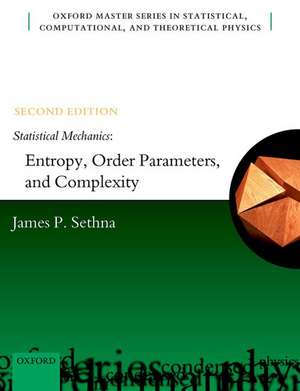
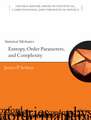
Statistical Mechanics: Entropy, Order Parameters, and Complexity: Oxford Master Series in Physics, cartea 14
Autor James P. Sethnaen Limba Engleză Paperback – 26 ian 2021
Din seria Oxford Master Series in Physics
- 11%
 Preț: 338.42 lei
 - 10%
 Preț: 346.40 lei
 -
 Preț: 243.77 lei
 - 9%
 Preț: 350.56 lei
 - 10%
 Preț: 264.79 lei
 -
 Preț: 383.52 lei
 - 11%
 Preț: 338.26 lei
 - 22%
 Preț: 524.43 lei
 - 10%
 Preț: 338.81 lei
 - 9%
 Preț: 345.40 lei
 - 10%
 Preț: 345.51 lei
 - 9%
 Preț: 347.72 lei
 - 10%
 Preț: 339.78 lei
 - 10%
 Preț: 324.52 lei
 - 12%
 Preț: 369.31 lei
 - 11%
 Preț: 361.80 lei
 - 10%
 Preț: 363.31 lei
 - 12%
 Preț: 283.33 lei
 - 11%
 Preț: 357.09 lei
 - 10%
 Preț: 370.64 lei
 - 10%
 Preț: 382.25 lei
 - 31%
 Preț: 908.07 lei
Preț: 345.35 lei
Preț vechi: 377.81 lei
-9%
Puncte Express: 518
Carte tipărită la comandă
Livrare economică 04-15 decembrie
Livrare express 30 octombrie-05 noiembrie pentru 93.49 lei
Livrare prin curier în România Termenul estimat este afișat lângă disponibilitate.
Transport gratuit de la 400.00 lei Plată online sau ramburs, în funcție de opțiunile comenzii.
Retur gratuit în 14 zile Comandă securizată și suport în română.
Specificații
ISBN-13: 9780198865254
ISBN-10: 0198865252
Pagini: 492
Ilustrații: 230 line drawings
Dimensiuni: 189 x 23 x 246 mm
Greutate: 1.04 kg
Ediția:2
Editura: OUP OXFORD
Colecția OUP Oxford
Seria Oxford Master Series in Physics
Locul publicării:Oxford, United Kingdom
ISBN-10: 0198865252
Pagini: 492
Ilustrații: 230 line drawings
Dimensiuni: 189 x 23 x 246 mm
Greutate: 1.04 kg
Ediția:2
Editura: OUP OXFORD
Colecția OUP Oxford
Seria Oxford Master Series in Physics
Locul publicării:Oxford, United Kingdom
Recenzii
Review from previous edition Since the book treats intersections of mathematics, biology, engineering, computer science and social sciences, it will be of great help to researchers in these fields in making statistical mechanics useful and comprehensible. At the same time, the book will enrich the subject for physicists who'd like to apply their skills in other disciplines. [...] The author's style, although quite concentrated, is simple to understand, and has many lovely visual examples to accompany formal ideas and concepts, which makes the exposition live and intuitvely appealing.
Sethna's book provides an important service to students who want to learn modern statistical mechanics. The text teaches students how to work out problems by guiding them through the exercises rather than by presenting them with worked-out examples.
Sethna's book provides an important service to students who want to learn modern statistical mechanics. The text teaches students how to work out problems by guiding them through the exercises rather than by presenting them with worked-out examples.
Notă biografică
James P. Sethna is professor of physics at Cornell University. Sethna has used statistical mechanics to make substantive contributions in a bewildering variety of subjects -- mathematics (dynamical systems and the onset of chaos), engineering (microstructure, plasticity, and fracture), statistics (information geometry, sloppy models, low-dimensional embeddings), materials science (glasses and spin glasses, liquid crystals, crackling noise, superconductivity), and popular culture (mosh pit dynamics and zombie outbreak epidemiology). He has collected cool, illustrative problems from students and colleagues over the decades, which inspired this textbook.
Cuprins
- Preface
- Contents
- List of figures
- What is statistical mechanics?
- 1.1: Quantum dice and coins
- 1.2: Probability distributions
- 1.3: Waiting time paradox
- 1.4: Stirling's formula
- 1.5: Stirling and asymptotic series
- 1.6: Random matrix theory
- 1.7: Six degrees of separation
- 1.8: Satisfactory map colorings
- 1.9: First to fail: Weibull
- 1.10: Emergence
- 1.11: Emergent vs. fundamental
- 1.12: Self-propelled particles
- 1.13: The birthday problem
- 1.14: Width of the height distribution
- 1.15: Fisher information and Cram¿er-Rao
- 1.16: Distances in probability space
- Random walks and emergent properties
- 2.1: Random walk examples: universality and scale invariance
- 2.2: The diffusion equation
- 2.3: Currents and external forces
- 2.4: Solving the diffusion equation
- Temperature and equilibrium
- 3.1: The microcanonical ensemble
- 3.2: The microcanonical ideal gas
- 3.3: What is temperature?
- 3.4: Pressure and chemical potential
- 3.5: Entropy, the ideal gas, and phase-space refinements
- Phase-space dynamics and ergodicity
- 4.1: Liouville's theorem
- 4.2: Ergodicity
- Entropy
- 5.1: Entropy as irreversibility: engines and the heat death of the Universe
- 5.2: Entropy as disorder
- 5.3: Entropy as ignorance: information and memory
- Free energies
- 6.1: The canonical ensemble
- 6.2: Uncoupled systems and canonical ensembles
- 6.3: Grand canonical ensemble
- 6.4: What is thermodynamics?
- 6.5: Mechanics: friction and fluctuations
- 6.6: Chemical equilibrium and reaction rates
- 6.7: Free energy density for the ideal gas
- Quantum statistical mechanics
- 7.1: Mixed states and density matrices
- 7.2: Quantum harmonic oscillator
- 7.3: Bose and Fermi statistics
- 7.4: Non-interacting bosons and fermions
- 7.5: Maxwell-Boltzmann 'quantum' statistics
- 7.6: Black-body radiation and Bose condensation
- 7.7: Metals and the Fermi gas
- Calculation and computation
- 8.1: The Ising model
- 8.2: Markov chains
- 8.3: What is a phase? Perturbation theory
- Order parameters, broken symmetry, and topology
- 9.1: Identify the broken symmetry
- 9.2: Define the order parameter
- 9.3: Examine the elementary excitations
- 9.4: Classify the topological defects
- Correlations, response, and dissipation
- 10.1: Correlation functions: motivation
- 10.2: Experimental probes of correlations
- 10.3: Equal-time correlations in the ideal gas
- 10.4: Onsager's regression hypothesis and time correlations
- 10.5: Susceptibility and linear response
- 10.6: Dissipation and the imaginary part
- 10.7: Static susceptibility
- 10.8: The fluctuation-dissipation theorem
- 10.9: Causality and Kramers-Kr¿onig
- Abrupt phase transitions
- 11.1: Stable and metastable phases
- 11.2: Maxwell construction
- 11.3: Nucleation: critical droplet theory
- 11.4: Morphology of abrupt transitions
- Continuous phase transitions
- 12.1: Universality
- 12.2: Scale invariance
- 12.3: Examples of critical points
- A Appendix: Fourier methods
- A.1: Fourier conventions
- A.2: Derivatives, convolutions, and correlations
- A.3: Fourier methods and function space
- A.4: Fourier and translational symmetry
- References
- Index