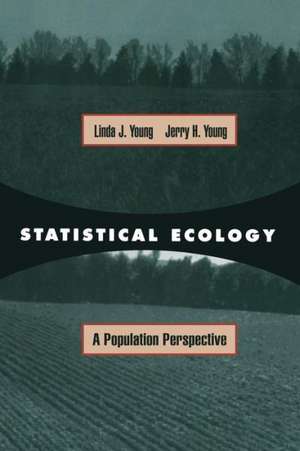
Statistical Ecology
Autor Linda J. Young, Jerry Youngen Limba Engleză Paperback – 20 feb 2013
Unique to this book is a focus on ecological data for single-species populations, from sampling through modeling. Examples come from real situations in pest management, forestry, wildlife biology, plant protection, and environmental studies, as well as from classical ecology. All those using this book will acquire a strong foundation in the statistical methods of modern ecological research.
This textbook is for late undergraduate and graduate students, and for professionals.
Preț: 936.30 lei
Preț vechi: 1141.82 lei
-18%
Puncte Express: 1404
Carte tipărită la comandă
Livrare economică 02-16 decembrie
Livrare prin curier în România Termenul estimat este afișat lângă disponibilitate.
Transport gratuit pentru acest produs Plată online sau ramburs, în funcție de opțiunile comenzii.
Retur gratuit în 14 zile Comandă securizată și suport în română.
Specificații
ISBN-13: 9781475728316
ISBN-10: 147572831X
Pagini: 584
Ilustrații: XVI, 566 p.
Dimensiuni: 152 x 229 x 32 mm
Greutate: 0.83 kg
Ediția:Softcover reprint of the original 1st ed. 1998
Editura: Springer
Locul publicării:New York, NY, United States
ISBN-10: 147572831X
Pagini: 584
Ilustrații: XVI, 566 p.
Dimensiuni: 152 x 229 x 32 mm
Greutate: 0.83 kg
Ediția:Softcover reprint of the original 1st ed. 1998
Editura: Springer
Locul publicării:New York, NY, United States
V-ar putea interesa
-
 Cradle to CradleMichael Braungart-19%Preț: 57.49 lei71.32 lei
 -
 The Vanishing Face of GaiaJames Lovelock-32%Preț: 63.04 lei92.24 lei
 -
 -18%Preț: 254.28 lei309.47 lei
 -
 Ecological Methods in Forest Pest ManagementDavid Wainhouse-32%Preț: 697.76 lei1032.21 lei
 -
 Symbiotic InteractionsA. E. Douglas-21%Preț: 299.10 lei378.72 lei
 -
 -12%Preț: 358.96 lei408.64 lei
 -
 A Rough Ride to the FutureJames LovelockPreț: 78.35 lei
 -
 ColdStreeverPreț: 128.60 lei
 -
 Oil and HoneyBill McKibbenPreț: 113.11 lei
 -
 The Great DisruptionPaul Gilding-28%Preț: 85.41 lei118.55 lei
 -
 -17%Preț: 90.85 lei109.72 lei
 -
 WILD LAW SECOND EDITION SECO 2Cormac Cullinan-42%Preț: 112.41 lei193.16 lei
Public țintă
ResearchCuprins
1: Probability Distributions.- 2: Goodness-of-Fit Tests.- 3: Models and Sampling.- 4: Sequential Estimation.- 5: Sequential Hypothesis Testing.- 6: Sequentially Testing Three Hypotheses.- 7: Aggregation and Spatial Correlation.- 8: Spatial Point Patterns.- 9: Capture—Recapture: Closed Populations.- 10: Capture—Recapture: Open Populations.- 11: Transect Sampling.- 12: Degree-Day Models.- 13: Life-Stage Analysis.- 14: Probit and Survival Analysis.- 15: Chaos.- References.