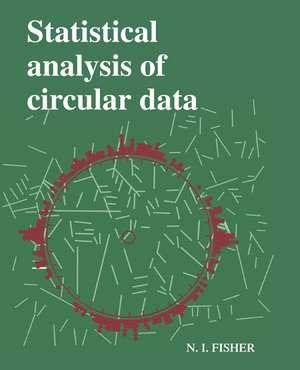
Statistical Analysis of Circular Data
Autor N. I. Fisheren Limba Engleză Paperback – 11 oct 1995
Remarcăm acest manual de referință publicat de Cambridge University Press, care oferă o abordare riguroasă și sistematizată a unui domeniu adesea neglijat în cursurile de statistică generală: datele circulare. Structura volumului Statistical Analysis of Circular Data este concepută pentru a răspunde nevoilor cercetătorilor din științe aplicate, unde măsurătorile sub formă de unghiuri — de la direcția de zbor a păsărilor până la orientarea planurilor de fractură în geologie — necesită un aparat matematic specific. Notăm cu interes modul în care autorul integrează 47 de tabele și aproape o sută de ilustrații pentru a clarifica concepte complexe de corelație și regresie aplicate acestor seturi de date.
Din punct de vedere metodologic, ediția de față aduce în prim-plan dezvoltări recente, precum metodele bootstrap și tehnicile de netezire nonparametrică, oferind soluții pentru probleme de analiză considerate anterior dificil de gestionat. Cititorii familiarizați cu Circular Statistics in R de Arthur Pewsey vor aprecia aici fundamentul teoretic solid și perspectiva unificată care precedă implementarea computațională, oferind o înțelegere mai profundă a modelelor matematice din spatele algoritmilor. În contextul operei autorului, această lucrare completează perfect titlul Statistical Analysis of Spherical Data, extinzând expertiza lui N. I. Fisher în domeniul statisticii direcționale. Volumul reușește să mențină un echilibru între rigoarea teoretică și aplicabilitatea practică, fiind un instrument indispensabil pentru mediul academic și cel de cercetare.
Preț: 414.73 lei
Carte tipărită la comandă
Livrare economică 10-24 iulie
Specificații
ISBN-10: 0521568900
Pagini: 296
Ilustrații: 98 b/w illus. 1 map 47 tables
Dimensiuni: 173 x 247 x 18 mm
Greutate: 0.51 kg
Ediția:Revised.
Editura: Cambridge University Press
Colecția Cambridge University Press
Locul publicării:Cambridge, United Kingdom
V-ar putea interesa
-
 Renormalization Methods: A Guide For BeginnersWilliam David McComb-13%Preț: 263.25 lei303.41 lei
 -
 Lectures on Complex NetworksSergey Dorogovtsev-13%Preț: 310.07 lei355.17 lei
 -
 -21%Preț: 604.79 lei765.93 lei
 -
 -11%Preț: 471.35 lei529.60 lei
 -
 Nonequilibrium Quantum Field TheoryEsteban A. Calzetta-19%Preț: 414.81 lei515.12 lei
 -
 Statistical Physics of FieldsMehran Kardar-8%Preț: 604.43 lei656.99 lei
 -
 Statistical Physics of ParticlesMehran Kardar-8%Preț: 465.28 lei505.74 lei
 -
 A First Course in String TheoryBarton Zwiebach-19%Preț: 522.43 lei644.98 lei
 -
 The Kerr Spacetime: Rotating Black Holes in General RelativityDavid L. Wiltshire-14%Preț: 1025.58 lei1192.54 lei
 -
 Quantum Field Theory and the Standard ModelMatthew D. Schwartz-8%Preț: 594.70 lei646.42 lei
 -
 Statistical PhysicsA. M. GuenaultPreț: 435.77 lei
 -
 A Modern Course in Statistical PhysicsLinda E. Reichl-14%Preț: 620.46 lei721.46 lei
De ce să citești această carte
Recomandăm această carte oricărui cercetător care lucrează cu date direcționale în biologie, meteorologie sau geofizică. Cititorul câștigă acces la un set complet de instrumente pentru vizualizarea și analiza corectă a unghiurilor și orientărilor, evitând erorile comune ale statisticii liniare aplicate datelor circulare. Este o resursă esențială pentru a stăpâni metode moderne precum bootstrap în contextul măsurătorilor spațiale.
Despre autor
N. I. Fisher este un statistician de renume, profesor vizitator la Universitatea din Sydney și fondator al ValueMetrics Australia. Experiența sa vastă îmbină cercetarea academică de vârf cu consultanța în performanță cantitativă. Pe lângă contribuția sa majoră în domeniul statisticii direcționale prin lucrări precum Statistical Analysis of Circular Data, a editat lucrările colectate ale lui Wassily Hoeffding, demonstrând o înțelegere profundă a fundamentelor statisticii matematice și a aplicațiilor acestora în politici publice și management.
Descriere scurtă
Cuprins
Recenzii
"I would recommend this book to any statistician who needs to analyze circular data. The author's style is quite readable. The page layout is pleasing, and the graphics are very well done....I was very impressed with this book." Thomas E. Wehrly, Technometrics
"...as circular data become more common and their underlying questions become more complex, Statistical Analysis of Circular Data will continue to help move this 'curious byway' into a mainstream of applied statistical science. This is a book that is written to be used." Nicholas Lange, Journal of the American Statistical Association
"...this well-crafted text contains a wealth of other historical and technical aspects of analyzing circular data that you will find both interesting and informative." Timothy G. Gregoire, Forest Science