Cantitate/Preț
Produs

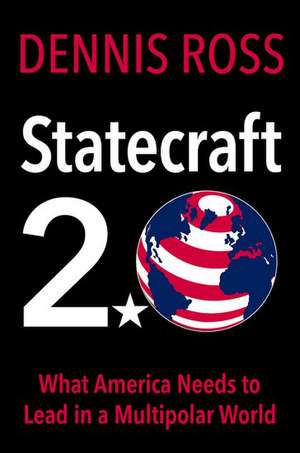
Statecraft 2.0: What America Needs to Lead in a Multipolar World

Autor Dennis Ross
en Limba Engleză Paperback – 13 mai 2025

Notăm cu interes apariția celei de-a doua ediții a lucrării Statecraft 2.0, un volum esențial pentru studenții la științe politice, cercetătorii în relații internaționale și practicienii din diplomație care doresc să înțeleagă noua paradigmă a puterii globale. Într-o eră în care hegemonia americană post-1991 este contestată activ de ascensiunea Chinei și de revizionismul Rusiei, Dennis Ross argumentează că Statele Unite nu își mai pot permite erori strategice. Premisa centrală a cărții este necesitatea imperioasă de a armoniza obiectivele politice cu mijloacele disponibile — fie ele diplomatice, economice, cibernetice sau militare. Descoperim aici o analiză riguroasă a eșecurilor din Afganistan și Irak, pe care autorul le folosește ca avertisment împotriva obiectivelor slab definite. Remarcăm structura pragmatică a volumului, care distilează lecții din succese istorice, precum unificarea Germaniei, și le aplică provocărilor contemporane: schimbările climatice, pandemiile și securitatea cibernetică. Această lucrare extinde cadrul propus de First Among Equals de Emma Ashford cu date noi din realitatea geopolitică a ultimilor ani, oferind o perspectivă mai aplicată asupra instrumentelor de stat. Față de abordarea teoretică din Force and Statecraft, Ross mizează pe o experiență de teren vastă, oferind un ghid de supraviețuire strategică într-o lume unde „excepționalismul american” nu mai este suficient pentru a menține ordinea internațională.

Citește tot Restrânge

Preț: 12304 lei

Preț vechi: 15052 lei
-18%

Puncte Express: 185

Carte disponibilă

Livrare economică 03-09 septembrie
Livrare express 19-25 august pentru 6380 lei

Livrare prin curier în România Termenul estimat este afișat lângă disponibilitate.
Transport gratuit de la 40000 lei Plată online sau ramburs, în funcție de opțiunile comenzii.
Retur gratuit în 14 zile Comandă securizată și suport în română.

Specificații

ISBN-13: 9780197698921
ISBN-10: 0197698921
Pagini: 496
Dimensiuni: 155 x 231 x 38 mm
Greutate: 0.61 kg
Ediția:2nd edition
Editura: Oxford University Press
Colecția OUP USA
Locul publicării:New York, United States

De ce să citești această carte

Această ediție a Statecraft 2.0 este o lectură fundamentală pentru oricine dorește să înțeleagă mecanismele puterii în secolul XXI. Cititorul câștigă acces la expertiza unui diplomat de carieră care a modelat politica externă a SUA timp de decenii. Este un manual de strategie care explică de ce unele intervenții eșuează lamentabil în timp ce altele reușesc, oferind soluții concrete pentru gestionarea relațiilor cu marii rivali globali.


Despre autor

Dennis Ross este un diplomat american de renume, recunoscut pentru rolul său cheie ca emisar pentru Orientul Mijlociu în administrațiile George H. W. Bush și Bill Clinton. În prezent membru al Washington Institute for Near East Policy, Ross este autorul unor lucrări de referință precum The Missing Peace și Doomed to Succeed, aceasta din urmă fiind premiată cu National Jewish Book Award. Expertiza sa se concentrează pe medierea conflictelor și pe analiza relațiilor dintre SUA și Israel, teme pe care le explorează și în volumul Be Strong and of Good Courage.


Descriere

In a world that is multipolar and America has less relative power, the United States no longer has the luxury to practice statecraft badly.The United States may still be the world's strongest country, but it now faces real challenges at both a global and regional level. The unipolar world which was dominated by America after the Cold War is gone. Unlike the Soviet Union, China is both a military and economic competitor and it is actively challenging the norms and institutions that the US used to shape an international order during and after the Cold War. Directly and indirectly, it has partners trying to undo the American-dominated order, with Russia seeking to extinguish Ukraine, and Iran trying to undermine American presence, influence, and any set of rules for the Middle East that it does not dominate. The failures of American policy in Afghanistan and Iraq have weakened the domestic consensus for a US leadership role internationally. Traditions in US foreign policy, especially the American sense of exceptionalism, have at different points justified both withdrawal and international activism. Iraq and Afghanistan fed the instinct to withdraw and to end the "forever wars." But the folly of these US interventions did not necessarily mean that all use of force to back diplomacy or specific political ends was wrong; rather it meant in these cases, the Bush Administration failed in the most basic task of good statecraft: namely, marrying objectives and means. Nothing more clearly defines effective statecraft than identifying well-considered goals and then knowing how to use all the tools of statecraft--diplomatic, economic, military, intelligence, information, cyber, scientific, education--to achieve them. But all too often American presidents have adopted goals that were poorly defined and not thought through. In Statecraft 2.0, Dennis Ross explains why failing to marry objectives and means has happened so often in American foreign policy. He uses historical examples to illustrate the factors that account for this, including political pressures, weak understanding of the countries where the US has intervened, changing objectives before achieving those that have been established, relying too much on ourselves and too little on allies and partners. To be fair, there have not only been failures, there have been successes as well. Ross uses case studies to look more closely at the circumstances in which Administrations have succeeded and failed in marrying objectives and means. He distills the lessons from good cases of statecraft--German unification in NATO, the first Gulf War, the surge in Iraq 2007-8--and bad cases of statecraft--going to war in Iraq 2003, and the Obama policy toward Syria. Based on those lessons, he develops a framework for applying today a statecraft approach to our policy toward China, Iran, and the Israeli-Palestinian conflict. The book concludes with how a smart statecraft approach would shape policy toward the new national security challenges of climate, pandemics, and cyber.

Notă biografică

Dennis Ross served in senior national security positions as a political appointee for Ronald Reagan, George H.W. Bush, Bill Clinton, and Barack Obama. He played a prominent role in shaping American policy toward the former Soviet Union, working out German unification in NATO, developing the Gulf War coalition, putting together the Madrid Peace Conference, negotiating between Arabs and Israelis as the chief American envoy, and later helping to formulate American approaches toward Iran. After his formal governmental stints, he has been an active participant in track two diplomatic efforts and discussions. He is a frequent commentator in the media on the Middle East and other international hotspots. Ross is presently the Davidson Distinguished Fellow at the Washington Institute for Near East Policy and a Distinguished Professor in the Practice of Diplomacy at Georgetown University.