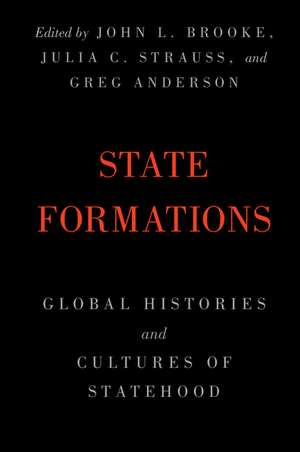
State Formations
Editat de John L. Brooke, Julia C. Strauss, Greg Andersonen Limba Engleză Paperback – 6 mar 2019
Destinat studenților în științe politice, cercetătorilor din domeniul istoriei globale și practicienilor interesați de sociologia puterii, volumul State Formations oferă o sinteză teoretică și empirică asupra evoluției autorității politice. Considerăm că valoarea centrală a acestei lucrări rezidă în capacitatea sa de a depăși granițele cronologice și geografice tradiționale, propunând o regândire a modului în care înțelegem structurile de putere, de la formațiunile pre-moderne până la statul contemporan. Spre deosebire de abordările care se concentrează strict pe modelul european, editorii John L. Brooke, Julia C. Strauss și Greg Anderson asamblează o perspectivă cu adevărat globală. Cititorii familiarizați cu The Making of the Modern State de B. Nelson vor aprecia modul în care acest volum extinde analiza dincolo de evoluția ideologică a modernității, integrând studii de caz diverse, precum coasta Swahili în perioada medievală sau structurile patrimoniale din India colonială. De asemenea, lucrarea intră în dialog direct cu States and Citizens, volum coordonat de Quentin Skinner, acesta din urmă fiind prezent și aici cu un capitol fundamental despre conceptul de persoană a statului. Structura volumului este riguros organizată în trei părți. Prima secțiune, „Definitions”, stabilește cadrul conceptual prin contribuțiile lui Skinner și Jessop. Partea a doua, „Foundings”, explorează originile statelor în contexte variate, inclusiv o analiză comparativă între formarea statului american și a celor non-democratice. Ultima parte, „Agendas”, investighează instrumentele puterii, de la administrarea Imperiului Roman până la rolul standardizării măsurilor și greutăților în consolidarea statală. Reținem astfel un parcurs narativ care trece de la abstractizarea teoretică la mecanismele concrete de guvernare.
Preț: 285.64 lei
Carte tipărită la comandă
Livrare economică 23 noiembrie-07 decembrie
Specificații
ISBN-10: 1108403948
Pagini: 408
Ilustrații: 1 b/w illus. 2 maps 4 tables
Dimensiuni: 152 x 229 x 24 mm
Greutate: 0.66 kg
Editura: Cambridge University Press
Locul publicării:New York, United States
V-ar putea interesa
-
 I Have More Souls Than OneFernando Pessoa-39%Preț: 17.26 lei28.37 lei
 -
 Women and Politics in Ancient RomeRichard A. BaumanPreț: 412.13 lei
 -
 -8%Preț: 462.54 lei502.75 lei
De ce să citești această carte
Această lucrare este esențială pentru oricine dorește să înțeleagă statul nu ca pe o entitate statică, ci ca pe un proces continuu de reformare. Cititorul câștigă o perspectivă comparativă rară, învățând cum s-au cristalizat structurile de putere în culturi diferite. Este o resursă academică solidă care demontează mitul dezvoltării liniare a statului modern, oferind instrumente critice pentru analiza politicii globale contemporane.
Despre autor
John L. Brooke este profesor de istorie la Ohio State University și director al Center for Historical Research. Opera sa este marcată de o abordare interdisciplinară, integrând istoria politică cu cea a mediului și a culturii. În lucrarea Climate Change and the Course of Global History, acesta a explorat intersecția dintre sistemele pământului și istoria umanității, o viziune amplă care se reflectă și în coordonarea prezentului volum. Recunoscut pentru rigoarea cercetării sale, Brooke a fost premiat de Society of the Historians of the Early American Republic pentru volumul Columbia Rising, consolidându-și reputația de specialist în formarea structurilor civile și politice.
Descriere scurtă
Cuprins
Recenzii
'Reading through State Formations is an extraordinarily rewarding experience.' Peter Onuf, Thomas Jefferson Foundation Professor of History, Emeritus, University of Virginia
'Social science too often treats the existence of states as obvious and focuses on the societies they demarcate or their international relations. State Formations brings a broad historical and comparative perspective to show how states are made and change, how they differ, and how conventional assumptions can mislead analysis. This is a book rich in empirical cases, well-marshalled to improve new thinking and better theory.' Craig Calhoun, President, Berggruen Institute, California
'This excellent volume brings together contributions from historians and theorists in discussing a wide range of historical formations of the state …' George Steinmetz, University of Michigan