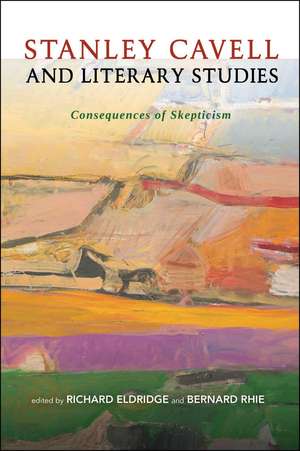
Stanley Cavell and Literary Studies: Consequences of Skepticism
Editat de Professor Richard Eldridge, Dr Bernard Rhieen Limba Engleză Paperback – 24 noi 2011
Preț: 245.35 lei
Preț vechi: 295.54 lei
-17%
Puncte Express: 368
Carte tipărită la comandă
Livrare economică 08-22 iunie
Specificații
ISBN-13: 9781441129451
ISBN-10: 1441129456
Pagini: 288
Dimensiuni: 138 x 216 x 20 mm
Greutate: 0.34 kg
Editura: Bloomsbury Publishing
Colecția Continuum
Locul publicării:New York, United States
ISBN-10: 1441129456
Pagini: 288
Dimensiuni: 138 x 216 x 20 mm
Greutate: 0.34 kg
Editura: Bloomsbury Publishing
Colecția Continuum
Locul publicării:New York, United States
V-ar putea interesa
-
 Literary Terms and CriticismJohn Peck-27%Preț: 197.58 lei269.86 lei
 -
 The Green Studies Reader: From Romanticism to EcocriticismLaurence CoupePreț: 380.44 lei
 -
 On DialogueDavid BohmPreț: 157.71 lei
 -
 The Post-Colonial Critic: Interviews, Strategies, DialoguesGayatri Chakravorty SpivakPreț: 412.14 lei
 -
 Preț: 418.18 lei
 -
 Death of the CriticRonan Mcdonald-42%Preț: 67.80 lei116.43 lei
 -
 Preț: 472.77 lei
 -
 Preț: 291.06 lei
 -
 Lucretius and ModernityJacques LezraPreț: 177.92 lei
 -
 Literary Theory: A Complete IntroductionSara Upstone-28%Preț: 74.56 lei102.87 lei
 -
 BookshelfLydia Pyne-33%Preț: 48.56 lei72.79 lei
 -
 Cigarette LighterJack Pendarvis-33%Preț: 48.48 lei72.74 lei
 -
 In Praise of LiteratureZygmunt BaumanPreț: 450.90 lei
 -
 In Praise of LiteratureRiccardo MazzeoPreț: 125.66 lei
 -
 Criticism: Ideas in ProfileCatherine Belsey-21%Preț: 53.35 lei67.71 lei
Cuprins
Notes on Contributors
Abbreviations
1. Introduction:
Cavell, Literary Studies, and the Human Subject: Consequences of Skepticism
Richard Eldridge and Bernard Rhie
I. Principles
2. The Adventure of Reading: Literature and Philosophy, Cavell and Beauvoir
Toril Moi
3. "Is 'Us' Me?" Cultural Studies and the Universality of Aesthetic Judgments
R. M. Berry
4. Cavell and Kant: The Work of Criticism and the Work of Art
Anthony J. Cascardi
5. Cavell and Wittgenstein on Morality: The Limits of Acknowledgment
Charles Altieri
6. The Word Viewed: Skepticism Degree Zero
Garrett Stewart
7. A Storied World: On Meeting and Being Met
Naomi Scheman
8. Skepticism and the Idea of an Other: Reflections on Cavell and Postcolonialism
Simona Bertacco and John Gibson
II. Practices
9. William Shakespeare and Stanley Cavell: Acknowledging, Confessing, and Tragedy
Sarah Beckwith
10. Competing for the Soul: Cavell on Shakespeare
Lawrence F. Rhu
11. "Communicating with Objects": Romanticism, Skepticism, and "The Specter of Animism" in Cavell and Wordsworth
Joshua Wilner
12. Emerson Discomposed: Skepticism, Naturalism, and the Search for Criteria in "Experience"
Paul Grimstad
13. Beside Ourselves: Near, Neighboring and Next-to in Cavell's The Senses of Walden and William Carlos Williams's "Fine Work with Pitch and Copper"
Elisa New
14. For all You Know
Andrew H. Miller
15. Empiricism, Exhaustion, and Meaning What We Say: Cavell and Contemporary Fiction
Robert Chodat
Select Bibliography
Index
Abbreviations
1. Introduction:
Cavell, Literary Studies, and the Human Subject: Consequences of Skepticism
Richard Eldridge and Bernard Rhie
I. Principles
2. The Adventure of Reading: Literature and Philosophy, Cavell and Beauvoir
Toril Moi
3. "Is 'Us' Me?" Cultural Studies and the Universality of Aesthetic Judgments
R. M. Berry
4. Cavell and Kant: The Work of Criticism and the Work of Art
Anthony J. Cascardi
5. Cavell and Wittgenstein on Morality: The Limits of Acknowledgment
Charles Altieri
6. The Word Viewed: Skepticism Degree Zero
Garrett Stewart
7. A Storied World: On Meeting and Being Met
Naomi Scheman
8. Skepticism and the Idea of an Other: Reflections on Cavell and Postcolonialism
Simona Bertacco and John Gibson
II. Practices
9. William Shakespeare and Stanley Cavell: Acknowledging, Confessing, and Tragedy
Sarah Beckwith
10. Competing for the Soul: Cavell on Shakespeare
Lawrence F. Rhu
11. "Communicating with Objects": Romanticism, Skepticism, and "The Specter of Animism" in Cavell and Wordsworth
Joshua Wilner
12. Emerson Discomposed: Skepticism, Naturalism, and the Search for Criteria in "Experience"
Paul Grimstad
13. Beside Ourselves: Near, Neighboring and Next-to in Cavell's The Senses of Walden and William Carlos Williams's "Fine Work with Pitch and Copper"
Elisa New
14. For all You Know
Andrew H. Miller
15. Empiricism, Exhaustion, and Meaning What We Say: Cavell and Contemporary Fiction
Robert Chodat
Select Bibliography
Index
Recenzii
"A serious encounter between literary theory and ordinary language philosophy is long overdue. This stimulating collection of essays is an indispensable resource for literary critics curious about Cavell and anyone eager to strengthen and deepen the relations between philosophy and literature." -- Rita Felski, William R. Kenan, Jr., Professor of English, University of Virginia, USA, and Editor, New Literary History
"In making good on its important effort to encourage and enact a rapprochement between Cavell and literary criticism, Stanley Cavell and Literary Studies is splendid testimony to one of this thinker's extraordinary strengths: his gift for inspiring brilliant minds to engage him in arguments about matters that are of compelling concern to readers across the humanities. This is a scintillating collection of passionately argued essays." -- Ross Posnock, Anna Garbedian Professor of the Humanities, Department of English and Comparative Literature, Columbia University, USA
"As Cavell's work restores emotional drama to ordinary language philosophy by attending to the literary, so does this splendid collection reenergize literary studies by bringing it into conversation with Cavell. Genres as diverse as Shakespearean tragedy, American Romanticism, and contemporary fiction reveal their commonalities here as confrontations with, and attempts to repair, the skeptical rupture between self and otherness. Through these searching essays, we are led to recognize anew the way writing functions both as withdrawal from the world and as an affirmation of the potentialities of our common language." -- Jennifer Fleissner, Associate Professor of English, Indiana University Bloomington, USA
It is worth saying that, while most contributors exhibit real sympathy with Cavell's preoccupations and perceptions, there is no shortage of critical questioning of both their finer details and broader implications. [.] The resulting essays have been divided into two groups: those primarily addressing matters of theory or principle and those primarily developing readings of individual authors and texts (although, as the editors make clear, some are less easy to subsume with such taxonomy than others). And the collection contains many examples of work in both categories that genuinely helps illuminate either the true nature of Cavell's work or the kinds of approach in literary studies that most deeply resist and most naturally invite engagement with it (in all its idiosyncrasy).
In this fine collection of essays, the energy of long-standing engagements with [Cavell's] philosophical legacy animates discussions of the relation between philosophy and literature and of the nature of aesthetic criticism more broadly. [.] The authors of the essays in this collection take up the challenge posed by an ordinary language approach to criticism with originality and vigor.
Stanley Cavell and Literary Studies: Consequences of Skepticism marks a fruition of the available criticism on Cavell's relation to literary studies. I t conveys the sense of a thorough assimilation of Cavell's project that reflects a deep-and sometimes long-acquaintance with it on the part of many of the contributors. [...] This volume is specialized but accessible, and evinces a real companionship of endeavor without being protective or exclusive. More in the spirit of Cavell's work than to the letter of it, this companionship permits disagreement, divergence of opinion, and even critique. S uch an attitude is a better compliment than reverence, showing both seriousness of engagement and, for some, true intellectual influence. [...] The collection as a whole is a rich exploration of Cavell's relation to literary studies, and a broader statement of belief in the dividends of reading.
"In making good on its important effort to encourage and enact a rapprochement between Cavell and literary criticism, Stanley Cavell and Literary Studies is splendid testimony to one of this thinker's extraordinary strengths: his gift for inspiring brilliant minds to engage him in arguments about matters that are of compelling concern to readers across the humanities. This is a scintillating collection of passionately argued essays." -- Ross Posnock, Anna Garbedian Professor of the Humanities, Department of English and Comparative Literature, Columbia University, USA
"As Cavell's work restores emotional drama to ordinary language philosophy by attending to the literary, so does this splendid collection reenergize literary studies by bringing it into conversation with Cavell. Genres as diverse as Shakespearean tragedy, American Romanticism, and contemporary fiction reveal their commonalities here as confrontations with, and attempts to repair, the skeptical rupture between self and otherness. Through these searching essays, we are led to recognize anew the way writing functions both as withdrawal from the world and as an affirmation of the potentialities of our common language." -- Jennifer Fleissner, Associate Professor of English, Indiana University Bloomington, USA
It is worth saying that, while most contributors exhibit real sympathy with Cavell's preoccupations and perceptions, there is no shortage of critical questioning of both their finer details and broader implications. [.] The resulting essays have been divided into two groups: those primarily addressing matters of theory or principle and those primarily developing readings of individual authors and texts (although, as the editors make clear, some are less easy to subsume with such taxonomy than others). And the collection contains many examples of work in both categories that genuinely helps illuminate either the true nature of Cavell's work or the kinds of approach in literary studies that most deeply resist and most naturally invite engagement with it (in all its idiosyncrasy).
In this fine collection of essays, the energy of long-standing engagements with [Cavell's] philosophical legacy animates discussions of the relation between philosophy and literature and of the nature of aesthetic criticism more broadly. [.] The authors of the essays in this collection take up the challenge posed by an ordinary language approach to criticism with originality and vigor.
Stanley Cavell and Literary Studies: Consequences of Skepticism marks a fruition of the available criticism on Cavell's relation to literary studies. I t conveys the sense of a thorough assimilation of Cavell's project that reflects a deep-and sometimes long-acquaintance with it on the part of many of the contributors. [...] This volume is specialized but accessible, and evinces a real companionship of endeavor without being protective or exclusive. More in the spirit of Cavell's work than to the letter of it, this companionship permits disagreement, divergence of opinion, and even critique. S uch an attitude is a better compliment than reverence, showing both seriousness of engagement and, for some, true intellectual influence. [...] The collection as a whole is a rich exploration of Cavell's relation to literary studies, and a broader statement of belief in the dividends of reading.
Caracteristici
Will
appeal
to
a
broad
academic
readership
of
students
and
scholars
in
literary
studies
and
philosophy.
Notă biografică
Richard
Eldridge
is
the
Charles
and
Harriett
Cox
McDowell
Professor
of
Philosophy
at
Swarthmore
College,
PA,
USA.
He
is
the
author
and
editor
of
numerous
books
in
philosophy
and
literature,
including,
as
editor,
The
Oxford
Handbook
of
Philosophy
and
Literature
(OUP,
2009)
and
Stanley
Cavell
(CUP,
2003,
2008),
and
as
author,
Literature,
Life,
and
Modernity
(Columbia
University
Press,
2008),
An
Introduction
to
the
Philosophy
of
Art
(CUP,
2004),
On
Moral
Personhood:
Philosophy,
Literature,
Criticism,
and
Self-Understanding
(University
of
Chicago
Press,1989),
and
Leading
a
Human
Life:
Wittgenstein,
Intentionality,
and
Romanticism
(University
of
Chicago
Press,
1997).Bernard
Rhie
is
Associate
Professor
of
English
at
Williams
College,
USA.