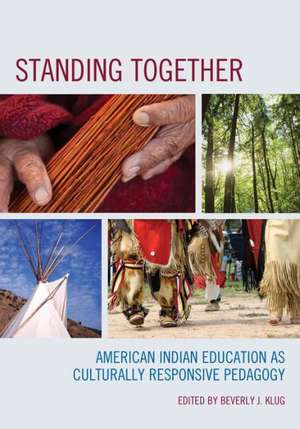
Standing Together: American Indian Education as Culturally Responsive Pedagogy
Autor Beverly J. Klugen Limba Engleză Hardback – 28 noi 2012
This book provides information about the importance of teaching American Indian students by bridging home and schools, using students' cultural capital as a springboard for academic success. Culturally Responsive Pedagogy is explored from its earliest beginnings following the 1928 Meriam Report. Successful education of Native students depends on all involved and respect for the voices of American Indians in calling for education that holds high expectations for native students and allows them to be grounded in their cultures and languages.
Preț: 659.75 lei
Preț vechi: 1005.22 lei
-34%
Puncte Express: 990
Carte tipărită la comandă
Livrare economică 09-23 noiembrie
Livrare prin curier în România Termenul estimat este afișat lângă disponibilitate.
Transport gratuit pentru acest produs Plată online sau ramburs, în funcție de opțiunile comenzii.
Retur gratuit în 14 zile Comandă securizată și suport în română.
Specificații
ISBN-13: 9781610487856
ISBN-10: 1610487850
Pagini: 220
Dimensiuni: 184 x 256 x 20 mm
Greutate: 0.58 kg
Ediția:New.
Editura: Bloomsbury Publishing
Colecția R&L Education
Locul publicării:New York, United States
ISBN-10: 1610487850
Pagini: 220
Dimensiuni: 184 x 256 x 20 mm
Greutate: 0.58 kg
Ediția:New.
Editura: Bloomsbury Publishing
Colecția R&L Education
Locul publicării:New York, United States
Cuprins
Introduction: Jane McCarthy
Part I: A History of American Indian Education in the United States
Beverly J. Klug
Chapter 1: From Federal Intervention to Self Determination: Looking Forward
Jaqueline Nuby & James Smith
Chapter 2: Historical Roots of Native American Education in South Dakota
William Young
Chapter 3: A History of American Indian Culturally Sensitive Education
Jon Reyhner
Chapter 4: Tundra Schools Then and Now: 30 Years of Possibilities
Stephen T. Marble
Part II: Integration of Culturally Relevant Pedagogy in an Era of High-Stakes Accountability
Beverly J. Klug
Chapter 5: The Savage Within: No Child Left Behind-Again, and Again, and Again
Jeanette Haynes Writer
Chapter 6: Falling From Grace: How the Latest Government Policies Undermine American Indian Education
Beverly J. Klug
Chapter 7: Teaching Choctaw as a Foreign Language in a Non-Traditional Setting: A Challenge with High expectations and Possibilities
Freddie A. Bowles
Chapter 8: Indigenous Languages and Cultures in Native American Student Achievement-Promising Practices and Cautionary Findings
Theresa L. McCarty
Part III: Exploring the Possibilities: Visions of the Future for Indigenous Education
Beverly J. Klug
Chapter 9: Who Speaks for the American Indian?
Jane McCarthy & Helene Johnson
Chapter 10: Collectively Transformative Pedagogy: Enhancing Educational Opportunities for Native American Students
Leann Putney
Chapter 11: A Three-Part Strategy for Assuring Culturally Relevant Pedagogy for American Indian Children
Angela M. Jaimie & R. Timothy Rush
Chapter 12: Looking into the Future: Native Americans in Educational Leadership
Jaqueline Nuby
Chapter 13: Leadership in Indian Education
Dean Chavers
Final Thoughts
Beverly J. Klug
Part I: A History of American Indian Education in the United States
Beverly J. Klug
Chapter 1: From Federal Intervention to Self Determination: Looking Forward
Jaqueline Nuby & James Smith
Chapter 2: Historical Roots of Native American Education in South Dakota
William Young
Chapter 3: A History of American Indian Culturally Sensitive Education
Jon Reyhner
Chapter 4: Tundra Schools Then and Now: 30 Years of Possibilities
Stephen T. Marble
Part II: Integration of Culturally Relevant Pedagogy in an Era of High-Stakes Accountability
Beverly J. Klug
Chapter 5: The Savage Within: No Child Left Behind-Again, and Again, and Again
Jeanette Haynes Writer
Chapter 6: Falling From Grace: How the Latest Government Policies Undermine American Indian Education
Beverly J. Klug
Chapter 7: Teaching Choctaw as a Foreign Language in a Non-Traditional Setting: A Challenge with High expectations and Possibilities
Freddie A. Bowles
Chapter 8: Indigenous Languages and Cultures in Native American Student Achievement-Promising Practices and Cautionary Findings
Theresa L. McCarty
Part III: Exploring the Possibilities: Visions of the Future for Indigenous Education
Beverly J. Klug
Chapter 9: Who Speaks for the American Indian?
Jane McCarthy & Helene Johnson
Chapter 10: Collectively Transformative Pedagogy: Enhancing Educational Opportunities for Native American Students
Leann Putney
Chapter 11: A Three-Part Strategy for Assuring Culturally Relevant Pedagogy for American Indian Children
Angela M. Jaimie & R. Timothy Rush
Chapter 12: Looking into the Future: Native Americans in Educational Leadership
Jaqueline Nuby
Chapter 13: Leadership in Indian Education
Dean Chavers
Final Thoughts
Beverly J. Klug
Recenzii
The importance of knowledge about our educational and cultural history is critical in this time of increasing diversity in the United States. The depth of the study and the rigor of thought in this volume is impressive and the use of the volume by teachers, teacher educators, and policy makers will be a benefit to all children and their families. The role of the American Indian population in our self-examination and reflection is critical.
The authors offer an enlightened portrait of Native American history as the dynamic and disruptive context for persistent culture conflict. Promising educational practices are documented as models for Native societies, whose heritages must now inform their own schooling, teacher development and cultural evolution.
This book addresses issues and concerns regarding Indian Education in a way that has not been previously addressed. There is much concern about Indian Education and the chapters provide insight to strategies and other teaching practices that work with Native American students and their families. An excellent resource for both pre-service and in-service teacher educators working in schools that serving Native American students, and others, because it reinforces the importance of establishing positive relationships with students and families and using students' prior learning experiences to enhance formal academic successes.
Standing Together: American Indian Education as Culturally Responsive Pedagogy is an excellent balanced collection that explores the continuing ineffectiveness of past and re-emerging assimilationist approaches to American Indian education in an era of standardization and accountability. Representing the works of many emerging and established scholars it is an important defense for culturally based education strategies that build upon the strengths of American Indian learners and their communities.
The authors offer an enlightened portrait of Native American history as the dynamic and disruptive context for persistent culture conflict. Promising educational practices are documented as models for Native societies, whose heritages must now inform their own schooling, teacher development and cultural evolution.
This book addresses issues and concerns regarding Indian Education in a way that has not been previously addressed. There is much concern about Indian Education and the chapters provide insight to strategies and other teaching practices that work with Native American students and their families. An excellent resource for both pre-service and in-service teacher educators working in schools that serving Native American students, and others, because it reinforces the importance of establishing positive relationships with students and families and using students' prior learning experiences to enhance formal academic successes.
Standing Together: American Indian Education as Culturally Responsive Pedagogy is an excellent balanced collection that explores the continuing ineffectiveness of past and re-emerging assimilationist approaches to American Indian education in an era of standardization and accountability. Representing the works of many emerging and established scholars it is an important defense for culturally based education strategies that build upon the strengths of American Indian learners and their communities.