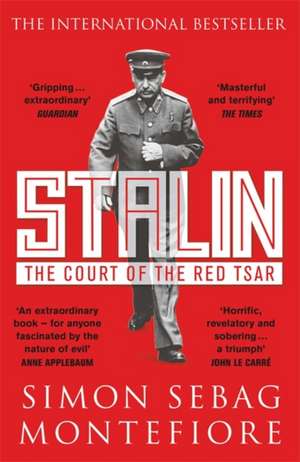
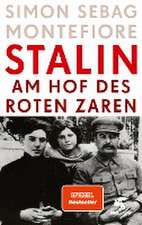
Stalin: The Court of the Red Tsar
Autor Simon Sebag Montefioreen Limba Engleză Paperback – 2 sep 2021
În această ediție a volumului Stalin, subtitulată „The Court of the Red Tsar”, apreciem rigoarea cu care Simon Sebag Montefiore reconstruiește universul secret al puterii de la Kremlin. Față de lucrările anterioare care se concentrau strict pe deciziile politice, această versiune pune accent pe documentarea amănunțită a vieții de familie, a privilegiilor și a trădărilor din cercul restrâns al dictatorului. Găsim în cele peste 700 de pagini o analiză care nu se rezumă la biografia unui singur om, ci radiografiază mecanismele terorii prin prisma celor care i-au fost apropiați. Comparabil cu Stalin: Volume I: Paradoxes of Power, 1878-1928 de Stephen Kotkin în rigurozitatea cercetării, dar actualizat pentru o înțelegere mai umană și mai intimă a personajului, volumul lui Montefiore reușește să evite jargonul comunist arid. Dacă Stephen Kotkin se concentrează pe structurile geopolitice și ascensiunea la putere, Montefiore alege să exploreze „curtea” țarului roșu, oferind o perspectivă narativă care se citește aproape ca un roman polițist istoric. Această lucrare ocupă un loc central în opera autorului, făcând trecerea firească de la studiul formării dictatorului din Young Stalin către marile narațiuni dinastice precum The Romanovs: 1613-1918. Stilul narativ este alert, susținut de cele 24 de ilustrații și hărți care ajută la contextualizarea geografică a evenimentelor. Dincolo de cifrele epurărilor, autorul ne prezintă un Stalin complex — deopotrivă intelectual marxist și lider brutal — a cărui influență a fost modelată de o personalitate profund defectuoasă.
Preț: 86.14 lei
Preț vechi: 111.73 lei
-23%
Carte disponibilă
Livrare economică 07-21 noiembrie
Livrare express 24-30 octombrie pentru 63.49 lei
Specificații
ISBN-10: 1474614817
Pagini: 752
Ilustrații: 24 illustrations, 2 maps
Dimensiuni: 128 x 196 x 44 mm
Greutate: 0.6 kg
Editura: Orion Publishing Group
Colecția W&N
Locul publicării:London, United Kingdom
V-ar putea interesa
-
 The Grocer's WivesGreenshields, IsobelPreț: 81.36 lei
 -
 Vivre en temps de guerreHenri BacquelainePreț: 100.36 lei
 -
 The WorldSimon Sebag MontefiorePreț: 330.28 lei
 -
 The Illegitimate Adventures of a Theatrical EccentricVirginia RussellPreț: 152.04 lei
 -
 Yishar KoachSusan SloanPreț: 119.59 lei
 -
 Young StalinSimon Sebag MontefiorePreț: 81.82 lei
 -
 Dead EndRon SharrowPreț: 135.23 lei
 -
 Mormon Is Not AmericanA. a. BastianPreț: 51.14 lei
 -
 Preț: 184.06 lei
 -
 Proudhon Et Ses Uvres CompletesEugene PelletanPreț: 60.91 lei
 -
 The Third Commandment and the Return of the AnusimStephen LeonPreț: 94.09 lei
 -
 Everything Is NormalSergey GrechishkinPreț: 93.18 lei
 -
 Die WeltSimon Sebag MontefiorePreț: 452.47 lei
 -
 StalinSimon Sebag MontefiorePreț: 194.62 lei
 -
 Changing TimesUlla FelsPreț: 126.34 lei
 -
 The Beach of NodMilyanna AmorinaPreț: 154.86 lei
De ce să citești această carte
Această carte este esențială pentru oricine dorește să înțeleagă nu doar istoria URSS, ci și psihologia puterii absolute. Cititorul câștigă acces la detalii inedite din arhivele sovietice, prezentate într-un stil accesibil și captivant. Este recomandată celor pasionați de biografiile politice și istoria secolului XX, oferind o perspectivă rară asupra modului în care viața privată a unui dictator influențează destinele a milioane de oameni.
Despre autor
Simon Sebag Montefiore este un istoric britanic de renume, prezentator de televiziune și autor de succes, specializat în istoria Rusiei și a Orientului Mijlociu. Printre cele mai cunoscute lucrări ale sale se numără Jerusalem și The World, volume care demonstrează capacitatea sa de a sintetiza perioade vaste de timp într-o formă narativă coerentă. Opera sa, premiată internațional, se distinge prin combinarea cercetării academice meticuloase cu un stil literar vibrant, reușind să aducă istoria în atenția publicului larg fără a sacrifica acuratețea faptelor.
Descriere
Longlisted for the Samuel Johnson Prize
This thrilling biography of Stalin and his entourage during the terrifying decades of his supreme power transforms our understanding of Stalin as Soviet dictator, Marxist leader and Russian tsar.
Based on groundbreaking research, Simon Sebag Montefiore reveals in captivating detail the fear and betrayal, privilege and debauchery, family life and murderous cruelty of this secret world. Written with extraordinary narrative verve, this magnificent feat of scholarly research has become a classic of modern history writing. Showing how Stalin's triumphs and crimes were the product of his fanatical Marxism and his gifted but flawed character, this is an intimate portrait of a man as complicated and human as he was brutal and chilling.
Recenzii
Horrific, revelatory and sobering ... triumph of research and should be required reading in Russia. Book of the Year
This grim masterpiece, shot through with lashes of black humour ... The personal details are riveting
Have you read Stalin: The Court of the Red Tsar? It's scarier than a Stephen King novel!
Fascinating ... [Montefiore] concentrates, as any good historian should, on pushing forward the boundaries of our knowledge of the subject ... [He] provides rich detail of daily life and family relationships in a world of human values turned inside out ... scrupulously fair in the way he describes Stalin's qualities - including his ability to charm, his uncanny grasp of geopolitical issues, his brilliant handling of foreign statesmen and his genuine passion for literature
Masterful and terrifying account of Stalin ... seldom has the picture been put in finer focus than by Sebag Montefiore. It is partly through his diligent interviews with the children of survivors and his admirable combination of history and gossip that one sees the awful banality, the brutal crudity of the men who carelessly sent so many millions to their senseless deaths
This magnificent portrait ... Montefiore has mined the rich veins of recent Russian writing on the Stalin age and of newly opened archives to give us an intimate history ... The stifling, contiguous life of the Soviet elite in and around the Kremlin is wonderfully conveyed, in some of the most striking and literary passages in the book ... A wonderfully rich and vibrant portrait of the Stalinist elite who lived in the shadow of a remarkable and dangerous colossus
Read it or face social Siberia ... a cross-over success. Academically and intellectually rigorous, it's also a riveting read ... it takes a great writer to make it seem fresh. And Sebag Montefiore certainly does that ... his greatest achievement has been to "humanise" Stalin. Uncle Joe was a mass murderer and a paranoid sociopath. But he was also charming, friendly and flirtatious
Grimly brilliant
Excellent ... This book is like a vast Russian novel full of characters, colour, terror, passion and treachery ... love affairs, marriages, divorces, imprisonments and killings
Montefiore has managed to get inside the mind of the 20th century's worst mass murderer. What he has found there will affect your view of human nature ... a thoughtful book of first-class scholarship as well as a transfixing narrative ... vividly recreated by Montefiore's caustically witty prose
Its extraordinary revelation of the evil - the complete amorality - at the heart of the dictator's court will change the way historians approach the great historical questions about the Stalinist regime
Montefiore drives his story forward with breathless enthusiasm ... in a work of great importance. Scholars will read it for the valuable new evidence it assembles. Others will enjoy it as a fascinating page-turner and an everyday saga of extraordinary Kremlin folk
Gripping and timely ... [Montefiore] had the bright idea of examining the letters, telegrams and diaries of [Stalin's] intimate associates. As a result, this is a book based on extraordinary primary research ... one of the few recent books on Stalinism that will be read in years to come. The devil is in the detail
An extraordinary book... he has managed to persuade a whole generation of little old ladies and elderly men - the wives, granddaughters, servants, nieces and nephews of Stalin's henchmen - to give him a series of extraordinary interviews and, in some cases, lend him their hand-written memoirs... For anyone fascinated by the nature of evil - and by the effects of absolute power on human relationships - this book will provide new insights on every page
Montefiore's STALIN, I should imagine, will be the standard work on this twentieth-century monster for years to come
The most revealing account of the inner circles of tyranny since Albert Speer's inside story of Hitler's bunker. Book of the Year
Enlivened by sharp pen portraits and grisly anecdotes, Montefiore's study ... was admired for its elegant prose as well as its grotesque cavalcade of monsters
Brings alive that many-sided monster ... the first book that has given me grounds for thinking it might be possible to understand how Stalin got away with his enormities
Montefiore's masterful study of Stalin and his entourage provides the best personal portrait to date of the man and his group
Enormously readable and even grimly amusing ... the details of the cruelty and depravity ... are incredible
I'm currently reading Simon Sebag-Montefiore's excellent biography of the Soviet monster [Stalin] 'the Court of the Red Czar' which I heartily recommend
Notă biografică
Extras
The Georgian and the Schoolgirl
Nadya and Stalin had been married for fourteen years but it extended deeper and longer than that, so steeped was their marriage in Bolshevism. They had shared the formative experiences of the underground life and intimacy with Lenin during the Revolution, then the Civil War. Stalin had known her family for nearly thirty years and he had first met her in 1904 when she was three. He was then twenty-five and he had been a Marxist for six years.
Joseph Vissarionovich Djugashvili was not born on 21 December 1879, Stalin's official birthday. "Soso" was actually born in a tiny shack (that still exists) to Vissarion, or "Beso," and his wife Ekaterina, "Keke," née Geladze, over a year earlier on 6 December 1878. They lived in Gori, a small town beside the Kura River in the romantic, mountainous and defiantly un-Russian province of Georgia, a small country thousands of miles from the Tsar's capital: it was closer to Baghdad than St. Petersburg.* Westerners often do not realize how foreign Georgia was: an independent kingdom for millennia with its own ancient language, traditions, cuisine, literature, it was only consumed by Russia in gulps between 1801 and 1878. With its sunny climate, clannish blood feuds, songs and vineyards, it resembles Sicily more than Siberia.
Soso's father was a violent, drunken semi-itinerant cobbler who savagely beat both Soso and Keke. She in turn, as the child later recalled, "thrashed him mercilessly." Soso once threw a dagger at his father. Stalin reminisced how Beso and Father Charkviani, the local priest, indulged in drinking bouts together to the fury of his mother: "Father, don't make my husband a drunk, it'll destroy my family." Keke threw out Beso. Stalin was proud of her "strong willpower." When Beso later forcibly took Soso to work as a cobbling apprentice in Tiflis, Keke's priests helped get him back.
Stalin's mother took in washing for local merchants. She was pious and became close to the priests who protected her. But she was also earthy and spicy: she may have made the sort of compromises that are tempting for a penniless single mother, becoming the mistress of her employers. This inspired the legends that often embroider the paternity of famous men. It is possible that Stalin was the child of his godfather, an affluent innkeeper, officer and amateur wrestler named Koba Egnatashvili. Afterwards, Stalin protected Egnatashvili's two sons, who remained friends until his death and reminisced in old age about Egnatashvili's wrestling prowess. Nonetheless, one sometimes has to admit that great men are the children of their own fathers. Stalin was said to resemble Beso uncannily. Yet he himself once asserted that his father was a priest.
Stalin was born with the second and third toes of his left foot joined. He suffered a pock-marked face from an attack of smallpox and later damaged his left arm, possibly in a carriage accident. He grew up into a sallow, stocky, surly youth with speckled honey-coloured eyes and thick black hair-a kinto, Georgian street urchin. He was exceptionally intelligent with an ambitious mother who wanted him to be a priest, perhaps like his real father. Stalin later boasted that he learned to read at five by listening to Father Charkviani teaching the alphabet. The five-year-old then helped Charkviani's thirteen-year-old daughter with her reading.
In 1888, he entered the Gori Church School and then, triumphantly, in 1894, won a "five rouble scholarship" to the Tiflis Seminary in the Georgian capital. As Stalin later told a confidant, "My father found out that along with the scholarship, I also earned money (five roubles a month) as a choirboy . . . and once I went out and saw him standing there: " 'Young man, sir,' said Beso, 'you've forgotten your father . . . Give me at least three roubles, don't be as mean as your mother!'
" 'Don't shout!' replied Soso. 'If you don't leave immediately, I'll call the watchman!' " Beso slunk away.* He apparently died of cirrhosis of the liver in 1909.
Stalin sometimes sent money to help his mother but henceforth kept his distance from Keke whose dry wit and rough discipline resembled his own. There has been too much cod-psychology about Stalin's childhood but this much is certain: raised in a poor priest-ridden household, he was damaged by violence, insecurity and suspicion but inspired by the local traditions of religious dogmatism, blood-feuding and romantic brigandry. "Stalin did not like to speak about his parents and childhood" but it is meaningless to over-analyse his psychology. He was emotionally stunted and lacked empathy yet his antennae were supersensitive. He was abnormal but Stalin himself understood that politicians are rarely normal: History, he wrote later, is full of "abnormal people."
The seminary provided his only formal education. This boarding school's catechismic teaching and "Jesuitical methods" of "surveillance, spying, invasion of the inner life, the violation of people's feelings" repelled, but impressed, Soso so acutely that he spent the rest of his life refining their style and methods. It stimulated this autodidact's passion for reading but he became an atheist in the first year. "I got some friends," he said, "and a bitter debate started between the believers and us!" He soon embraced Marxism.
In 1899, he was expelled from the seminary, joined the Russian Social Democratic Workers' Party and became a professional revolutionary, adopting the nom de revolution Koba, inspired by the hero of a novel, The Parricide, by Alexander Kazbegi, a dashing, vindictive Caucasian outlaw. He combined the "science" of Marxism with his soaring imagination: he wrote romantic poetry, published in Georgian, before working as a weatherman at the Tiflis Meteorological Institute, the only job he held before becoming one of the rulers of Russia in 1917.
"Koba" was convinced by the universal panacea of Marxism, "a philosophical system" that suited the obsessive totality of his character. The class struggle also matched his own melodramatic pugnacity. The paranoid secrecy of the intolerant and idiosyncratic Bolshevik culture dovetailed with Koba's own self-contained confidence and talent for intrigue. Koba plunged into the underworld of revolutionary politics that was a seething, stimulating mixture of conspiratorial intrigue, ideological nitpicking, scholarly education, factional games, love affairs with other revolutionaries, police infiltration and organizational chaos. These revolutionaries hailed from every background-Russians, Armenians, Georgians and Jews, workers, noblemen, intellectuals and daredevils-and organized strikes, printing presses, meetings and heists. United in the obsessional study of Marxist literature, there was always a division between the educated bourgeois émigrés, like Lenin himself, and the rough men of action in Russia itself. The underground life, always itinerant and dangerous, was the formative experience not only of Stalin but of all his comrades. This explains much that happens later.
In 1902, Koba won the spurs of his first arrest and Siberian exile, the first of seven such exiles from which he escaped six times. These exiles were far from Stalin's brutal concentration camps: the Tsars were inept policemen. They were almost reading holidays in distant Siberian villages with one part-time gendarme on duty, during which revolutionaries got to know (and hate) each other, corresponded with their comrades in Petersburg or Vienna, discussed abstruse questions of dialectical materialism, and had affairs with local girls. When the call of freedom or revolution became urgent, they escaped, yomping across the taiga to the nearest train. In exile, Koba's teeth, a lifelong source of pain, began to deteriorate.
Koba avidly supported Vladimir Lenin and his seminal work, What Is to Be Done? This domineering political genius combined the Machiavellian practicality of seizing power with mastery of Marxist ideology. Exploiting the schism that would lead to the creation of his own Bolshevik Party, Lenin's message was that a supreme Party of professional revolutionaries could seize power for the workers and then rule in their name in a "dictatorship of the proletariat" until this was no longer necessary because socialism had been achieved. Lenin's vision of the Party as "the advance detachment" of the "army of proletarians . . . a fighting group of leaders" set the militarist tone of Bolshevism.
In 1904, on Koba's return to Tiflis, he met his future father-in-law Sergei Alliluyev, twelve years his senior, a skilled Russian electrical artisan married to Olga Fedorenko, a strong-willed Georgian-German-Gypsy beauty with a taste for love affairs with revolutionaries, Poles, Hungarians, even Turks. It was whispered that Olga had an affair with the young Stalin, who fathered his future wife, Nadya. This is false since Nadezhda was already three when her parents first met Koba, but his affair with Olga is entirely credible and he himself may have hinted at it. Olga, who, according to her granddaughter Svetlana, had a "weakness for southern men," saying "Russian men are boors," always had a "soft spot" for Stalin. Her marriage was difficult. Family legend has Nadya's elder brother Pavel seeing his mother making up to Koba. Such short liaisons were everyday occurrences among revolutionaries.
Long before they fell in love, Stalin and Nadya were part of the Bolshevik family who passed through the Alliluyev household: Kalinin and Yenukidze among others at that dinner in 1932. There was another special link: soon afterwards, Koba met the Alliluyevs in Baku, and saved Nadya from drowning in the Caspian Sea, a romantic bond if ever there was one.
Koba meanwhile married another sprig of a Bolshevik family. Ekaterina, "Kato," a placid, darkly pretty Georgian daughter of a cultured family, was the sister of Alexander Svanidze, also a Bolshevik graduate of the Tiflis seminary who joined Stalin's Kremlin entourage. Living in a hut near the Baku oilfields, Kato gave him a son, Yakov. But Koba's appearances at home were sporadic and unpredictable.
During the 1905 Revolution, in which Leon Trotsky, a Jewish journalist, bestrode the Petersburg Soviet, Koba claimed he was organizing peasant revolts in the Kartli region of Georgia. After the Tsarist backlash, he travelled to a Bolshevik conference in Tammerfors, Finland-his first meeting with his hero, Lenin, "that mountain eagle." The next year, Koba travelled to the Congress in Stockholm. On his return, he lived the life of a Caucasian brigand, raising Party funds in bank robberies or "expropriations": he boasted in old age of these "heists . . . our friends grabbed 250,000 roubles in Yerevan Square!"
After visiting London for a Congress, Koba's beloved, half-ignored Kato died "in his arms" in Tiflis of tuberculosis on 25 November 1907. Koba was heartbroken. When the little procession reached the cemetery, Koba pressed a friend's hand and said, "This creature softened my heart of stone. She died and with her died my last warm feelings for people." He pressed his heart: "It's desolate here inside." Yet he left their son Yakov to be brought up by Kato's family. After hiding in the Alliluyevs' Petersburg apartment, he was recaptured and returned to his place of banishment, Solvychegodsk. It was in this remote one-horse town in January 1910 that Koba moved into the house of a young widow named Maria Kuzakova by whom he fathered a son.* Soon afterwards, he was involved in a love affair with a schoolgirl of seventeen named Pelageya Onufrieva. When she went back to school, he wrote: "Let me kiss you now. I am not simply sending a kiss but am KISSSSSING you passionately (it's not worth kissing otherwise)." The locals in the north Russified "Iosef" to "Osip" and his letters to Pelageya were often signed by her revealing nickname for him: "Oddball Osip."
After yet another escape, Koba returned to Petersburg in 1912, sharing digs with a ponderous Bolshevik who was to be the comrade most closely associated with him: Vyacheslav Scriabin, only twenty-two, had just followed the Bolshevik custom of assuming a macho nom de revolution and called himself that "industrial name" Molotov-"the hammer." Koba had also assumed an "industrial" alias: he first signed an article "Stalin" in 1913. It was no coincidence that "Stalin" sounds like "Lenin." He may have been using it earlier and not just for its metallic grit. Perhaps he borrowed the name from the "buxom pretty" Bolshevik named Ludmilla Stal with whom he had had an affair.
This "wonderful Georgian," as Lenin called him, was co-opted by the Party's Central Committee at the end of the Prague conference of 1912. In November, Koba Stalin travelled from Vienna to Cracow to meet Lenin with whom he stayed: the leader supervised his keen disciple in the writing of an article expressing Bolshevik policy on the sensitive nationality question, henceforth Stalin's expertise. "Marxism and the National Question," arguing for holding together the Russian Empire, won him ideological kudos and Lenin's trust.
"Did you write all of it?" asked Lenin (according to Stalin).
"Yes . . . Did I make mistakes?"
"No, on the contrary, splendid!" This was his last trip abroad until the Teheran Conference in 1943.
In February 1913, Stalin was rearrested and given a suspiciously light exile: was he an agent of the Tsar's secret police, the Okhrana? The historical sensationalism of Stalin's duplicity shows a naïve misunderstanding of underground life: the revolutionaries were riddled with Okhrana spies but many were double or triple agents.* Koba was willing to betray colleagues who opposed him though, as the Okhrana admitted in their reports, he remained a fanatical Marxist-and that is what mattered.
Stalin's final exile began in 1913 in the distant cold north-east of Siberia, where he was nicknamed "Pock-marked Joe" by the local peasants. Fearing more escapes, the exile was moved to Kureika, a desolate village in Turukhansk, north of the Arctic Circle where his fishing prowess convinced locals of magical powers and he took another mistress. Stalin wrote pitiful letters to Sergei and Olga Alliluyev: "Nature in this cursed region is shamefully poor" and he begged them to send him a postcard: "I'm crazy with longing for nature scenes if only on paper." Yet it was also, strangely, a happy time, perhaps the happiest of his life for he reminisced about his exploits there until his death, particularly about the shooting expedition when he skied into the taiga, bagged many partridges and then almost froze to death on the way back.
The military blunders and food shortages of the Great War inexorably destroyed the monarchy which, to the surprise of the Bolsheviks, collapsed suddenly in February 1917, replaced by a Provisional Government. On 12 March, Stalin reached the capital and visited the Alliluyevs: once again, Nadya, a striking brunette, sixteen, her sister Anna and brother Fyodor, questioned this returning hero about his adventures. When they accompanied him by tram towards the offices of the newspaper Pravda, he called out, "Be sure to set aside a room in the new apartment for me. Don't forget." He found Molotov editing Pravda, a job he immediately commandeered for himself. While Molotov had taken a radical anti-government line, Stalin and Lev Kamenev, né Rosenfeld, one of Lenin's closest comrades, were more conciliatory. Lenin, who arrived on 4 April, overruled Stalin's vacillations.
In a rare apology to Molotov, Stalin conceded, "You were closer to Lenin . . ." When Lenin needed to escape to Finland to avoid arrest, Stalin hid him chez Alliluyev, shaved off his beard and escorted him to safety.
From the Hardcover edition.