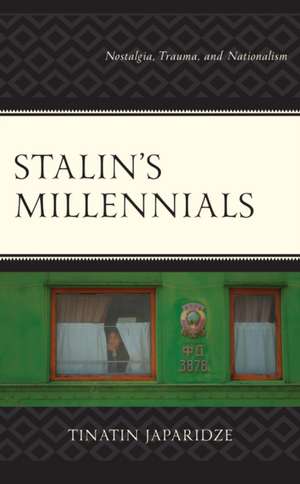
Stalin's Millennials: Nostalgia, Trauma, and Nationalism
Autor Tinatin Japaridzeen Limba Engleză Hardback – 3 mar 2022
Preț: 549.82 lei
Preț vechi: 815.53 lei
-33%
Puncte Express: 825
Carte tipărită la comandă
Livrare economică 16-30 noiembrie
Livrare prin curier în România Termenul estimat este afișat lângă disponibilitate.
Transport gratuit pentru acest produs Plată online sau ramburs, în funcție de opțiunile comenzii.
Retur gratuit în 14 zile Comandă securizată și suport în română.
Specificații
ISBN-13: 9781793641861
ISBN-10: 1793641862
Pagini: 180
Dimensiuni: 152 x 232 x 16 mm
Greutate: 0.43 kg
Editura: Bloomsbury Publishing
Colecția Lexington Books
Locul publicării:New York, United States
ISBN-10: 1793641862
Pagini: 180
Dimensiuni: 152 x 232 x 16 mm
Greutate: 0.43 kg
Editura: Bloomsbury Publishing
Colecția Lexington Books
Locul publicării:New York, United States
Cuprins
Acknowledgments.. ...............................
Introduction: A Trip to Gori.................................
Chapter I. Stalin: Nostalgia for the Past, Present & Future............
Chapter II. Georgian Man of Borderlands...................
Chapter III. Soviet Red Tsar.................................
Chapter IV. Tale of the Third Stalin .....................................
Chapter V. Cult of Personality ........................................
Chapter VI. Trauma and Nationalism........................................
Chapter VII. Nostalgia ...........................................
Conclusion: Back to Gori...........................
Bibliography..................................
Index..................................
About the Author.............................
Introduction: A Trip to Gori.................................
Chapter I. Stalin: Nostalgia for the Past, Present & Future............
Chapter II. Georgian Man of Borderlands...................
Chapter III. Soviet Red Tsar.................................
Chapter IV. Tale of the Third Stalin .....................................
Chapter V. Cult of Personality ........................................
Chapter VI. Trauma and Nationalism........................................
Chapter VII. Nostalgia ...........................................
Conclusion: Back to Gori...........................
Bibliography..................................
Index..................................
About the Author.............................
Recenzii
Given the contemporary salience and political significance of the topic in both Georgia and Russia, this [book] seems a worthwhile direction for further research.
Japaridze has written the next chapter in Stalinist history. It has been almost seventy years since Stalin's death, and yet he continues to cast a long shadow on post-Soviet Russia and Georgia. The continued nostalgia, fear, and fascination surrounding Stalin's legacy have become watermarks of modern political and cultural identity, showing how the past continues to palpably shape the present.
Fascinating, revisionist, and original, this is a shrewd analysis of the different identities of Stalin, examining how, in Georgia, Russia, and the West, he remains a titanic but brooding presence in our political world seventy years after his death.
Superbly written and highly engaging. In the middle of acrimonious debates in the West about the dangers of the rehabilitation of Stalin and Soviet nostalgia, Japaridze offers a fresh and courageous look at the 'Third Stalin,' expertly revealing how the millennial generation grapples with the intense ethical dilemmas, contradictory emotions, and multiple historical lessons that have conditioned the formation of their own post-Soviet identities, sense of national belongings and global experiences.
Elegantly written and intensely personal. Japaridze navigates the nuances and complexities of Georgian and Russian nostalgia, memory, and identity. Far from a typical assessment of Stalin, this book instead offers us a glimpse into current Russian and Georgian societies via their simultaneous adulation and demonization of the former dictator.
As a Georgian herself, Tinatin Japaridze presents an experimental, fascinating, and impressionistic view of Stalin's legacy in Soviet and Post-Soviet Georgia. In contrast to the traditional academic studies of Stalin's biography and Stalinism in the Soviet Union, Japaridze offers her own interpretation of Stalin's legacy, based on her own impressions after her visits to Stalin's birthplace in Georgia. Concentrating on three topics-nostalgia, trauma and nationalism, Japaridze distinctly explains Stalin's legacy in post-Soviet Georgia, which can help us understand the recent developments in post-Soviet space, especially the rise of Stalin's nostalgia in Putin's Russia today.
In her distinctly personal yet historically precise journey, Tinatin Japaridze brings to life the complex personality and cult of 'personality, trauma, nationalism, and nostalgia' that was the multi-faceted history and legacy of Josef Stalin. Written with the backdrop of her own Georgian family that lived through and suffered during Stalin's reign, Japaridze's deft handling of history and competing global, Soviet, Russian, and domestic Georgian narratives of the enigma that was Stalin and his different legacies is remarkably well-done. For one who himself traveled during Georgia's fateful summer of 1989 to Stalin's birthplace in Gori where Japaridze's meticulously researched story begins and ends, this beautifully written book and personal journey is remarkably authentic to me. It is a must read for those interested in this specific period and theme, as well as for those curious, expansive readers simply desirous of a fascinating, colorfully written historical and personal experience.
From Khrushchev's Secret Speech to the Georgian Dream party, Japaridze weaves together history, ethnography, and autobiography to build a nuanced account of how present-day Georgia and Russia confront the legacies of Stalin. The author's unique perspective as a Georgian citizen who was raised in Moscow then emigrated to the U.S. offers a singular voice-one which she uses to cover a lot of territory. This book's themes include nostalgia in post-Soviet politics; the role of strong leaders-Stalin, Gamsakhurdia, and Saakashvili-in shaping national identity, the relationship between Georgia and Russia, and how historical trauma influences post-Soviet generations. This book's use of Stalin as a lens to analyze post-Soviet developments yields illuminating insights for anyone who wants to deepen their understanding of both Russia and Georgia.
Tinatin Japaridze's book, Stalin's Millennials: Nostalgia, Trauma, and Nationalism, is a personal tour de force. Although it is her first work, it already places her squarely in the courageous intellectual and social tradition of Hannah Arendt whose groundbreaking piece, The Human Condition, is as powerfully emotive as ever. But, Japaridze offers a delightful twist, a personal touch. Her book is not just an interpretation of Stalin as viewed in history and by the present generations, but it is a down-to-earth psychological deep dive into the yearning and emotional needs of Georgians and Russians, as well as people everywhere, ironically and by design, including herself. The brilliance of Japaridze is her discovery of another Stalin, not the Georgian or Russian Stalin, but a Third Stalin, one not bound by geography, time or even facts. The Third Stalin is a myth created to make individual Russians and Georgians feel proud through his exploits, be it victory in the Great Patriotic War (WWII) or viscerally through the acclaimed international status accorded Georgia, a small country, by his mastery and ruling over Russia and the other nations (ironically including Georgia) of an empire, the USSR. Pride ironically also has the virtue of soothing and justifying the enduring pain of the historic injustices for the survivors and the millennials, of course only for the living, as those no longer with us have no voice, they cannot be heard. Japaridze's natural genius is that she demonstrates thorough storytelling, as well as traditional analysis, that we all want to feel good about ourselves, with the consequence that myth creation becomes our opium and nostalgia our fantasy. Her book is a must read; and a sequel in keeping with the Arendt tradition is now our demand.
Vladimir Ulyanov's body lies disintegrating discreetly in the Mausoleum, but the various avatars of Joseph Stalin haunt both his Georgian birthplace and the triumphant Red Square parades celebrating 'his victory.' In one, the self-appointed dialectician is a local boy who showed the Russians how and what for, while in the other Georgian is the heir of the Tsars and political ancestor to Vladimir Putin. Tinatin Japaridze is well-qualified to consider these prismatic reflections of Stalin's posthumous reputation in the former Soviet Union. Born in Georgia, reared in Moscow, she saw her father spend his post-Soviet days back in Tbilisi, where her mother nursed the memory of a purged grandparent, so she is well-aware of the many shades of grey in Stalin's shadow. But she also shows how the black-and-white caricatures of detractors and defenders alike obscure Koba's genuine history, distorting his retrospective image into a post-revolutionary Rorschach test, to evoke their own political psychoses and to advance their contemporary political agendas.
Part memoir, part socio-political study, part reportage, Stalin's Millennials is wholly original. Through the lens of Stalin and his continued relevance for today's world, Japaridze provides a unique perspective on the ongoing memory wars, an engaging and well-informed primer on post-Soviet politics more broadly, and an intimate portrait of the Republic of Georgia, the author's homeland, as it continues to grapple with the history of its most infamous native son.
Japaridze has written the next chapter in Stalinist history. It has been almost seventy years since Stalin's death, and yet he continues to cast a long shadow on post-Soviet Russia and Georgia. The continued nostalgia, fear, and fascination surrounding Stalin's legacy have become watermarks of modern political and cultural identity, showing how the past continues to palpably shape the present.
Fascinating, revisionist, and original, this is a shrewd analysis of the different identities of Stalin, examining how, in Georgia, Russia, and the West, he remains a titanic but brooding presence in our political world seventy years after his death.
Superbly written and highly engaging. In the middle of acrimonious debates in the West about the dangers of the rehabilitation of Stalin and Soviet nostalgia, Japaridze offers a fresh and courageous look at the 'Third Stalin,' expertly revealing how the millennial generation grapples with the intense ethical dilemmas, contradictory emotions, and multiple historical lessons that have conditioned the formation of their own post-Soviet identities, sense of national belongings and global experiences.
Elegantly written and intensely personal. Japaridze navigates the nuances and complexities of Georgian and Russian nostalgia, memory, and identity. Far from a typical assessment of Stalin, this book instead offers us a glimpse into current Russian and Georgian societies via their simultaneous adulation and demonization of the former dictator.
As a Georgian herself, Tinatin Japaridze presents an experimental, fascinating, and impressionistic view of Stalin's legacy in Soviet and Post-Soviet Georgia. In contrast to the traditional academic studies of Stalin's biography and Stalinism in the Soviet Union, Japaridze offers her own interpretation of Stalin's legacy, based on her own impressions after her visits to Stalin's birthplace in Georgia. Concentrating on three topics-nostalgia, trauma and nationalism, Japaridze distinctly explains Stalin's legacy in post-Soviet Georgia, which can help us understand the recent developments in post-Soviet space, especially the rise of Stalin's nostalgia in Putin's Russia today.
In her distinctly personal yet historically precise journey, Tinatin Japaridze brings to life the complex personality and cult of 'personality, trauma, nationalism, and nostalgia' that was the multi-faceted history and legacy of Josef Stalin. Written with the backdrop of her own Georgian family that lived through and suffered during Stalin's reign, Japaridze's deft handling of history and competing global, Soviet, Russian, and domestic Georgian narratives of the enigma that was Stalin and his different legacies is remarkably well-done. For one who himself traveled during Georgia's fateful summer of 1989 to Stalin's birthplace in Gori where Japaridze's meticulously researched story begins and ends, this beautifully written book and personal journey is remarkably authentic to me. It is a must read for those interested in this specific period and theme, as well as for those curious, expansive readers simply desirous of a fascinating, colorfully written historical and personal experience.
From Khrushchev's Secret Speech to the Georgian Dream party, Japaridze weaves together history, ethnography, and autobiography to build a nuanced account of how present-day Georgia and Russia confront the legacies of Stalin. The author's unique perspective as a Georgian citizen who was raised in Moscow then emigrated to the U.S. offers a singular voice-one which she uses to cover a lot of territory. This book's themes include nostalgia in post-Soviet politics; the role of strong leaders-Stalin, Gamsakhurdia, and Saakashvili-in shaping national identity, the relationship between Georgia and Russia, and how historical trauma influences post-Soviet generations. This book's use of Stalin as a lens to analyze post-Soviet developments yields illuminating insights for anyone who wants to deepen their understanding of both Russia and Georgia.
Tinatin Japaridze's book, Stalin's Millennials: Nostalgia, Trauma, and Nationalism, is a personal tour de force. Although it is her first work, it already places her squarely in the courageous intellectual and social tradition of Hannah Arendt whose groundbreaking piece, The Human Condition, is as powerfully emotive as ever. But, Japaridze offers a delightful twist, a personal touch. Her book is not just an interpretation of Stalin as viewed in history and by the present generations, but it is a down-to-earth psychological deep dive into the yearning and emotional needs of Georgians and Russians, as well as people everywhere, ironically and by design, including herself. The brilliance of Japaridze is her discovery of another Stalin, not the Georgian or Russian Stalin, but a Third Stalin, one not bound by geography, time or even facts. The Third Stalin is a myth created to make individual Russians and Georgians feel proud through his exploits, be it victory in the Great Patriotic War (WWII) or viscerally through the acclaimed international status accorded Georgia, a small country, by his mastery and ruling over Russia and the other nations (ironically including Georgia) of an empire, the USSR. Pride ironically also has the virtue of soothing and justifying the enduring pain of the historic injustices for the survivors and the millennials, of course only for the living, as those no longer with us have no voice, they cannot be heard. Japaridze's natural genius is that she demonstrates thorough storytelling, as well as traditional analysis, that we all want to feel good about ourselves, with the consequence that myth creation becomes our opium and nostalgia our fantasy. Her book is a must read; and a sequel in keeping with the Arendt tradition is now our demand.
Vladimir Ulyanov's body lies disintegrating discreetly in the Mausoleum, but the various avatars of Joseph Stalin haunt both his Georgian birthplace and the triumphant Red Square parades celebrating 'his victory.' In one, the self-appointed dialectician is a local boy who showed the Russians how and what for, while in the other Georgian is the heir of the Tsars and political ancestor to Vladimir Putin. Tinatin Japaridze is well-qualified to consider these prismatic reflections of Stalin's posthumous reputation in the former Soviet Union. Born in Georgia, reared in Moscow, she saw her father spend his post-Soviet days back in Tbilisi, where her mother nursed the memory of a purged grandparent, so she is well-aware of the many shades of grey in Stalin's shadow. But she also shows how the black-and-white caricatures of detractors and defenders alike obscure Koba's genuine history, distorting his retrospective image into a post-revolutionary Rorschach test, to evoke their own political psychoses and to advance their contemporary political agendas.
Part memoir, part socio-political study, part reportage, Stalin's Millennials is wholly original. Through the lens of Stalin and his continued relevance for today's world, Japaridze provides a unique perspective on the ongoing memory wars, an engaging and well-informed primer on post-Soviet politics more broadly, and an intimate portrait of the Republic of Georgia, the author's homeland, as it continues to grapple with the history of its most infamous native son.