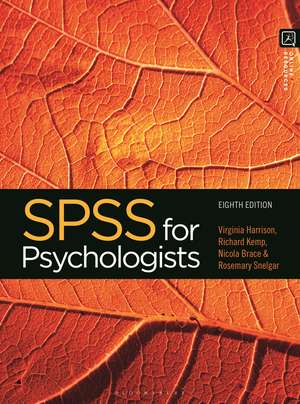
SPSS for Psychologists
Autor Virginia Harrison, Richard Kempen Limba Engleză Paperback – 19 feb 2026
Further features of this new edition include a dedicated chapter on non-parametric tests, guidance on when to use each type of test, updated and additional activities, and helpful explanations of basic concepts such as normality, power and reproducibility.
This book is an unbeatable, must-have guide to SPSS that will allow psychology students at all levels to master this powerful software tool.
Accompanying online resources are available for this title, including exercises and data sets to help students follow along and practice the analyses in SPSS. These resources are designed to support teaching and learning when using this textbook and are available at no extra cost.
Preț: 276.39 lei
Preț vechi: 318.18 lei
-13%
Puncte Express: 415
Carte disponibilă
Livrare economică 23 octombrie-06 noiembrie
Livrare express 09-15 octombrie pentru 119.19 lei
Livrare prin curier în România Termenul estimat este afișat lângă disponibilitate.
Transport gratuit de la 400.00 lei Plată online sau ramburs, în funcție de opțiunile comenzii.
Retur gratuit în 14 zile Comandă securizată și suport în română.
Specificații
ISBN-13: 9781350465022
ISBN-10: 135046502X
Pagini: 544
Ilustrații: 526 illustrations
Dimensiuni: 194 x 260 x 26 mm
Greutate: 1.26 kg
Ediția:8. Auflage
Editura: Bloomsbury Publishing
Colecția Bloomsbury Academic
Locul publicării:London, United Kingdom
ISBN-10: 135046502X
Pagini: 544
Ilustrații: 526 illustrations
Dimensiuni: 194 x 260 x 26 mm
Greutate: 1.26 kg
Ediția:8. Auflage
Editura: Bloomsbury Publishing
Colecția Bloomsbury Academic
Locul publicării:London, United Kingdom
Cuprins
1. Introduction
2. Data entry in SPSS
3. Exploring, cleaning and graphing data in SPSS
4. Working with data and testing Normality
5. Tests of correlation and bivariate regression
6. T-tests
7. One-way analysis of variance
8. Non-parametric tests of difference
9. Tests for nominal data
10. Factorial analysis of variance
11. Multiple regression
12. Analysis of covariance and multivariate analysis of variance
13. Discriminant analysis and logistic regression
14. Factor analysis and reliability and dimensionality of scales
15. Using syntax and other useful features of SPSS
2. Data entry in SPSS
3. Exploring, cleaning and graphing data in SPSS
4. Working with data and testing Normality
5. Tests of correlation and bivariate regression
6. T-tests
7. One-way analysis of variance
8. Non-parametric tests of difference
9. Tests for nominal data
10. Factorial analysis of variance
11. Multiple regression
12. Analysis of covariance and multivariate analysis of variance
13. Discriminant analysis and logistic regression
14. Factor analysis and reliability and dimensionality of scales
15. Using syntax and other useful features of SPSS
Recenzii
I really appreciate the practical, step-by-step process of inputting an analysis into SPSS (namely, "which variable goes into which box?") and interpreting the output ("which table is actually most important in the 9 tables that SPSS has spat out to me? Which number do I need to look at here? What does this other number mean?"). I feel like no other textbook does that as well as 'SPSS for Psychologists'.
My own personal view is that textbooks that tie themselves to a very costly proprietary software that will not be available to students after leaving academia (such as SPSS) have an increasingly limited appeal. The sector is slowly but steadily moving to open-source software (R) that is used outside the academic world
The main strength is that it very clearly guides through the use of various elements of the SPSS program, and that it is easy to look up a particular test. It is good with the examples and data, including how to write up the results using APA after each section.
Excellent illustrations taking students through SPSS output. [.] I've always liked (for example) p244 and p249, and how when discussing epsilon values, the book notes that you could use one of three, but that you should not get too hung up on which one. This is the sort of thing I prefer. Explain where needed, gloss over unnecessary complications, to get the students through the challenges.
We do not recommend this at present but I do like that is has online tutorials and exercises/data sets this is very useful for students. I also like that at the end of each of the sections there is a summary. The data sets at the back of the book are helpful for reference and the glossary is useful too.
It explains concepts clearly and is structured well so students can easily find the information they need. Additionally, the order in which chapters are presented is logical. I also find the information covered here is suitable for multiple years of research methods students. If students purchase the book, they can use it over the course of their studies.
I have used this book before in my teachings, and it is a great book. However, it misses additional exercises with added datasets that they can be used for student assignments. Also there are no instructor resources that the instructor can use in class to follow the same routines and structure that they are used in the book. [more exercises and PowerPoint slides are being added to the website]
I'd really only consider this text if the amount of formulas/math was increased and I fully understand that the authors probably purposefully avoided including that material - and that makes complete sense. This is a great text; it just doesn't fully meet my very specific needs. [We have not changed this as the book is not designed to do this; Brysbaert Statistics for Psychologists would be a better alternative for this instructor]
My own personal view is that textbooks that tie themselves to a very costly proprietary software that will not be available to students after leaving academia (such as SPSS) have an increasingly limited appeal. The sector is slowly but steadily moving to open-source software (R) that is used outside the academic world
The main strength is that it very clearly guides through the use of various elements of the SPSS program, and that it is easy to look up a particular test. It is good with the examples and data, including how to write up the results using APA after each section.
Excellent illustrations taking students through SPSS output. [.] I've always liked (for example) p244 and p249, and how when discussing epsilon values, the book notes that you could use one of three, but that you should not get too hung up on which one. This is the sort of thing I prefer. Explain where needed, gloss over unnecessary complications, to get the students through the challenges.
We do not recommend this at present but I do like that is has online tutorials and exercises/data sets this is very useful for students. I also like that at the end of each of the sections there is a summary. The data sets at the back of the book are helpful for reference and the glossary is useful too.
It explains concepts clearly and is structured well so students can easily find the information they need. Additionally, the order in which chapters are presented is logical. I also find the information covered here is suitable for multiple years of research methods students. If students purchase the book, they can use it over the course of their studies.
I have used this book before in my teachings, and it is a great book. However, it misses additional exercises with added datasets that they can be used for student assignments. Also there are no instructor resources that the instructor can use in class to follow the same routines and structure that they are used in the book. [more exercises and PowerPoint slides are being added to the website]
I'd really only consider this text if the amount of formulas/math was increased and I fully understand that the authors probably purposefully avoided including that material - and that makes complete sense. This is a great text; it just doesn't fully meet my very specific needs. [We have not changed this as the book is not designed to do this; Brysbaert Statistics for Psychologists would be a better alternative for this instructor]