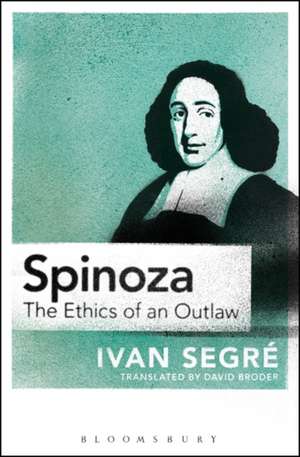
Spinoza: The Ethics of an Outlaw
Autor Ivan Segré Traducere de David Broderen Limba Engleză Paperback – 9 feb 2017
Through a close reading of Leo Strauss and several contemporary Jewish thinkers, such as Jean-Claude Milner and Benny Levy (Sartre's last secretary), Spinoza: the Ethics of an Outlaw aptly delineates the common cause of Spinoza's contemporary censors: an explicit hatred of reason and its emancipatory potential. Spinoza's radical heresy lies in his rejection of any and all blind adherence to Biblical Law, and in his plea for the freedom and autonomy of thought. Segré reclaims Spinoza as a faithful interpreter of the revolutionary potential contained within the Old Testament.
Preț: 193.99 lei
Preț vechi: 266.70 lei
-27%
Puncte Express: 291
Carte disponibilă
Livrare economică 17 noiembrie-01 decembrie
Livrare prin curier în România Termenul estimat este afișat lângă disponibilitate.
Transport gratuit de la 400.00 lei Plată online sau ramburs, în funcție de opțiunile comenzii.
Retur gratuit în 14 zile Comandă securizată și suport în română.
Specificații
ISBN-13: 9781350016613
ISBN-10: 1350016616
Pagini: 200
Dimensiuni: 128 x 196 x 12 mm
Greutate: 0.24 kg
Editura: Bloomsbury Publishing
Colecția Bloomsbury Academic
Locul publicării:London, United Kingdom
ISBN-10: 1350016616
Pagini: 200
Dimensiuni: 128 x 196 x 12 mm
Greutate: 0.24 kg
Editura: Bloomsbury Publishing
Colecția Bloomsbury Academic
Locul publicării:London, United Kingdom
V-ar putea interesa
-
 The Portable EmersonRalph Waldo EmersonPreț: 172.82 lei
 -
 -11%Preț: 362.12 lei407.14 lei
 -
 Leibniz: A Very Short IntroductionMaria Rosa Antognazza-19%Preț: 57.46 lei71.12 lei
 -
 Tragedy, Recognition, and the Death of God: Studies in Hegel and NietzscheRobert R. Williams-30%Preț: 836.41 lei1192.85 lei
 -
 After Herder: Philosophy of Language in the German TraditionMichael N. Forster-21%Preț: 379.07 lei477.16 lei
 -
 Oxford Studies in Early Modern Philosophy Volume VIDaniel Garber-30%Preț: 849.71 lei1214.65 lei
 -
 -10%Preț: 374.91 lei414.64 lei
 -
 The Evident Connexion: Hume on Personal IdentityGalen Strawson-13%Preț: 298.78 lei342.28 lei
 -
 Treatise on TolerationVoltaire-26%Preț: 57.82 lei78.42 lei
 -
 Preț: 80.65 lei
 -
 Life Lessons from HobbesHannah Dawson-10%Preț: 44.88 lei49.66 lei
 -
 -36%Preț: 50.15 lei77.76 lei
 -
 Deja Vu and the End of HistoryPaolo VirnoPreț: 131.17 lei
 -
 The Philosophy of MarxEtienne BalibarPreț: 112.71 lei
Cuprins
Translator's Note
Prologue
Part One: Election, Hatred, and The Philosopher: Spinoza and "Bourgeois" Theorists
Introduction
1. Discourse on Method
2. The Song of the Sign
3. Kingship
4. On Contradiction
Part Two: The Bible Spinoza
Introduction
1. The At Judaei Manifesto
2. A 'Christ' without the Passion
3. The Origin of the Law
4. True Otherness
5. The Masquerade
6. The Tree of Knowledge
Epilogue
Apologue: The Spectre's Manifesto
Notes
Index
Prologue
Part One: Election, Hatred, and The Philosopher: Spinoza and "Bourgeois" Theorists
Introduction
1. Discourse on Method
2. The Song of the Sign
3. Kingship
4. On Contradiction
Part Two: The Bible Spinoza
Introduction
1. The At Judaei Manifesto
2. A 'Christ' without the Passion
3. The Origin of the Law
4. True Otherness
5. The Masquerade
6. The Tree of Knowledge
Epilogue
Apologue: The Spectre's Manifesto
Notes
Index
Recenzii
[An] excellent and original engagement with Spinoza's thought . Segré accomplishes no small feat: he gives a coherent reading of Spinoza in light of Jewish exegetical tradition that does not come from a place of harsh judgment . but rather, from a place of love.
Ivan Segré's Spinoza: The Ethics of an Outlaw is a major and long overdue contribution to our understanding of Spinoza's complex and overdetermined relation not merely to Judaism, but to the great texts of the Jewish tradition as Spinoza understood it. Segré possesses the ability to follow Spinoza through the labyrinth of Maimonides' Guide and contextualize the citations and criticisms whose orientation has escaped most readers. Of particular interest is his demonstration that Christianity from Spinoza's perspective is as concerned with the disposition of the flesh as the Judaism it claimed to supersede: if circumcision is nothing, then so is the crucifixion. Segré's Spinoza neither celebrates (a) religion nor does he demand its suppression in favor of of a secularism that rests on a disavowed sacralization of state sovereignty. His god is the collective power by which the Jews were delivered from the House of Servitude. This is a powerful and original reading that opens new areas of research and offers conclusive proof of Spinoza's contemporaneity.
Ivan Segré's Spinoza: The Ethics of an Outlaw is a major and long overdue contribution to our understanding of Spinoza's complex and overdetermined relation not merely to Judaism, but to the great texts of the Jewish tradition as Spinoza understood it. Segré possesses the ability to follow Spinoza through the labyrinth of Maimonides' Guide and contextualize the citations and criticisms whose orientation has escaped most readers. Of particular interest is his demonstration that Christianity from Spinoza's perspective is as concerned with the disposition of the flesh as the Judaism it claimed to supersede: if circumcision is nothing, then so is the crucifixion. Segré's Spinoza neither celebrates (a) religion nor does he demand its suppression in favor of of a secularism that rests on a disavowed sacralization of state sovereignty. His god is the collective power by which the Jews were delivered from the House of Servitude. This is a powerful and original reading that opens new areas of research and offers conclusive proof of Spinoza's contemporaneity.