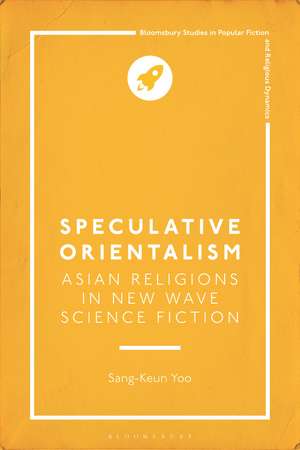
Speculative Orientalism: Asian Religions in New Wave Science Fiction: Bloomsbury Studies in Popular Fiction and Religious Dynamics
Autor Sang-Keun Yoo Alana Vincent, Nina Fischeren Limba Engleză Paperback – 18 mar 2027
Underpinning this study, Sang-Keun Yoo argues that "Speculative Orientalism" emerged in American science fiction during the 1950s and 60s. This concept adopted various aspects of Asian religions to envision alternative worlds, unburdened by the constraints of colonialism, totalitarianism, racism, and sexism present in contemporary American society.
Bringing fresh perspectives to the works of William S. Burroughs, Philip K. Dick, Ursula K. Le Guin and Samuel R. Delany, this book offers an insightful examination of the role of Asian religions in American science fiction and their impact on the genre's history.
Preț: 209.19 lei
Preț vechi: 279.89 lei
-25% Precomandă
Puncte Express: 314
Carte nepublicată încă
Livrare prin curier în România Precomanda se expediază când titlul devine disponibil.
Transport gratuit de la 400.00 lei Plată online sau ramburs, în funcție de opțiunile comenzii.
Retur gratuit în 14 zile Comandă securizată și suport în română.
Doresc să fiu notificat când acest titlu va fi disponibil:
Se trimite...
Specificații
ISBN-13: 9781350447943
ISBN-10: 1350447943
Pagini: 248
Ilustrații: 7 b&w illus
Dimensiuni: 156 x 234 x 25 mm
Greutate: 0.45 kg
Editura: Bloomsbury Publishing
Colecția Bloomsbury Academic
Seria Bloomsbury Studies in Popular Fiction and Religious Dynamics
Locul publicării:London, United Kingdom
ISBN-10: 1350447943
Pagini: 248
Ilustrații: 7 b&w illus
Dimensiuni: 156 x 234 x 25 mm
Greutate: 0.45 kg
Editura: Bloomsbury Publishing
Colecția Bloomsbury Academic
Seria Bloomsbury Studies in Popular Fiction and Religious Dynamics
Locul publicării:London, United Kingdom
Cuprins
List of Illustrations
Acknowledgements
Series Preface
Introduction: Speculative Orientalism and New Wave Science Fiction
1. The Birth of Speculative Orientalism: British New Wave Science Fiction
2. First Encounter with Asia: The Impact of War Propaganda on American New Wave Science Fiction
3. The Prototype of Speculative Orientalism: William S. Burroughs's Poststructuralist Chinese
4. The Evolution of Speculative Orientalism: From Goods to Religion in Philip K. Dick's Short Stories 1950-1970
5. An Afro-Orientalist Version of Speculative Orientalism: Samuel R. Delany's Dhalgren
6. Beyond Speculative Orientalism: The Taoist Temporalities in Ursula K. Le Guin
Conclusion: Speculative Orientalism Now
Index
Acknowledgements
Series Preface
Introduction: Speculative Orientalism and New Wave Science Fiction
1. The Birth of Speculative Orientalism: British New Wave Science Fiction
2. First Encounter with Asia: The Impact of War Propaganda on American New Wave Science Fiction
3. The Prototype of Speculative Orientalism: William S. Burroughs's Poststructuralist Chinese
4. The Evolution of Speculative Orientalism: From Goods to Religion in Philip K. Dick's Short Stories 1950-1970
5. An Afro-Orientalist Version of Speculative Orientalism: Samuel R. Delany's Dhalgren
6. Beyond Speculative Orientalism: The Taoist Temporalities in Ursula K. Le Guin
Conclusion: Speculative Orientalism Now
Index
Recenzii
Through wide-ranging readings of major New Wave SF writers, Sang-Keun Yoo reveals how imaginations about "Asian civilization" have functioned as a signifier of radical alterity and racialized futurity in what is arguably the most critically significant period of American and British science fiction. Bridging postcolonial theory, Asian American studies, and critical SF studies, this rigorous book reframes the global politics of genre fiction and expands the critical horizons of both ethnic and Asian studies. Speculative Orientalism is essential reading for anyone interested in the cultural politics of science fiction, the racial imaginaries of empire, and the shifting place of traditional religion in speculative world-building
Speculative Orientalism shows how profoundly ideas from Asian cultures transformed Western SF during the influential New Wave era, while adding complexity to our understanding of racialized stereotypes by analyzing this neglected period between the "yellow peril" of early SF and the techno-Orientalism of cyberpunk. Adeptly illustrating the continuing legacies of the speculative Orientalist trope, the book requires us to rethink SF history in light of the significant impact that US military intervention in Asia had on American ways of imagining the future.
Speculative Orientalism shows how profoundly ideas from Asian cultures transformed Western SF during the influential New Wave era, while adding complexity to our understanding of racialized stereotypes by analyzing this neglected period between the "yellow peril" of early SF and the techno-Orientalism of cyberpunk. Adeptly illustrating the continuing legacies of the speculative Orientalist trope, the book requires us to rethink SF history in light of the significant impact that US military intervention in Asia had on American ways of imagining the future.