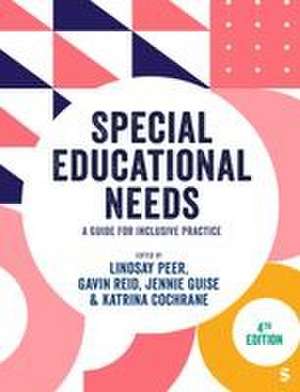
Special Educational Needs
Editat de Gavin Reid, Jennie Guise, Katrina Cochrane, Lindsay Peeren Limba Engleză Paperback – 13 feb 2027
Preț: 294.27 lei
Precomandă
Puncte Express: 441
Carte nepublicată încă
Livrare prin curier în România Precomanda se expediază când titlul devine disponibil.
Transport gratuit de la 400.00 lei Plată online sau ramburs, în funcție de opțiunile comenzii.
Retur gratuit în 14 zile Comandă securizată și suport în română.
Doresc să fiu notificat când acest titlu va fi disponibil:
Se trimite...
Specificații
ISBN-13: 9781036214128
ISBN-10: 1036214125
Pagini: 384
Dimensiuni: 189 x 246 mm
Ediția:4 Revised edition
Editura: SAGE Publications Ltd
ISBN-10: 1036214125
Pagini: 384
Dimensiuni: 189 x 246 mm
Ediția:4 Revised edition
Editura: SAGE Publications Ltd
Notă biografică
Dr Lindsay Peer CBE is a recently retired Practitioner Psychologist, international speaker, author and expert witness. In 2002, she was appointed Commander of the Order of the British Empire for services to Education and Dyslexia. She was a Patron of GroOops, a charity dedicated to creating an emotionally healthy, dyslexia aware world. In 2011, she was presented with an Outstanding Lifetime Academic Achievement Award by the British Dyslexia Association. In 2017, she was awarded a Science Council Chartered Scientist CPD Commendation. She was an Associate Fellow and Chartered Scientist of the British Psychological Society, and a Fellow of the International Academy of Research in Learning Disabilities and the Royal Society of Arts. She was a member of the Association of Child Psychologists in Private Practice, and of the Association for Child and Adolescent Mental Health. She remains registered to practice with the Health and Care Professions Council. She was Education Director and Deputy CEO of the British Dyslexia Association. She has many years' experience as a teacher, teacher trainer and SENCo. She has lectured extensively as a keynote speaker and advised governments, policy makers, lawyers, adults, schools, psychologists, therapists and parents. She has published a considerable body of material both theoretical and practical, and published the first ground-breaking book linking Glue Ear with Dyslexia. She is also an Advanced Paediatric Sleep Practitioner.
Dr Gavin Reid is an international consultant, psychologist and author based in Vancouver, Canada. He is co-director of the Reading Lab where he carries out consultancies and psychological assessments. He is also currently involved in a number of consultancy and writing projects. Dr. Reid was formerly a classroom teacher (10 years) and university lecturer (16 years). He was a senior lecturer at Moray House School of Education, University of Edinburgh from 1991-2007 where he wrote the first Masters course in dyslexia in the UK in 1993. He has written 40 books in the field of dyslexia, learning skills and motivation. His books have been translated into seven languages.
Jennie Guise has over 30 years of experience working with children, young people and adults, and is highly qualified in the areas of psychology, education and business. She is based in the UK but has also regularly worked in Abu Dhabi, Dubai and Geneva. She has co-authored several books on dyslexia, effective study and learning, and teenage school difficulties. She was involved in the Delphi process that culminated in the development of the 2025 definition of dyslexia. Jennie is a Trustee of the Helen Arkell Dyslexia Charity, a Director of Dyslexia Scotland and a member of the Cross-party Group on Dyslexia at the Scottish Parliament. As founder and CEO of Dysguise Diagnostics Ltd, she has also developed DARA (Dysguise Assessment Reports Assistant) software to support assessors by removing much of the clerical burden involved in writing up SASC compliant reports. DARA is a completely innovative approach designed to help professionals to fully focus on their analysis, improving consistency and efficiency in the field of SpLD assessment.
Katrina Cochrane is the Director of Positive Dyslexia Ltd and a highly experienced dyslexia specialist since qualifying as a diagnostic assessor in 1999. She has worked for two major Dyslexia charities - Dyslexia Action and the British Dyslexia Association where she was Head of Education. She has been a board member of SASC and joint Vice Chair of the BDA Accreditation Board. She founded Positive Dyslexia in 2016 and is now a course leader and national conference organiser, working with children, adults, educators, employers, and professionals across the UK. She is currently a Trustee of the Adult Dyslexia Centre. Katrina is passionate about raising awareness of neurodiversity and translating theory into practical, high-quality assessment and accredited training. Through Positive Dyslexia Ltd, she leads nationally recognised courses for assessors, workplace needs assessors, and education professionals, and regularly delivers training and keynote talks at conferences and events. Her work is driven by a commitment to improving understanding, inclusion, and outcomes for neurodivergent individuals.
Dr Gavin Reid is an international consultant, psychologist and author based in Vancouver, Canada. He is co-director of the Reading Lab where he carries out consultancies and psychological assessments. He is also currently involved in a number of consultancy and writing projects. Dr. Reid was formerly a classroom teacher (10 years) and university lecturer (16 years). He was a senior lecturer at Moray House School of Education, University of Edinburgh from 1991-2007 where he wrote the first Masters course in dyslexia in the UK in 1993. He has written 40 books in the field of dyslexia, learning skills and motivation. His books have been translated into seven languages.
Jennie Guise has over 30 years of experience working with children, young people and adults, and is highly qualified in the areas of psychology, education and business. She is based in the UK but has also regularly worked in Abu Dhabi, Dubai and Geneva. She has co-authored several books on dyslexia, effective study and learning, and teenage school difficulties. She was involved in the Delphi process that culminated in the development of the 2025 definition of dyslexia. Jennie is a Trustee of the Helen Arkell Dyslexia Charity, a Director of Dyslexia Scotland and a member of the Cross-party Group on Dyslexia at the Scottish Parliament. As founder and CEO of Dysguise Diagnostics Ltd, she has also developed DARA (Dysguise Assessment Reports Assistant) software to support assessors by removing much of the clerical burden involved in writing up SASC compliant reports. DARA is a completely innovative approach designed to help professionals to fully focus on their analysis, improving consistency and efficiency in the field of SpLD assessment.
Katrina Cochrane is the Director of Positive Dyslexia Ltd and a highly experienced dyslexia specialist since qualifying as a diagnostic assessor in 1999. She has worked for two major Dyslexia charities - Dyslexia Action and the British Dyslexia Association where she was Head of Education. She has been a board member of SASC and joint Vice Chair of the BDA Accreditation Board. She founded Positive Dyslexia in 2016 and is now a course leader and national conference organiser, working with children, adults, educators, employers, and professionals across the UK. She is currently a Trustee of the Adult Dyslexia Centre. Katrina is passionate about raising awareness of neurodiversity and translating theory into practical, high-quality assessment and accredited training. Through Positive Dyslexia Ltd, she leads nationally recognised courses for assessors, workplace needs assessors, and education professionals, and regularly delivers training and keynote talks at conferences and events. Her work is driven by a commitment to improving understanding, inclusion, and outcomes for neurodivergent individuals.
Cuprins
Chapter 1: Introduction - Jennie Guise and Katrina Cochrane
Part I: Moving Forward in SEN
Chapter 2: Neurodiversity - Moving Towards an Inclusive Future - Amanda Kirby and Gavin Reid
Chapter 3: Intersectionality, Neurodiversity and Disability - Unlearning Invisibility and the Importance of Radical Compassion - Donna Stevenson
Chapter 4: A New Definition of Dyslexia - Rachael McMullen
Chapter 5: How can a definition of a Specific Learning Difficulty in mathematics/Dyscalculia be used to inform classroom support? - Janet Goring
Chapter 6: Beyond Legislation - support for dyslexia and inclusion in England, Scotland, Wales and the Republic of Ireland - Alison Szalay, Fran Foreman, Julie Ross, Rhiannon Packer, Jan Frost, Rebecca James and Trevor James
Part II: Perspectives from Practice
Chapter 7: Speech, Language and Communication - Juanita Hurley and Sally Moore
Chapter 8: Auditory Processing Disorder (APD) - Doris-Eva Bamiou and Tony Sirimanna
Chapter 9: Developmental Coordination Disorder/ Developmental Dyspraxia in the Context of Education - Sally Scott-Roberts and Catherine Purcell
Chapter 10: Training for Professionals - The Importance of Continuing Professional Development (CPD) - Lynn Lovell and Helen Goodsall
Chapter 11: Mathematical Learning Difficulties and Dyscalculia - Steve Chinn
Chapter 12: Assistive Technology to support Learners with Dyslexia - Laura Cook
Part III: Overlapping Neurodiversities
Chapter 13: Attention Deficit Hyperactivity Disorder - (ADHD) - Tony Lloyd and Colin Foley
Chapter 14: Visual and Cerebral Visual Impairment and Education: Beyond Mere Awareness Raising - John Ravenscroft and Elizabeth McCann
Chapter 15: Inclusive Education for Students who are Deaf or Hard of Hearing - Jill Duncan
Chapter 16: The Twice-Exceptional Learner: Hear My Cry - Fidelma Healy Eames
Chapter 17: Understanding Executive Function - The Path to Inclusion and Universal Design for Learning - Jenn Clark
Chapter 18: Autism Spectrum Disorder (ASD): Research, Practice and Experience - Jo-Ann Page
Part IV: Working Together
Chapter 19: Parents as Partners - Jillian Zocher and Katie Nelson
Chapter 20: Children and Young People's Voices - Susan Flohr
Part V: Mental Health/Feeling Positive
Chapter 21: Mental Health Knowledge and Awareness - Rob Long
Chapter 22: Mental Health and Resilience - Stan Godek
Part I: Moving Forward in SEN
Chapter 2: Neurodiversity - Moving Towards an Inclusive Future - Amanda Kirby and Gavin Reid
Chapter 3: Intersectionality, Neurodiversity and Disability - Unlearning Invisibility and the Importance of Radical Compassion - Donna Stevenson
Chapter 4: A New Definition of Dyslexia - Rachael McMullen
Chapter 5: How can a definition of a Specific Learning Difficulty in mathematics/Dyscalculia be used to inform classroom support? - Janet Goring
Chapter 6: Beyond Legislation - support for dyslexia and inclusion in England, Scotland, Wales and the Republic of Ireland - Alison Szalay, Fran Foreman, Julie Ross, Rhiannon Packer, Jan Frost, Rebecca James and Trevor James
Part II: Perspectives from Practice
Chapter 7: Speech, Language and Communication - Juanita Hurley and Sally Moore
Chapter 8: Auditory Processing Disorder (APD) - Doris-Eva Bamiou and Tony Sirimanna
Chapter 9: Developmental Coordination Disorder/ Developmental Dyspraxia in the Context of Education - Sally Scott-Roberts and Catherine Purcell
Chapter 10: Training for Professionals - The Importance of Continuing Professional Development (CPD) - Lynn Lovell and Helen Goodsall
Chapter 11: Mathematical Learning Difficulties and Dyscalculia - Steve Chinn
Chapter 12: Assistive Technology to support Learners with Dyslexia - Laura Cook
Part III: Overlapping Neurodiversities
Chapter 13: Attention Deficit Hyperactivity Disorder - (ADHD) - Tony Lloyd and Colin Foley
Chapter 14: Visual and Cerebral Visual Impairment and Education: Beyond Mere Awareness Raising - John Ravenscroft and Elizabeth McCann
Chapter 15: Inclusive Education for Students who are Deaf or Hard of Hearing - Jill Duncan
Chapter 16: The Twice-Exceptional Learner: Hear My Cry - Fidelma Healy Eames
Chapter 17: Understanding Executive Function - The Path to Inclusion and Universal Design for Learning - Jenn Clark
Chapter 18: Autism Spectrum Disorder (ASD): Research, Practice and Experience - Jo-Ann Page
Part IV: Working Together
Chapter 19: Parents as Partners - Jillian Zocher and Katie Nelson
Chapter 20: Children and Young People's Voices - Susan Flohr
Part V: Mental Health/Feeling Positive
Chapter 21: Mental Health Knowledge and Awareness - Rob Long
Chapter 22: Mental Health and Resilience - Stan Godek