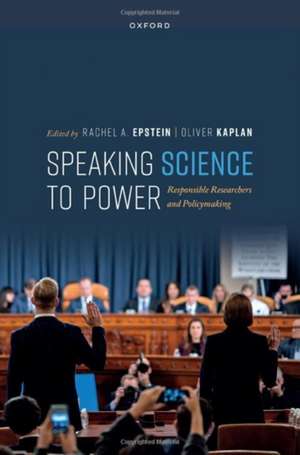
Speaking Science to Power: Responsible Researchers and Policymaking
Rachel A. Epstein, Oliver Kaplanen Limba Engleză Paperback – 15 oct 2024
Preț: 240.13 lei
Preț vechi: 291.03 lei
-17%
Puncte Express: 360
Carte disponibilă
Livrare economică 30 octombrie-10 noiembrie
Livrare express 17-23 octombrie pentru 76.80 lei
Livrare prin curier în România Termenul estimat este afișat lângă disponibilitate.
Transport gratuit de la 400.00 lei Plată online sau ramburs, în funcție de opțiunile comenzii.
Retur gratuit în 14 zile Comandă securizată și suport în română.
Specificații
ISBN-13: 9780198877134
ISBN-10: 0198877137
Pagini: 240
Dimensiuni: 155 x 232 x 12 mm
Greutate: 0.37 kg
Editura: OUP OXFORD
Colecția OUP Oxford
Locul publicării:Oxford, United Kingdom
ISBN-10: 0198877137
Pagini: 240
Dimensiuni: 155 x 232 x 12 mm
Greutate: 0.37 kg
Editura: OUP OXFORD
Colecția OUP Oxford
Locul publicării:Oxford, United Kingdom
Recenzii
This terrific group of academics provides reflections on the decisions they made when facing a range of ethical dilemmas while conducting research and communicating findings. Scholars who seek to reach broad policy and public audiences and ensure they are pursuing responsible engagement will find this book indispensable.
This volume presents actionable advice for researchers to engage in reflection, deliberation, and careful practice when communicating with policymakers. It should serve as required reading for all social scientists as part of training in responsible conduct of research.
Epstein and Kaplan have collected incredibly valuable perspectives on the seemingly contradictory demands of science and democracy. The book provides insight into the complexities of responsible policy engagement and will be of great value to any expert jumping into the fray of policy and politics. I plan to use it in my graduate seminars on science policy. Highly recommended.
This is a book that should become core reading for all PhD students and early career researchers… And yet to define this collection as being solely focused on professional skills and the practicalities of policy engagement would represent a gross misreading of its content and relevance. Speaking Science to Power makes several intellectual contributions in relation to deepening our understanding of the "science-of-science," "metascience," and the emerging field of "impact evaluation studies".
It will serve as a refreshing addition to graduate-level research and professional ethics courses.
A unique and useful edited volume that has the potential to start a wider trend of reflective dialogue on methodologies beyond the standard research methods.
Examine[s] the opportunity for researchers to improve public policies by contributing to the quality of democracy, aiding in conflict resolution, or advancing more equitable economic policy, considering their responsibility to guard against misunderstandings, misuse, misconduct, and other potential harms.
Speaking Science to Power provides advice for researchers interested in policy-relevant research. It draws on the lived experiences and reflections of several social scientists who have grappled with questions of integrity, audience engagement and scope for contribution in light of funding priorities and limited access to policy-making processes. It is an immensely accessible and honest resource for researchers seeking practical advice on how to overcome these challenges and also reflect on their own role in the field.
This volume is a valuable resource for scholars at all stages of policy-engaged research, from researchers who are currently engaged in policy-relevant research to those just beginning to embark on this journey... This volume would be of particular value as a classroom resource... The case studies lend themselves particularly well to scholars of international relations and social science, although the lessons could be equally relevant to any researchers whose work may inform the policy process.
This volume presents actionable advice for researchers to engage in reflection, deliberation, and careful practice when communicating with policymakers. It should serve as required reading for all social scientists as part of training in responsible conduct of research.
Epstein and Kaplan have collected incredibly valuable perspectives on the seemingly contradictory demands of science and democracy. The book provides insight into the complexities of responsible policy engagement and will be of great value to any expert jumping into the fray of policy and politics. I plan to use it in my graduate seminars on science policy. Highly recommended.
This is a book that should become core reading for all PhD students and early career researchers… And yet to define this collection as being solely focused on professional skills and the practicalities of policy engagement would represent a gross misreading of its content and relevance. Speaking Science to Power makes several intellectual contributions in relation to deepening our understanding of the "science-of-science," "metascience," and the emerging field of "impact evaluation studies".
It will serve as a refreshing addition to graduate-level research and professional ethics courses.
A unique and useful edited volume that has the potential to start a wider trend of reflective dialogue on methodologies beyond the standard research methods.
Examine[s] the opportunity for researchers to improve public policies by contributing to the quality of democracy, aiding in conflict resolution, or advancing more equitable economic policy, considering their responsibility to guard against misunderstandings, misuse, misconduct, and other potential harms.
Speaking Science to Power provides advice for researchers interested in policy-relevant research. It draws on the lived experiences and reflections of several social scientists who have grappled with questions of integrity, audience engagement and scope for contribution in light of funding priorities and limited access to policy-making processes. It is an immensely accessible and honest resource for researchers seeking practical advice on how to overcome these challenges and also reflect on their own role in the field.
This volume is a valuable resource for scholars at all stages of policy-engaged research, from researchers who are currently engaged in policy-relevant research to those just beginning to embark on this journey... This volume would be of particular value as a classroom resource... The case studies lend themselves particularly well to scholars of international relations and social science, although the lessons could be equally relevant to any researchers whose work may inform the policy process.
Notă biografică
Rachel A. Epstein is a Professor at the Josef Korbel School of International Studies at the University of Denver. Her research focuses on international political economy, financial crises and reform, international security, and the role of international organizations in eliciting compliance from target states and states-in-transition. She has held several postdoctoral fellowships at the European University Institute in Florence, Italy and was also an Advanced Postdoctoral Fellow at the Freie Universität in Berlin in 2016.Oliver Kaplan is an Associate Professor at the Josef Korbel School of International Studies at the University of Denver. He is the author of the book, Resisting War: How Communities Protect Themselves (Cambridge University Press, 2017). Kaplan has also published articles on the conflict-related effects of land reforms, ex-combatant reintegration and recidivism, and research ethics. Kaplan was a Jennings Randolph Senior Fellow at the US Institute of Peace and a postdoctoral Research Associate at Princeton University and at Stanford University.
Cuprins
- Preface and Acknowledgments
- 1: Rachel A. Epstein and Oliver Kaplan: Responsible Policy Engagement: A New Imperative for Social Scientists
- 2: Jason Lyall: Preregister Your Ethical Redlines: Vulnerable Populations, Policy Engagement, and the Perils of E-Hacking
- 3: Tricia D. Olsen: Sharing Unpopular Findings: When Academic Research Challenges Policy Efforts
- 4: Timothy D. Sisk: Coping with Conflicting Claims: Ethnic Power Sharing for Sustainable Peace?
- 5: Oliver Kaplan: Partnered Policy Engagement: Positionality and the Ethics of Collaborating with Civil-Society Organizations
- 6: George F. DeMartino: Should Economists Deceive? Prosocial Lying, Paternalism, and the "Ben Bernanke Problem"
- 7: Rachel A. Epstein: The Problem of Overgeneralization: The Effects of NATO Enlargement
- 8: César Caballero Reinoso: He Who is a Gentleman Resigns: Data Ethics and the Power of Data
- 9: Leanne Erdberg Steadman: Policymaker's Epilogue: From the Receiving End of Responsible Engagement
- 10: Rachel A. Epstein and Oliver Kaplan: Conclusion: The Future of Responsible Engagement