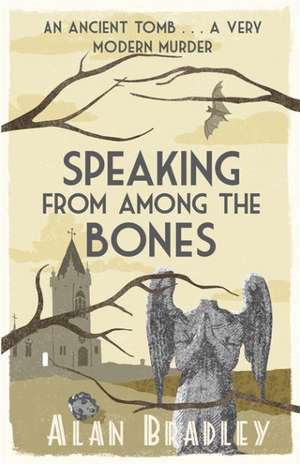
Speaking from Among the Bones: The fifth novel in the gripping Flavia series - now a major Sky Original film!: Flavia de Luce Mystery
Autor Alan Bradleyen Limba Engleză Paperback – 27 mar 2014
Structura narativă ne plasează direct în mintea analitică a Flaviei, unde chimia și deducția se împletesc într-un ritm alert. Bishop’s Lacey se pregătește de sărbătoare, dar sacrul devine profan în cel mai scurt timp. Cinci sute de ani de liniște în mormântul Sfântului Tancred sunt spulberați de o prezență străină. Nu este un sfânt, ci un organist mascat. Tensiunea crește instantaneu. Cine l-ar ascunde pe Mr. Collicutt într-un loc atât de sfânt? Apreciem cum Alan Bradley folosește curiozitatea morbidă a unei fete de unsprezece ani pentru a demonta fațada unei comunități rurale britanice. La intersecția dintre A Red Herring Without Mustard și The Weed That Strings the Hangman's Bag, acest volum combină explorarea trecutului dureros al familiei De Luce cu rigoarea științifică a otrăvurilor. Față de volume precum As Chimney Sweepers Come To Dust, unde Flavia este exilată în Canada, aici ea rămâne stăpână pe laboratorul său de la Buckshaw, folosindu-și eprubetele pentru a decoda un asasinat ritualic. Stilul este tăios, iar atmosfera de „cosy mystery” este rapid perforată de detalii grotești care ne-au atras atenția încă de la primele pagini. Nu este doar o investigație, ci o cursă contra cronometru printre oase vechi și secrete noi.




Preț: 60.51 lei
Preț vechi: 80.39 lei
-25%
Carte disponibilă
Livrare economică 05-19 noiembrie
Livrare express 22-28 octombrie pentru 44.70 lei
Specificații
ISBN-10: 1409118185
Pagini: 400
Dimensiuni: 134 x 198 x 26 mm
Greutate: 0.32 kg
Editura: Orion Publishing Group
Colecția Orion
Seria Flavia de Luce Mystery
Locul publicării:London, United Kingdom
V-ar putea interesa
-
 Preț: 120.71 lei
 -
 The Bloomsbury MurderMike HollowPreț: 154.85 lei
 -
 -25%Preț: 59.46 lei79.76 lei
 -
 The Dead and the DyingLin AndersonPreț: 144.57 lei
 -
 A Slowly Dying CauseElizabeth GeorgePreț: 119.55 lei
 -
 -27%Preț: 57.03 lei77.76 lei
 -
 -26%Preț: 53.78 lei72.33 lei
 -
 -25%Preț: 87.78 lei116.42 lei
 -
 -25%Preț: 60.17 lei80.16 lei
 -
 -24%Preț: 60.87 lei80.60 lei
 -
 -20%Preț: 82.58 lei102.89 lei
 -
 -25%Preț: 59.46 lei79.76 lei
 -
 -25%Preț: 60.81 lei80.55 lei
 -
 -25%Preț: 59.71 lei79.90 lei
 -
 -25%Preț: 60.36 lei80.29 lei
 -
 -26%Preț: 59.11 lei79.53 lei
 -
 -27%Preț: 77.56 lei106.86 lei
 -
 -25%Preț: 93.14 lei123.39 lei
 -
 -26%Preț: 117.13 lei157.95 lei
De ce să citești această carte
Recomandăm această carte cititorilor care savurează romanele polițiste clasice, dar caută o voce proaspătă și excentrică. Veți câștiga o perspectivă fascinantă asupra Angliei postbelice prin ochii unei eroine geniale și cinice. Este lectura ideală dacă vă plac misterele britanice unde laboratorul de chimie devine principala armă împotriva crimei.
Despre autor
Alan Bradley s-a născut într-o familie de povestitori pasionați, element care i-a marcat profund stilul narativ. Fost profesor la Universitatea din Saskatchewan, unde a predat scrierea de scenarii, Bradley a debutat spectaculos în literatura polițistă. Seria sa, Flavia de Luce Mystery, a devenit un fenomen internațional, fiind recompensată cu premii prestigioase precum Agatha Award și Macavity Award. Autorul locuiește în prezent în Insula Man, continuând să exploreze universul complex al micii detective chimiste, care a fost recent adaptat într-o producție cinematografică majoră Sky Original.
Descriere
An ancient tomb...a very modern murder
When the tomb of St Tancred is opened, no one expects to find the body of the organist, lying in a pool of blood, his handsome features covered by a gas mask.Eleven-year-old Flavia de Luce is intrigued. Why would anyone want to kill the much-admired organist in such a brutal and bizarre fashion?
Why place his body in the tomb? And what happened to the remains of the previous occupant?
The mystery leads Flavia deep into the past, to a strange story of lost manuscripts and ancient relics...
Praise for the historical Flavia de Luce mysteries:
'The Flavia de Luce novels are now a cult favourite' Mail on Sunday
'A cross between Dodie Smith's I Capture The Castle and the Addams family...delightfully entertaining' Guardian
Fans of M. C. Beaton's Agatha Raisin, Frances Brody and Alexander McCall Smith will enjoy the Flavia de Luce mysteries:
1. Sweetness at the Bottom of the Pie
2. The Weed That Strings the Hangman's Bag
3. A Red Herring Without Mustard
4. I Am Half Sick of Shadows
5. Speaking From Among the Bones
6. The Dead in Their Vaulted Arches
7. As Chimney Sweepers Come To Dust
8. Thrice the Brinded Cat Hath Mew'd
9. The Grave's a Fine and Private Place
If you're looking for a cosy crime series to keep you hooked then look no further than the Flavia de Luce mysteries.
* Each Flavia de Luce mystery can be read as a standalone or in series order *
Recenzii
Certain to become a national treasure
Delightfully entertaining
Flavia is enchanting
A breath of fresh air to the world of period-piece sleuthing
Flavia is mercilessly addictive
A clever, witty and totally gripping read with lots of surprises
At once precocious and endearing. Flavia is a marvellous character. Quirkily appealing, this is definitely a crime novel with a difference
It's like entering the lost world of the Mitford sisters where the girls are allowed to run completely wild
Hilarious, eccentric and mischievous
Engaging, entertaining, bright and breezy; and above all, great fun!
Notă biografică
Extras
Blood dripped from the neck of the severed head and fell in a drizzle of red raindrops, clotting into a ruby pool upon the black and white tiles. The face wore a grimace of surprise, as if the man had died in the middle of a scream. His teeth, each clearly divided from its neighbor by a black line, were bared in a horrible, silent scream.
I couldn’t take my eyes off the thing.
The woman who proudly held the gaping head at arm’s length by its curly blue-black hair was wearing a scarlet dress—almost, but not quite, the color of the dead man’s blood.
To one side, a servant with downcast eyes held the platter upon which she had carried the head into the room. Seated on a wooden throne, a matron in a saffron dress leaned forward in square-jawed pleasure, her hands clenched into fists on the arms of her chair as she took a good look at the grisly trophy. Her name was Herodias, and she was the wife of the king.
The younger woman, the one clutching the head, was—at least, according to the historian Flavius Josephus—named Salome. She was the stepdaughter of the king, whose name was Herod, and Herodias was her mother.
The detached head, of course, belonged to John the Baptist.
I remembered hearing the whole sordid story not more than a month ago when Father read aloud the Second Lesson from the back of the great carved wooden eagle which served as the lectern at St. Tancred’s.
On that winter morning I had gazed up, transfixed, just as I was gazing now, at the stained-glass window in which this fascinating scene was depicted.
Later, during his sermon, the vicar had explained that in Old Testament times, our blood was thought to contain our lives.
Of course!
Blood!
Why hadn’t I thought of it before?
“Feely,” I said, tugging at her sleeve, “I have to go home.”
My sister ignored me. She peered closely at the music book as, in the dusky shadows of the fading light, her fingers flew like white birds over the keys of the organ.
Mendelssohn’s Wie gross ist des Allmächt’gen Güte.
“ ‘How great are the works of the Almighty,’ ” she told me it meant.
Easter was now less than a week away and Feely was trying to whip the piece into shape for her official debut as organist of St. Tancred’s. The flighty Mr. Collicutt, who had held the post only since last summer, had vanished suddenly from our village without explanation and Feely had been asked to step into his shoes.
St. Tancred’s went through organists like a python goes through white mice. Years ago, there had been Mr. Taggart, then Mr. Denning. It was now Mr. Collicutt’s kick at the cat.
“Feely,” I said. “It’s important. There’s something I have to do.”
Feely jabbed one of the ivory coupling buttons with her thumb and the organ gave out a roar. I loved this part of the piece: the point where it leaps in an instant from sounding like a quiet sea at sunset to the snarl of a jungle animal.
When it comes to organ music, loud is good—at least to my way of thinking.
I tucked my knees up under my chin and huddled back into the corner of the choir stall. It was obvious that Feely was going to slog her way through to the end come hell or high water, and I would simply have to wait it out.
I looked at my surroundings but there wasn’t much to see. In the feeble glow of the single bulb above the music rack, Feely and I might as well have been castaways on a tiny raft of light in a sea of darkness.
By twisting my neck and tilting my head back like a hanged man, I could just make out the head of Saint Tancred, which was carved in English oak at the end of a hammer beam in the roof of the nave. In the weird evening light, he had the look of a man with his nose pressed flat against a window, peering in from the cold to a cozy room with a cheery fire burning on the hearth.
I gave him a respectful bob of my head, even though I knew he couldn’t see me since his bones were moldering away in the crypt below. But better safe than sorry.
Above my head, on the far side of the chancel, John the Baptist and his murderers had now faded out almost completely. Twilight came quickly in these cloudy days of March and, viewed from inside the church, the windows of St. Tancred’s could change from a rich tapestry of glorious colors to a muddy blackness in less time than it would take you to rattle off one of the longer psalms.
To tell the truth, I’d have rather been at home in my chemical laboratory than sitting here in the near-darkness of a drafty old church, but Father had insisted.
Even though Feely was six years older than me, Father refused to let her go alone to the church for her almost nightly rehearsals and choir practices.
“A lot of strangers likely to be about these days,” he said, referring to the team of archaeologists who would soon be arriving in Bishop’s Lacey to dig up the bones of our patron saint.
How I was to defend Feely against the attacks of these savage scholars, Father had not bothered to mention, but I knew there was more to it than that.
In the recent past there had been a number of murders in Bishop’s Lacey: fascinating murders in which I had rendered my assistance to Inspector Hewitt of the Hinley Constabulary.
In my mind, I ticked off the victims on my fingers: Horace Bonepenny, Rupert Porson, Brookie Harewood, Phyllis Wyvern. . . .
One more corpse and I’d have a full hand.
Each of them had come to a sticky end in our village, and I knew that Father was uneasy.
“It isn’t right, Ophelia,” he said, “for a girl who’s—for a girl your age to be rattling about alone in an old church at night.”
“There’s nobody there but the dead.” Feely had laughed, perhaps a little too gaily. “And they don’t bother me. Not nearly so much as the living.”
Behind Father’s back, my other sister, Daffy, had licked her wrist and wetted down her hair on both sides of an imaginary part in the middle of her head, like a cat washing its face. She was poking fun at Ned Cropper, the potboy at the Thirteen Drakes, who had the most awful crush on Feely and sometimes followed her about like a bad smell.
Feely had scratched her ear to indicate she had understood Daffy’s miming. It was one of those silent signals that fly among sisters like semaphore messages from ship to ship, indecipherable to anyone who doesn’t know the code. Even if Father had seen the gesture, he would not have understood its meaning. Father’s codebook was in a far different language from ours.
“Still,” Father had said, “if you’re coming or going after dark, you are to take Flavia with you. It won’t hurt her to learn a few hymns.”
Learn a few hymns indeed! Just a couple of months ago when I was confined to bed during the Christmas holidays, Mrs. Mullet, in giggling whispers and hushed pledges of secrecy, had taught me a couple of new ones. I never tired of bellowing:
“Hark the herald angels sing,
Beecham’s Pills are just the thing.
Peace on earth and mercy mild,
Two for a man and one for a child!”
Either that or:
“We Three Kings of Leicester Square,
Selling ladies’ underwear,
So fantastic, no elastic,
Only tuppence a pair.”
—until Feely flung a copy of Hymns Ancient and Modern at my head. One thing I have learned about organists is that they have absolutely no sense of humor.
“Feely,” I said, “I’m freezing.”
I shivered and buttoned up my cardigan. It was bitterly cold in the church at night. The choir had left an hour ago, and without their warm bodies round me, shoulder to shoulder like singing sardines, it seemed even colder still.
But Feely was submerged in Mendelssohn. I might as well have been talking to the moon.
Suddenly the organ gave out a fluttering gasp, as if it had choked on something, and the music gargled to a stop.
“Oh, fiddle,” Feely said. It was as close to swearing as she ever came—at least in church. My sister was a pious fraud.
She stood up on the pedals and waddled her way off the organ bench, making a harsh mooing of bass notes.