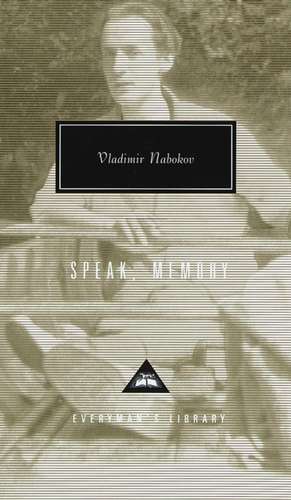
Speak, Memory
Autor Vladimir Nabokoven Limba Engleză Hardback – 23 mar 1999
Recomandăm această ediție a volumului Speak, Memory care marchează o etapă esențială în istoria publicării operei lui Vladimir Nabokov. Față de versiunea din 1951 (intitulată „Conclusive Evidence”) și revizuirea din 1966, acest volum din seria Penguin Modern Classics integrează pentru prima dată celebrul „Capitol 16”. Această secțiune inedită, recuperată din arhiva familiei, oferă o perspectivă critică și introspectivă asupra propriului proces de scriere a memoriilor, transformând textul dintr-o simplă autobiografie într-un exercițiu de metaficțiune. Suntem de părere că această adăugire este crucială pentru înțelegerea modului în care Nabokov și-a reconstruit trecutul pierdut. Cartea extinde cadrul propus de Nabokov's Fifth Arc de J. E. Rivers, oferind datele primare pe care cercetătorii le analizează pentru a înțelege „spirala” vieții autorului. Dacă în Letters to Vera descoperim latura intimă a parteneriatului său de o viață, în Speak, Memory asistăm la efortul monumental de a salva prin limbaj o lume distrusă de Revoluția Rusă. Tonul este precis, de o eleganță aristocrată, alternând între evocarea senzorială a moșiilor rusești și rigoarea intelectuală a anilor de studiu în Anglia. Spre deosebire de explorarea frustrărilor umane din Nabokov's Dozen, memoriile sale radiază o formă de nostalgie controlată chirurgical, unde fiecare amintire este fixată precum fluturii din colecțiile sale de entomolog.
Preț: 151.45 lei
Carte disponibilă
Livrare economică 11-25 noiembrie
Specificații
ISBN-10: 0375405534
Pagini: 344
Dimensiuni: 134 x 212 x 28 mm
Greutate: 0.5 kg
Editura: Knopf Doubleday Publishing Group
V-ar putea interesa
-
 My Invented Country: Isabel AllendeIsabel AllendePreț: 78.32 lei
 -
 The Last of the MohicansJames Fenimore CooperPreț: 28.01 lei
 -
 Tales of Mystery and ImaginationEdgar Allan PoePreț: 28.01 lei
 -
 CLASSICS LITTLE PRINCESS PBFrances Hodgson BurnettPreț: 28.01 lei
 -
 Preț: 28.01 lei
 -
 The Upside of UnrequitedBecky Albertalli-26%Preț: 47.79 lei64.60 lei
 -
 Sound Engineering ExplainedMichael Talbot-Smith-8%Preț: 450.86 lei490.07 lei
 -
 American Art and ArchitectureMichael J Lewis-14%Preț: 83.66 lei97.49 lei
 -
 The Bonesetter's DaughterAmy TanPreț: 58.77 lei
 -
 A History of American Literature: 1950 to the PresentLinda Wagner–MartinPreț: 282.13 lei
 -
 Visual Content MarketingStephen GamblePreț: 183.36 lei
 -
 Preț: 396.51 lei
 -
 Preț: 415.40 lei
 -
 Developing Story Ideas: The Power and Purpose of StorytellingMichael RabigerPreț: 369.39 lei
 -
 -14%Preț: 122.37 lei143.07 lei
 -
 She Persisted: 13 American Women Who Changed the WorldChelsea ClintonPreț: 112.08 lei
 -
 Handbook of Art Therapy, Second EditionCathy A. Malchiodi-9%Preț: 647.86 lei711.93 lei
 -
 Music TherapyBitsey King BrunkPreț: 109.32 lei
De ce să citești această carte
Această autobiografie este esențială pentru oricine dorește să înțeleagă rădăcinile geniului nabokovian. Cititorul câștigă o lecție magistrală de stilistică și o cronică vie a unei Europe dispărute. Recomandăm volumul pentru capitolul 16 inedit, care oferă cheia de lectură a întregii opere, și pentru capacitatea autorului de a transforma exilul într-o victorie a memoriei asupra timpului.
Despre autor
Vladimir Nabokov (1899–1977) a fost un romancier, poet și entomolog ruso-american, considerat unul dintre cei mai străluciți stilisti ai secolului XX. Născut într-o familie aristocrată din Sankt Petersburg, a fost forțat să părăsească Rusia în 1919. După studii la Cambridge și ani de activitate literară în Berlin sub pseudonimul Vladimir Sirin, s-a stabilit în SUA, unde a scris faimosul roman Lolita. Expert în lepidopterologie și compozitor de probleme de șah, Nabokov a adus în beletristică o precizie științifică împletită cu o imaginație debordantă, fiind de șapte ori finalist al National Book Award.
Descriere scurtă
Nabokov's memoir is a moving account of a loving, civilized family, of adolescent awakenings, flight from Bolshevik terror, education in England, and emigre life in Paris and Berlin. The Nabokovs were eccentric, liberal aristocrats, who lived a life immersed in politics and literature on splendid country estates until their world was swept away by the Russian revolution when the author was eighteen years old. Speak, Memory vividly evokes a vanished past in the inimitable prose of Nabokov at his best.
(Book Jacket Status: Jacketed)
Notă biografică
The Nabokov household was trilingual, and as a child Nabokov was already reading Wells, Poe, Browning, Keats, Flaubert, Verlaine, Rimbaud, Tolstoy, and Chekhov, alongside the popular entertainments of Sir Arthur Conan Doyle and Jules Verne. As a young man, he studied Slavic and romance languages at Trinity College, Cambridge, taking his honors degree in 1922. For the next eighteen years he lived in Berlin and Paris, writing prolifically in Russian under the pseudonym Sirin and supporting himself through translations, lessons in English and tennis, and by composing the first crossword puzzles in Russian. In 1925 he married Vera Slonim, with whom he had one child, a son, Dmitri.
Having already fled Russia and Germany, Nabokov became a refugee once more in 1940, when he was forced to leave France for the United States. There he taught at Wellesley, Harvard, and Cornell. He also gave up writing in Russian and began composing fiction in English. In his afterword to Lolita he claimed: "My private tragedy, which cannot, and indeed should not, be anybody's concern, is that I had to abandon my natural idiom, my untrammeled, rich, and infinitely docile Russian tongue for a second-rate brand of English, devoid of any of those apparatuses–the baffling mirror, the black velvet backdrop, the implied associations and traditions–which the native illusionist, frac-tails flying, can magically use to transcend the heritage in his own way." [p. 317] Yet Nabokov's American period saw the creation of what are arguably his greatest works, Bend Sinister (1947), Lolita (1955), Pnin (1957), and Pale Fire (1962), as well as the translation of his earlier Russian novels into English. He also undertook English translations of works by Lermontov and Pushkin and wrote several books of criticism. Vladimir Nabokov died in Montreux, Switzerland, in 1977.