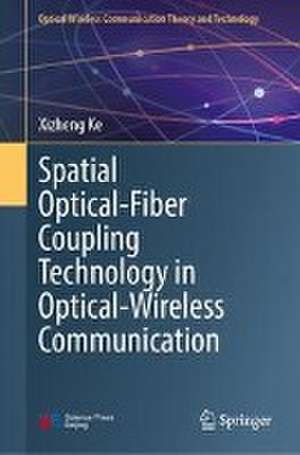
Spatial Optical-Fiber Coupling Technology in Optical-Wireless Communication: Optical Wireless Communication Theory and Technology
Autor Xizheng Keen Limba Engleză Hardback – 3 iul 2023


Preț: 926.76 lei
Preț vechi: 1130.20 lei
-18%
Puncte Express: 1390
Carte disponibilă
Livrare economică 16-30 noiembrie
Livrare prin curier în România Termenul estimat este afișat lângă disponibilitate.
Transport gratuit pentru acest produs Plată online sau ramburs, în funcție de opțiunile comenzii.
Retur gratuit în 14 zile Comandă securizată și suport în română.
Specificații
ISBN-13: 9789819915248
ISBN-10: 9819915244
Pagini: 236
Ilustrații: X, 226 p. 133 illus., 90 illus. in color.
Dimensiuni: 160 x 241 x 18 mm
Greutate: 0.52 kg
Ediția:2023
Editura: Springer
Colecția Optical Wireless Communication Theory and Technology
Seria Optical Wireless Communication Theory and Technology
Locul publicării:Singapore, Singapore
V-ar putea interesa
-
 Introduction to Fiber-Optic CommunicationsRongqing Hui-27%Preț: 766.77 lei1050.37 lei
-
 -19%Preț: 436.56 lei538.97 lei
-
 Fundamentals of Photonics, Third Edition, 2V SetBahaa E. A. Saleh-23%Preț: 1227.17 lei1593.73 lei
-
 -20%Preț: 1290.56 lei1613.21 lei
-
 -27%Preț: 1519.30 lei2073.27 lei
-
 -36%Preț: 284.35 lei440.95 lei
-
 Principles and Applications of Free Space Optical CommunicationsArun K. Majumdar-18%Preț: 865.87 lei1055.93 lei
-
 Simulation Techniques in Microwave Photonics SystemsRangana Banerjee Chaudhuri-18%Preț: 920.78 lei1122.90 lei
-
 -14%Preț: 798.79 lei928.83 lei
-
 -15%Preț: 482.13 lei567.21 lei
-
 Optical and Wireless TechnologiesVijay Janyani-24%Preț: 1169.23 lei1538.46 lei
-
 Optical and Wireless TechnologiesManish Tiwari-24%Preț: 1145.83 lei1507.67 lei
-
 -24%Preț: 959.86 lei1262.97 lei
-
 -24%Preț: 880.53 lei1158.60 lei
-
 Fiber Optic InterferometerYanbiao Liao-18%Preț: 1156.02 lei1409.78 lei
-
 -18%Preț: 1043.78 lei1272.89 lei
-
 -18%Preț: 1048.74 lei1278.95 lei
-
 UV Light Self Organizing Network TheoryXizheng Ke-18%Preț: 1052.78 lei1283.88 lei
Cuprins
Introduction.- Fiber-optic mode theory.- Single-lens single-mode fiber coupling under ideal conditions.- Spatial plane-wave single-lens single-mode fiber coupling in weakly turbulent atmospheres.- Automatic fiber-optic-coupling alignment system.- Mode-conversion methods.- Adaptive-optical wavefront correction.
Notă biografică
Xizheng Ke, Doctor of Science, Second-Level Professor, Head of the Department of Information and Communication Systems at Xi'an University of Technology, and Deputy Director of the Key Laboratory of Military-Civilian Joint Construction of Intelligent Cooperative Networks in Shaanxi Province. Famous teacher in Shaanxi Province, Fellow of Chinese Institute of Electronics, Director of Chinese Optical Engineering Society, Executive Director of Shaanxi Optical Society. He received a Bachelor's degree from Shaanxi Institute of Technology in 1983 and a Doctor of Science degree from the University of Chinese Academy of Sciences in 1996. From 1997 to 2002, he conducted post-doctoral research at Xidian University and the Second Artillery Engineering College. Dr Xizheng Ke is a member of the editorial board of "Journal of Electronics", "Infrared and Laser Engineering", "Journal of Electronic Measurement and Instrument", "Laser Technology", "Applied Optics", "Journal of Xi'an University of Technology", "Journal of Time and Frequency" and "Journal of Atmospheric Science Research". He is the national expert for reviewing science and technology awards and a member of the disciplinary review group of the Shaanxi Academic Degrees Committee. In 2000, Dr Xizheng Ke won the Outstanding Young Scholar Award of the Chinese Academy of Sciences. In 2009, he was awarded the title of "Outstanding Science and Technology Commissioner of Guangdong Province" by the Ministry of Science and Technology. In 2015, he was awarded the title of "A Golden Phoenix on Green Poplar" in Yangzhou City. In 2018, he won the China Industry-University-Research Innovation Award, and in 2019, he won the China Industry-University-Research Innovation Achievement Award. Since 2001, he has won 16 provincial and ministerial science and technology awards, including 1 first prize and 5 second prizes. He has obtained more than 20 nationally approved invention patents, published 9 monographs in Science Press, and published more than 400 academic papers in domestic and foreign journals. More than 30 PhD students have been trained under his direction.
Textul de pe ultima copertă
This book analyzes the development of space light-fiber coupling research, highlights its importance, examines the underlying theory and key problems, and elaborates on methods to improve the space light-fiber coupling efficiency. Starting from the basic theory of electromagnetic field, the transmission characteristics of light in optical fibers are expounded, and the coupling characteristics of optical signals of different modes are investigated. The spatial light-fiber coupling techniques such as mode conversion method, lens coupling method, and wavefront distortion correction method are discussed in detail, and the key technologies involved are verified by experiments. This book is suitable for the vast majority of engineering and technical personnel and teachers in colleges and institutions who are engaged in wireless optical communication. It can also be used to train senior undergraduates and graduate students in relevant fields.
Caracteristici
Solves the space fiber-fiber coupling technology from both theoretical and practical aspects Summarizes related work on space fiber coupling Researches on space light-fiber coupling efficiency