Cantitate/Preț
Produs
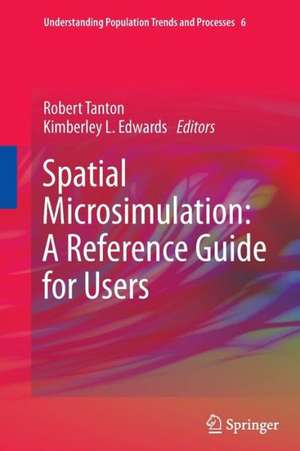
Spatial Microsimulation: A Reference Guide for Users de Robert Tanton

Spatial Microsimulation: A Reference Guide for Users Understanding Population Trends and Processes, cartea 6

61888 lei 72809 lei -15%
  • Economic11-25 ianuarie 27 61888 lei
Adaugă în listă928 Puncte Express
  • Transport gratuit pentru acest produs
  • Plată online sau ramburs
  • Retur gratuit în 14 zile

Despre carte

This book is a practical guide on how to design, create and validate a spatial microsimulation model. These models are becoming more popular as academics and policy makers recognise the value of place in research and policy making. Recent spatial microsimulation models have been used to analyse health and social disadvantage for small areas; and to look at the effect of policy change for small areas. This provides a powerful analysis tool for researchers and policy makers.
 
This book covers preparing the data for spatial microsimulation; a number of methods for both static and dynamic spatial microsimulation models; validation of the models to ensure the outputs are reasonable; and the future of spatial microsimulation. The book will be an essential handbook for any researcher or policy maker looking to design and create a spatial microsimulation model.
 
This book will also be useful to those policy makers who are commissioning a spatial microsimulation model, or looking to commission work using a spatial microsimulation model, as it provides information on the different methods in a non-technical way.

Din seria Understanding Population Trends and Processes

  • Fertility, Living Arrangements, Care and Mobility
    63263 lei -15% 74428 lei
  • Spatial and Social Disparities
    56803 lei -8% 61743 lei
  • Population Dynamics and Projection Methods
    63400 lei -15% 74589 lei
  • Understanding Family Change and Variation
    61441 lei -15% 72283 lei
  • Spatial Microsimulation: A Reference Guide for Users
    66916 lei -15% 78726 lei
  • Rural Aging in 21st Century America
    62456 lei -15% 73478 lei

Detalii

ISBN-13
9789401781336
ISBN-10
9401781338
Editura
Springer
Colecția
Understanding Population Trends and Processes
Seria
Understanding Population Trends and Processes
Ediția
2013
Pagini
288
Ilustrații
VIII, 280 p.
Dimensiuni
155 x 235 x 16 mm
Greutate
0.44 kg
Locul publicării
Dordrecht, Netherlands

Cuprins

Part 1: Background: Chapter 1: Introduction to spatial microsimulation – History, Methods and Applications: Robert Tanton and Kimberley Edwards.- Chapter 2: Building a static spatial microsimulation model: data preparation: Rebecca Cassells, Riyana Miranti and Ann Harding.- Part 2: Static spatial microsimulation models.- Chapter 3: An Evaluation of Two Synthetic Small-Area Microdata simulation methodologies: Synthetic Reconstruction and Combinatorial Optimisation methodologies: Paul Williamson.- Chapter 4: Estimating Small Area Income Deprivation: An Iterative Proportional Fitting Approach: Ben Anderson.- Chapter 5: SimObesity: Combinatorial Optimisation (deterministic) model: Kimberley Edwards and Graham Clarke.- Chapter 6: Spatial Microsimulation using a generalised regression model: Robert Tanton, Ann Harding and Justine McNamara.- Chapter 7: Creating a Spatial Microsimulation model of the Irish Local Economy: Niall Farrell, Karyn Morrissey andCathal O’Donoghue.- Chapter 8: Linking static spatial microsimulation modelling to meso-scale models: The Relationship between Access to GP services & Long Term Illness: Karyn Morrissey, Graham Clarke and Cathal O’Donoghue.- Chapter 9: Projections using a static Spatial Microsimulation model: Yogi Vidyattama and Robert Tanton.- Chapter 10: Limits of static Spatial Microsimulation models: Robert Tanton and Kimberley Edwards.- Part 3: Dynamic spatial microsimulation models.- Chapter 11: Moses: A dynamic spatial microsimulation model for demographic planning: Belinda Wu and Mark Birkin.- Chapter 12: Design principles for micro models: Einar Holm and Kalle Mäkilä.- Chapter 13: SimEducation: a dynamic spatial microsimulation model for understanding educational inequalities: Dimitris Kavroudakis, Dimitris Ballas and Mark Birkin.- Chapter 14: Challenges for spatial dynamic microsimulation modelling: Mark Birkin.- Part 4: Validation of spatial microsimulation models and conclusion.- Chapter 15: Validation of spatial microsimulation models: Kimberley Edwards and Robert Tanton.- Chapter 16: Conclusions and the future of spatial microsimulation modelling: Graham Clarke and Ann Harding.

Recenzii din presă

“This edited volume serves as a guide for thoselooking to learn more about spatial microsimulation modeling. … The book iswell organized and topics appear sequentially. This text includes many usefultopics and procedures for practitioners and researchers alike in the arena ofspatial microsimulation. … Those intending to research further into the benefitsof the use of microsimulation models should find this text very informative.” (S.E. Ahmed, Technometrics,Vol. 57 (1), February, 2015)

Textul de pe ultima copertă

This book is a practical guide on how to design, create and validate a spatial microsimulation model. These models are becoming more popular as academics and policy makers recognise the value of place in research and policy making. Recent spatial microsimulation models have been used to analyse health and social disadvantage for small areas; and to look at the effect of policy change for small areas. This provides a powerful analysis tool for researchers and policy makers.
 
This book covers preparing the data for spatial microsimulation; a number of methods for both static and dynamic spatial microsimulation models; validation of the models to ensure the outputs are reasonable; and the future of spatial microsimulation. The book will be an essential handbook for any researcher or policy maker looking to design and create a spatial microsimulation model.
 
This book will also be useful to those policy makers who are commissioning a spatial microsimulation model, or looking to commission work using a spatial microsimulation model, as it provides information on the different methods in a non-technical way.

Caracteristici

Brings together all the techniques and methods for spatial microsimulation in one book Contains new material on data requirements and preparing data for spatial microsimulation Describes the whole process of creating a spatial microsimulation model, from data preparation/cleaning to validation

Public țintă

Research