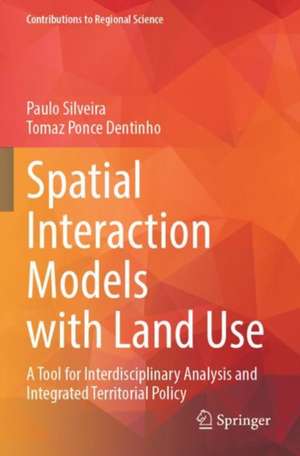
Spatial Interaction Models with Land Use: Contributions to Regional Science
Autor Paulo Silveira, Tomaz Ponce Dentinhoen Limba Engleză Paperback – 26 apr 2025
This book will appeal to scholars and students of regional and spatial science, ecological economics, and agricultural economics, as well as to spatial planners and practitioners dealing with issues of spatial planning to address such problems as unsustainable land use, adaptation to climate change, desertification of rural areas heavily dependent on land use, and the impacts of external shocks on land and property values.




Preț: 680.94 lei
Preț vechi: 895.98 lei
-24%
Puncte Express: 1021
Carte tipărită la comandă
Livrare economică 05-11 decembrie
Livrare prin curier în România Termenul estimat este afișat lângă disponibilitate.
Transport gratuit pentru acest produs Plată online sau ramburs, în funcție de opțiunile comenzii.
Retur gratuit în 14 zile Comandă securizată și suport în română.
Specificații
ISBN-13: 9783031550102
ISBN-10: 3031550102
Pagini: 204
Dimensiuni: 155 x 235 x 11 mm
Greutate: 0.36 kg
Editura: Springer
Seria Contributions to Regional Science
ISBN-10: 3031550102
Pagini: 204
Dimensiuni: 155 x 235 x 11 mm
Greutate: 0.36 kg
Editura: Springer
Seria Contributions to Regional Science
Notă biografică
Tomaz Ponce Dentinho is a Professor of Regional, Environmental, and Agriculture Economics at the University of Azores, Portugal.
Paulo Ávila Silveira is an expert at the Statistics Department of the Azores, Portugal.
Paulo Ávila Silveira is an expert at the Statistics Department of the Azores, Portugal.
Textul de pe ultima copertă
This book develops spatial interaction models for the analysis of human interaction within space, in terms of both accessibility and land use. Presenting case studies on the Azores and Morocco, it covers applications in various regions of Europe and Africa. The respective models simulate land use, employment, households, commuting and shopping movements and land values, employment distribution for basic activities, changes in accessibility, and changes in land suitability due to climate change. This book will appeal to scholars and students of regional and spatial science, ecological economics, and agricultural economics, as well as to spatial planners and practitioners dealing with issues of spatial planning to address such problems as unsustainable land use, adaptation to climate change, desertification of rural areas heavily dependent on land use, and the impacts of external shocks on land and property values.
Caracteristici
Develops spatial interaction models for the analysis of human interaction Presents case studies on the Azores and Morocco Written for scholars of regional and spatial science and economics