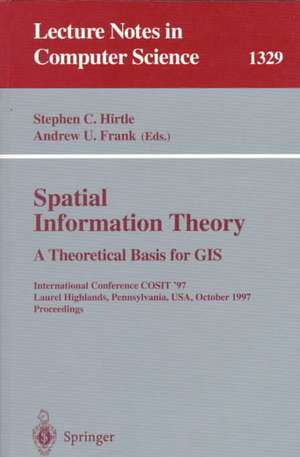
Spatial Information Theory A Theoretical Basis for GIS
Editat de Stephen C. Hirtle, Andrew U. Franken Limba Engleză Paperback – oct 1997
Preț: 661.32 lei
Preț vechi: 826.65 lei
-20%
Puncte Express: 992
Carte tipărită la comandă
Livrare economică 20 noiembrie-04 decembrie
Livrare prin curier în România Termenul estimat este afișat lângă disponibilitate.
Transport gratuit pentru acest produs Plată online sau ramburs, în funcție de opțiunile comenzii.
Retur gratuit în 14 zile Comandă securizată și suport în română.
Specificații
ISBN-13: 9783540636236
ISBN-10: 3540636234
Pagini: 532
Ilustrații: XIV, 518 p.
Dimensiuni: 155 x 235 x 29 mm
Greutate: 0.8 kg
Ediția:1997
Editura: Springer
Locul publicării:Berlin, Heidelberg, Germany
ISBN-10: 3540636234
Pagini: 532
Ilustrații: XIV, 518 p.
Dimensiuni: 155 x 235 x 29 mm
Greutate: 0.8 kg
Ediția:1997
Editura: Springer
Locul publicării:Berlin, Heidelberg, Germany
V-ar putea interesa
-
 -18%Preț: 1645.96 lei2007.27 lei
 -
 Cognitive and Linguistic Aspects of Geographic SpaceAndrew U. Frank-18%Preț: 1891.12 lei2306.25 lei
 -
 Computer VisionSimon J. D. Prince-20%Preț: 574.23 lei717.78 lei
 -
 Enterprise Content and Search Management for Building Digital PlatformsShailesh Kumar Shivakumar-20%Preț: 510.94 lei638.68 lei
 -
 Spock: Up and RunningRob Fletcher-20%Preț: 351.55 lei439.44 lei
 -
 Tragic DesignJonathan Shariat-20%Preț: 186.50 lei233.12 lei
 -
 Thoughtful Machine Learning with PythonMatthew Kirk-20%Preț: 251.71 lei314.64 lei
 -
 This is Service Design DoingMarc Stickdorn-20%Preț: 263.20 lei329.00 lei
 -
 Karau, H: High Performance SparkHolden Karau-20%Preț: 242.50 lei303.13 lei
 -
 Practical TableauRyan Sleeper-20%Preț: 314.69 lei393.36 lei
 -
 Course in Mathematical CryptographyGilbert Baumslag-20%Preț: 343.49 lei429.36 lei
 -
 Geographic Information ScienceMatt Duckham-20%Preț: 339.95 lei424.94 lei
 -
 -20%Preț: 622.31 lei777.89 lei
 -
 -20%Preț: 402.90 lei503.62 lei
 -
 -20%Preț: 417.15 lei521.43 lei
 -
 GI — 7. Jahrestagung: Nürnberg, 26.– 28. September 1977H. J. Schneider-20%Preț: 618.78 lei773.47 lei
 -
 -20%Preț: 343.12 lei428.90 lei
 -
 Spatial Information Theory: A Theoretical Basis for GISAndrew U. Frank-20%Preț: 345.68 lei432.09 lei
 -
 Cognitive and Linguistic Aspects of Geographic SpaceMartin Raubal-47%Preț: 586.22 lei1096.26 lei
 -
 Relational Database Systems: Analysis and ComparisonJoachim W. Schmidt-20%Preț: 640.96 lei801.20 lei
 -
 -20%Preț: 272.03 lei340.04 lei
 -
 Funktionstrennung in ERP-Systemen: Konzepte, Methoden und FallstudienPetra Maria Asprion-34%Preț: 376.50 lei569.82 lei
 -
 ISSE 2012 Securing Electronic Business ProcessesHelmut Reimer-20%Preț: 339.66 lei424.58 lei
Public țintă
ResearchCuprins
Continuous change in spatial regions.- Qualitative representation of change.- Image-schemata-based spatial inferences: The container-surface algebra.- A city metaphor to support navigation in complex information spaces.- Using hierarchical spatial data structures for hierarchical spatial reasoning.- Structuring space with image schemata: Wayfinding in airports as a case study.- Fiat and bona fide Boundaries: Towards an ontology of spatially extended objects.- A representation-oriented taxonomy of gradation.- Classification as an impediment to the reliable and valid use of spatial information: A disaggregate approach.- What maps mean to people: Denotation, connotation, and geographic visualization in land-use debates.- The algebraic structure of sets of regions.- Complex regions in topological queries.- A cognitive assessment of topological spatial relations: Results from an empirical investigation.- Voronoï diagrams on line segments: Measurements for contextual generalization purposes.- A qualitative coordinate language of location of figures within the ground.- Identification of fuzzy objects from field observation data.- Long-term spatial representations from pictorial and textual input.- Feature accumulation and route structuring in distance estimations — An interdisciplinary approach.- The perception and cognition of environmental distance: Direct sources of information.- Improving multi-purpose GIS design: Participative design.- Self-organization, cities, cognitive maps and information systems.- Cognitive requirements on making and interpreting maps.- From knowledge to words to wayfinding: Issues in the production and comprehension of route directions.- Spatial representation for pragmatic navigation.- Partition and conquer.- Supporting emergence in spatialreasoning with shape algebras and formal logic.- Linear constraints: Geometric objects represented by inequalitiesl.- An event-based approach to spatial information.- Geocognostics — A new framework for spatial information theory.- Graphical modelling for geographic explanation.- Experiments using context and significance to enhance the reporting capabilities of gis.- Automatic summarization of radiographic imagery.- An automated system for name placement which complies with cartographic quality criteria: The hydrographic network.- Agent-based simulations of a city dynamics in a gis environment.- A logical approach to incorporating qualitative spatial reasoning into GIS (Extended Abstract).- User interaction in a sketch-based GIS user interface.- Metrical refinement of topological relations.- Approximation of topological relations between fuzzy regions satisfying a linguistically described query.