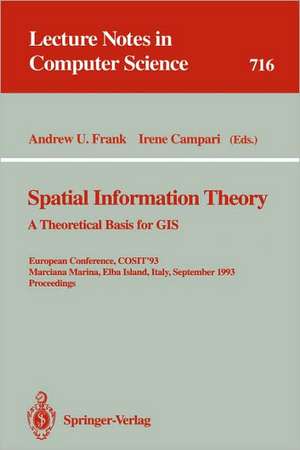
Spatial Information Theory: A Theoretical Basis for GIS
Editat de Andrew U. Frank, Irene Camparien Limba Engleză Paperback – 2 sep 1993
Preț: 332.39 lei
Preț vechi: 415.48 lei
-20%
Puncte Express: 499
Carte tipărită la comandă
Livrare economică 11-25 iunie
Specificații
ISBN-13: 9783540572077
ISBN-10: 3540572074
Pagini: 500
Ilustrații: XII, 488 p.
Dimensiuni: 155 x 235 x 27 mm
Greutate: 0.75 kg
Ediția:1993
Editura: Springer
Locul publicării:Berlin, Heidelberg, Germany
ISBN-10: 3540572074
Pagini: 500
Ilustrații: XII, 488 p.
Dimensiuni: 155 x 235 x 27 mm
Greutate: 0.75 kg
Ediția:1993
Editura: Springer
Locul publicării:Berlin, Heidelberg, Germany
V-ar putea interesa
-
 Performance Analysis of ATM NetworksDemetres D Kouvatsos-20%Preț: 1248.66 lei1560.83 lei
 -
 -18%Preț: 1577.34 lei1923.59 lei
 -
 -18%Preț: 1761.47 lei2148.13 lei
 -
 Computer Vision: Models, Learning, and InferenceSimon J. D. Prince-20%Preț: 528.19 lei660.24 lei
 -
 Enterprise Content and Search Management for Building Digital PlatformsShailesh Kumar Shivakumar-20%Preț: 491.62 lei614.53 lei
 -
 Spock: Up and RunningRob Fletcher-20%Preț: 338.31 lei422.88 lei
 -
 Tragic DesignJonathan Shariat-20%Preț: 178.73 lei223.41 lei
 -
 Thoughtful Machine Learning with PythonMatthew Kirk-20%Preț: 240.54 lei300.67 lei
 -
 This is Service Design DoingMarc Stickdorn-20%Preț: 246.08 lei307.59 lei
 -
 Karau, H: High Performance SparkHolden Karau-20%Preț: 233.24 lei291.55 lei
 -
 Practical TableauRyan Sleeper-20%Preț: 304.12 lei380.15 lei
 -
 A Course in Mathematical CryptographyGilbert Baumslag-20%Preț: 321.05 lei401.31 lei
 -
 Geographic Information ScienceMatt Duckham-20%Preț: 326.88 lei408.60 lei
 -
 -20%Preț: 639.38 lei799.23 lei
 -
 -20%Preț: 207.50 lei259.38 lei
 -
 -20%Preț: 337.93 lei422.41 lei
 -
 -20%Preț: 313.95 lei392.44 lei
 -
 -20%Preț: 329.94 lei412.42 lei
 -
 Spatial Information Theory A Theoretical Basis for GISStephen C. Hirtle-20%Preț: 635.76 lei794.70 lei
 -
 -20%Preț: 327.92 lei409.89 lei
 -
 Service AvailabilityMiroslaw Malek-20%Preț: 315.61 lei394.51 lei
 -
 -47%Preț: 562.99 lei1060.84 lei
Public țintă
ResearchCuprins
A cognitive model for the process of multimodal, incremental route descriptions.- Cognitive maps, cognitive collages, and spatial mental models.- A logical framework for reasoning about space.- Maintaining qualitative spatial knowledge.- Qualitative triangulation for spatial reasoning.- Enhancing qualitative spatial reasoning — Combining orientation and distance.- Map semantics.- Development of a cartographic language.- Spatial queries and data models.- Topological querying of multiple map layers.- Towards a conceptual data model for the analysis of spatio-temporal processes: the example of the search for optimal grazing strategies.- The cognitive structure of space: An analysis of temporal sequences.- Hierarchies of space and time.- The voronoi model and cultural space: applications to the social sciences and humanities.- Interaction with GIS attribute data based on categorical coverages.- The semantics of relations in 2D space using representative points: Spatial indexes.- Computing visibility maps on a digital terrain model.- Toward a theoretical framework for geographic entity types.- Land, space and spatial planning in three time regions.- Geographic and manipulable space in two Tamil linguistic systems.- Scale and multiple psychologies of space.- GIS and modeling prerequisites.- A map editing kernel implementation: application to multiple scale display.- Metaphors create theories for users.- Using a landscape metaphor to represent a corpus of documents.- From interface to interplace: the spatial environment as a medium for interaction.- A keystroke level analysis of manual map digitizing.- Critical issues in the evaluation of spatial autocorrelation.- A directional path distance model for raster distance mapping.- Symbolic spatial reasoning on object shapes forqualitative matching.- Reasoning about spatial structure in landscapes with Geographic Information Systems.