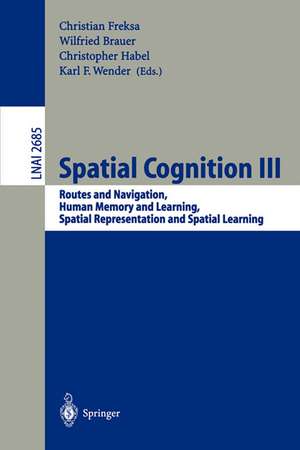
Spatial Cognition III
Editat de Christian Freksa, Wilfried Brauer, Christopher Habel, Karl F. Wenderen Limba Engleză Paperback – 23 iun 2003
Preț: 342.06 lei
Preț vechi: 427.57 lei
-20%
Puncte Express: 513
Carte tipărită la comandă
Livrare economică 27 noiembrie-11 decembrie
Livrare prin curier în România Termenul estimat este afișat lângă disponibilitate.
Transport gratuit de la 400.00 lei Plată online sau ramburs, în funcție de opțiunile comenzii.
Retur gratuit în 14 zile Comandă securizată și suport în română.
Specificații
ISBN-13: 9783540404309
ISBN-10: 3540404309
Pagini: 432
Ilustrații: X, 422 p.
Dimensiuni: 155 x 235 x 24 mm
Greutate: 0.65 kg
Ediția:2003
Editura: Springer
Locul publicării:Berlin, Heidelberg, Germany
ISBN-10: 3540404309
Pagini: 432
Ilustrații: X, 422 p.
Dimensiuni: 155 x 235 x 24 mm
Greutate: 0.65 kg
Ediția:2003
Editura: Springer
Locul publicării:Berlin, Heidelberg, Germany
V-ar putea interesa
-
 -20%Preț: 89.95 lei112.23 lei
 -
 Computer VisionSimon J. D. Prince-20%Preț: 582.72 lei728.39 lei
 -
 Machine LearningPeter Flach-20%Preț: 386.84 lei483.55 lei
 -
 Multi-Agent Machine LearningSchwartz-20%Preț: 675.81 lei844.77 lei
 -
 Wavelet Neural NetworksAntonis K Alexandridis-20%Preț: 634.18 lei792.72 lei
 -
 Practical Introduction to CompDawson-Howe-20%Preț: 518.21 lei647.76 lei
 -
 Machine Learning: An Algorithmic Perspective, Second EditionStephen Marsland-20%Preț: 625.22 lei781.53 lei
 -
 -9%Preț: 987.33 lei1084.98 lei
 -
 Multidisciplinary Approaches to Language ProductionChristopher Habel-23%Preț: 1172.45 lei1522.65 lei
 -
 Procedural Content Generation in GamesNoor Shaker-20%Preț: 495.59 lei619.49 lei
 -
 Decision Diagrams for OptimizationDavid Bergman-20%Preț: 614.34 lei767.93 lei
 -
 -20%Preț: 667.38 lei834.22 lei
 -
 Computer Supported Qualitative ResearchAntónio Pedro Costa-20%Preț: 666.51 lei833.14 lei
 -
 Software Engineering: Challenges and SolutionsLech Madeyski-20%Preț: 956.11 lei1195.14 lei
 -
 Computational CreativityTony Veale-20%Preț: 1212.70 lei1515.87 lei
 -
 Räumliche Konzepte und sprachliche StrukturenChristiane Von Stutterheim-23%Preț: 1122.55 lei1457.86 lei
 -
 -20%Preț: 176.20 lei220.25 lei
 -
 Automata, Languages and ProgrammingWilfried Brauer-20%Preț: 416.55 lei520.69 lei
 -
 Logic and Algebra of SpecificationFriedrich L. Bauer-20%Preț: 1032.69 lei1290.86 lei
 -
 Preț: 317.00 lei
 -
 Believable BotsPhilip Hingston-20%Preț: 676.70 lei845.88 lei
 -
 Transactions on Computational Science XXVIIIMarina L. Gavrilova-20%Preț: 338.34 lei422.92 lei
Public țintă
ResearchCuprins
Routes and Navigation.- Navigating by Mind and by Body.- Pictorial Representations of Routes: Chunking Route Segments during Comprehension.- Self-localization in Large-Scale Environments for the Bremen Autonomous Wheelchair.- The Role of Geographical Slant in Virtual Environment Navigation.- Granularity Transformations in Wayfinding.- A Geometric Agent Following Route Instructions.- Cognition Meets Le Corbusier — Cognitive Principles of Architectural Design.- Human Memory and Learning.- The Effect of Speed Changes on Route Learning in a Desktop Virtual Environment.- Is It Possible to Learn and Transfer Spatial Information from Virtual to Real Worlds?.- Acquisition of Cognitive Aspect Maps.- How Are the Locations of Objects in the Environment Represented in Memory?.- Priming in Spatial Memory: A Flow Model Approach.- Context Effects in Memory for Routes.- Spatial Representation.- Towards an Architecture for Cognitive Vision Using Qualitative Spatio-temporal Representations and Abduction.- How Similarity Shapes Diagrams.- Spatial Knowledge Representation for Human-Robot Interaction.- How Many Reference Frames?.- Motion Shapes: Empirical Studies and Neural Modeling.- Use of Reference Directions in Spatial Encoding.- Spatial Reasoning.- Reasoning about Cyclic Space: Axiomatic and Computational Aspects.- Reasoning and the Visual-Impedance Hypothesis.- Qualitative Spatial Reasoning about Relative Position.- Interpretation of Intentional Behavior in Spatial Partonomies.