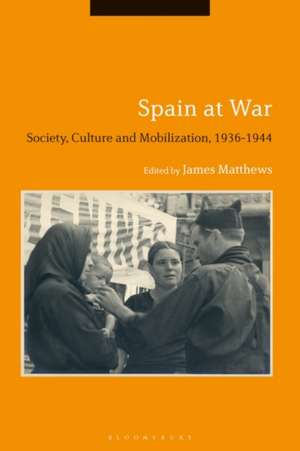
Spain at War: Society, Culture and Mobilization, 1936-44
Editat de Dr James Matthewsen Limba Engleză Hardback – 18 apr 2019
In spite of the unabated flood of books on the Spanish Civil War and its consequences, historians of Spain in the 20th century have focused relatively little on the interaction of society and culture, and their roles in wartime mobilization. Spain at War addresses this omission through an examination of individual experiences of conflict and the mobilization of society. This edited volume acknowledges the agency of low-ranking individuals and the impact of their choices upon the historical processes that shaped the conflict and its aftermath.
In doing so, this new military history provides a more complex and nuanced understanding of Spain's most intense period of wartime cultural mobilization between the years 1936 to 1944 and challenges traditional political accounts of the period.
Preț: 709.53 lei
Preț vechi: 937.67 lei
-24%
Puncte Express: 1064
Carte tipărită la comandă
Livrare economică 27 noiembrie-11 decembrie
Livrare prin curier în România Termenul estimat este afișat lângă disponibilitate.
Transport gratuit pentru acest produs Plată online sau ramburs, în funcție de opțiunile comenzii.
Retur gratuit în 14 zile Comandă securizată și suport în română.
Specificații
ISBN-13: 9781350030121
ISBN-10: 1350030120
Pagini: 280
Ilustrații: 14 bw illus
Dimensiuni: 156 x 234 x 16 mm
Greutate: 0.52 kg
Editura: Bloomsbury Publishing
Colecția Bloomsbury Academic
Locul publicării:London, United Kingdom
ISBN-10: 1350030120
Pagini: 280
Ilustrații: 14 bw illus
Dimensiuni: 156 x 234 x 16 mm
Greutate: 0.52 kg
Editura: Bloomsbury Publishing
Colecția Bloomsbury Academic
Locul publicării:London, United Kingdom
Cuprins
1. Introduction - James Matthews (Independent Scholar, Spain)
Initial Mobilization
2. 'With Nothing but Our Bared Chests': Republican Militia Columns in the Early Phase of the Spanish Civil War - Michael Alpert (University of Westminster, UK) and James Matthews (Independent Scholar, Spain)
3. Red Berets, Blue Shirts: Nationalist Militia Forces in the Spanish Civil War - Mercedes Peñalba Sotorrío (Manchester Metropolitan University)
Mobilizing for Total War
4. Foot Soldiers for the Two Spains: Conscript Experience during the Spanish Civil War - James Matthews (Independent Scholar, Spain)
5. Desertion and Shirking in the Civil War: Man Versus Propaganda - Pedro Corral (Independent Scholar, Spain)
6. The Reds and the Greens. Encounters between Moroccan and Republican Enemies during the Spanish Civil War - Ali Al Tuma (UN University Tokyo, Japan)
7. Republican Spies and their Civilian Informers in the Nationalist Rear Guard during the Spanish Civil War - Hernán Rodríguez Velasco (University of Salamanca, Spain)
Rear Guard Areas and Actors
8. Political Economies and Monetary Policies during the Spanish Civil War - Michael Seidman (University of North Carolina, USA)
9. Social Work in the Spanish Civil War - Ángela Cenarro (University of Zaragoza, Spain)
10. A Lost Generation?: Children and the Spanish Civil War - Verónica Sierra Blas (University of Alcalá de Henares, Spain)
11. Homefront Cooking: Eating and Daily Life in Republican Cities during the Spanish Civil War - Suzanne Dunai (University of California San Diego, USA)
Legacies of the Spanish Civil War, 1939-1944
12. The Demobilization of Francoist and Republican War Veterans, 1939-1944: A Great Divergence? - Ángel Alcalde (University of Melbourne, Australia)
13. A Spanish Exception in a War of Extermination? The 'Blue Division' on the Eastern Front, 1941-44 - Xosé Manoel Núñez Seixas (University of Santiago de Compostela, Spain)
14. 'Boys into Men': The Emergence of Francoist Martial Masculinity 1939-1944 - Ian Winchester (University of New Mexico, USA)
Initial Mobilization
2. 'With Nothing but Our Bared Chests': Republican Militia Columns in the Early Phase of the Spanish Civil War - Michael Alpert (University of Westminster, UK) and James Matthews (Independent Scholar, Spain)
3. Red Berets, Blue Shirts: Nationalist Militia Forces in the Spanish Civil War - Mercedes Peñalba Sotorrío (Manchester Metropolitan University)
Mobilizing for Total War
4. Foot Soldiers for the Two Spains: Conscript Experience during the Spanish Civil War - James Matthews (Independent Scholar, Spain)
5. Desertion and Shirking in the Civil War: Man Versus Propaganda - Pedro Corral (Independent Scholar, Spain)
6. The Reds and the Greens. Encounters between Moroccan and Republican Enemies during the Spanish Civil War - Ali Al Tuma (UN University Tokyo, Japan)
7. Republican Spies and their Civilian Informers in the Nationalist Rear Guard during the Spanish Civil War - Hernán Rodríguez Velasco (University of Salamanca, Spain)
Rear Guard Areas and Actors
8. Political Economies and Monetary Policies during the Spanish Civil War - Michael Seidman (University of North Carolina, USA)
9. Social Work in the Spanish Civil War - Ángela Cenarro (University of Zaragoza, Spain)
10. A Lost Generation?: Children and the Spanish Civil War - Verónica Sierra Blas (University of Alcalá de Henares, Spain)
11. Homefront Cooking: Eating and Daily Life in Republican Cities during the Spanish Civil War - Suzanne Dunai (University of California San Diego, USA)
Legacies of the Spanish Civil War, 1939-1944
12. The Demobilization of Francoist and Republican War Veterans, 1939-1944: A Great Divergence? - Ángel Alcalde (University of Melbourne, Australia)
13. A Spanish Exception in a War of Extermination? The 'Blue Division' on the Eastern Front, 1941-44 - Xosé Manoel Núñez Seixas (University of Santiago de Compostela, Spain)
14. 'Boys into Men': The Emergence of Francoist Martial Masculinity 1939-1944 - Ian Winchester (University of New Mexico, USA)
Recenzii
Spain at War demonstrates a truly impressive archival grounding, and will interest anyone who has perhaps read the broad strokes about the Spanish Civil War, but is ready to explore cutting edge research at the intersections of military and socio-cultural history. For the scholar of Spain, it is essentially reading.
An inventive exploration of military mobilization during the Spanish Civil War, Jamie Matthews' wide-ranging volume offers new perspectives on the conflict by examining the experiences of spies, conscripts, children, and other 'ordinary' Spaniards during turbulent and dislocating times.
This is an impressive collection which brings together a significant amount of new research, some of it in translation. Above all, the book presents a new vision of the Spanish Civil War. Instead of heroic, ideologically-motivated volunteers we see a landscape populated by conscripts, deserters, spies and black marketeers, all engaged in the daily struggle for survival. This is a very different - and all too credible - account of a country in the throes of a devastating civil conflict.
A lively, illuminating and welcome examination of the little-explored links between society, culture and the armed forces during and after the Spanish Civil War.
[A] fairly coherent and well-structured volume in which short chapters present the most innovative and recent research on the Spanish Civil War ... this particular book allows the reader to keep abreast of the latest historiographical developments with relatively little effort.
An inventive exploration of military mobilization during the Spanish Civil War, Jamie Matthews' wide-ranging volume offers new perspectives on the conflict by examining the experiences of spies, conscripts, children, and other 'ordinary' Spaniards during turbulent and dislocating times.
This is an impressive collection which brings together a significant amount of new research, some of it in translation. Above all, the book presents a new vision of the Spanish Civil War. Instead of heroic, ideologically-motivated volunteers we see a landscape populated by conscripts, deserters, spies and black marketeers, all engaged in the daily struggle for survival. This is a very different - and all too credible - account of a country in the throes of a devastating civil conflict.
A lively, illuminating and welcome examination of the little-explored links between society, culture and the armed forces during and after the Spanish Civil War.
[A] fairly coherent and well-structured volume in which short chapters present the most innovative and recent research on the Spanish Civil War ... this particular book allows the reader to keep abreast of the latest historiographical developments with relatively little effort.