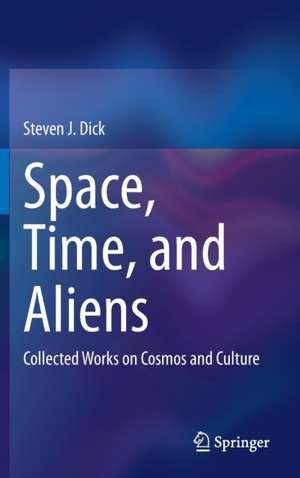
Space, Time, and Aliens
Autor Steven J. Dicken Limba Engleză Hardback – 12 mai 2020
In this comprehensive and interdisciplinary volume, former NASA Chief Historian Steven Dick reflects on the exploration of space, astrobiology and its implications, cosmic evolution, astronomical institutions, discovering and classifying the cosmos, and the philosophy of astronomy. The unifying theme of the book is the connection between cosmos and culture, or what Carl Sagan many years ago called the “cosmic connection.”
As both an astronomer and historian of science, Dr. Dick has been both a witness to and a participant in many of the astronomical events of the last half century. This collection of papers presents his reflections over the last forty years in a way accessible to historians, philosophers, and scientists alike. From the search for alien life to ongoing space exploration efforts, readers will find this volume full of engaging topics relevant to science, society, and our collective future on planet Earth and beyond.
As both an astronomer and historian of science, Dr. Dick has been both a witness to and a participant in many of the astronomical events of the last half century. This collection of papers presents his reflections over the last forty years in a way accessible to historians, philosophers, and scientists alike. From the search for alien life to ongoing space exploration efforts, readers will find this volume full of engaging topics relevant to science, society, and our collective future on planet Earth and beyond.
Preț: 956.33 lei
Preț vechi: 1166.25 lei
-18%
Puncte Express: 1434
Carte tipărită la comandă
Livrare economică 26 decembrie 26 - 09 ianuarie 27
Livrare prin curier în România Termenul estimat este afișat lângă disponibilitate.
Transport gratuit pentru acest produs Plată online sau ramburs, în funcție de opțiunile comenzii.
Retur gratuit în 14 zile Comandă securizată și suport în română.
Specificații
ISBN-13: 9783030416133
ISBN-10: 3030416135
Pagini: 824
Ilustrații: XXII, 799 p. 127 illus., 71 illus. in color.
Dimensiuni: 160 x 241 x 50 mm
Greutate: 1.33 kg
Ediția:1st edition 2020
Editura: Springer International Publishing
Locul publicării:Cham, Switzerland
ISBN-10: 3030416135
Pagini: 824
Ilustrații: XXII, 799 p. 127 illus., 71 illus. in color.
Dimensiuni: 160 x 241 x 50 mm
Greutate: 1.33 kg
Ediția:1st edition 2020
Editura: Springer International Publishing
Locul publicării:Cham, Switzerland
Cuprins
Epigraph
Dedication
Preface: Cosmos and Culture
Part I. The Biological Universe
Introduction
1. Plurality of Worlds: A Persistent Theme in Western Civilization
2. The Twentieth Century History of the Extraterrestrial Life Debate: Major Themes
3. From the Physical World to the Biological Universe: Historical Developments Underlying the Search for Extraterrestrial Intelligence (SETI)
4. The Biophysical Cosmology: The Place of Bioastronomy in the History of Science
5. The Biological Universe Revisited
6. Back to the Future: SETI Before the Space Age
7. The Drake Equation in Context
Part II. Cosmic Evolution and Implications of Alien Life
Introduction
8. Cosmic Evolution: History, Culture, and Human Destiny
9. Consequences of Success in SETI: Lessons from the History of Science 10. Cultural Aspects of Astrobiology: A Preliminary Reconnaissance at the Turn of the Millennium
11. The Role of Anthropology in SETI: An Historical View 12. Bringing Culture to Cosmos: Cultural Evolution, the Postbiological Universe, and SETI
13. Toward a Constructive Naturalistic Cosmotheology
14. Astroethics and Cosmocentrism
15. Should We Message ET and Is an Asilomar Consultation Process Possible
16. Astrobiology and Society: An Overview at the Beginning of the 21st Century Part III. The Exploration of Space
Introduction
17. Exploring the Unknown: 50 Years of NASA History
18. Exploration, Discovery and Culture: NASA’s Role in History
19. Space, Time and Aliens: The Role of Imagination in Outer Space
20. The Impact of the Hubble Space Telescope 21. The Decision to Cancel the Hubble Space Telescope Servicing Mission (SM4) and its Reversal
22. Reflections on French-American Relations in Space, 1957–1975
Part IV. Measuring the Universe: Goals, Institutions, Techniques
Introduction
23. Measuring the Universe: A Brief History of Astrometry
24. Pulkovo Observatory and the National Observatory Movement 25. John Quincy Adams, the Smithsonian Bequest, and the Origins of the U. S. Naval Observatory
26. The First Time Balls, the First North American Time Ball
27. The U. S. Naval Astronomical Expedition of James Melville Gilliss in the Southern Hemisphere, 1849-1852 28. Measuring the Astronomical Unit: The American Transit of Venus Expeditions of 1874 and 1882
29. Geodesy, Time, and the Markowitz Moon Camera: An Interwoven International Geophysical Year Story
Part V. Discovering, Classifying, and Understanding the Cosmos
Introduction
30. Pluto, Discovery, and Classification in Astronomy
31. Astronomy’s Three Kingdoms: A Comprehensive Classification System for Astronomy
32. The Discovery of Polar Motion and its Importance
33. Observation and Interpretation of the Leonid Meteors over the Last Millennium
34. The Discovery and Exploration of the Moons of Mars
35. The Universe and Alfred Russel Wallace 36. Discovering a New Realm of the Universe: Hubble, Galaxies, and Classification
Part VI The Philosophy of Astronomy, Cosmology, and Astrobiology
Introduction
37. The Philosophy of Astronomy, Cosmology, and Astrobiology: A Preliminary Reconnaissance
38. Critical Issues in the History, Philosophy, and Sociology of Astrobiology
39. Lessons Learned from the Twentieth-Century Extraterrestrial Life Debate 40. Cosmology and Biology, an Entangled Web?
Part VII Envoi: Reflections on Humanity and the Cosmos
41. Interstellar Humanity
42. The Consolations of Astronomy and the Cosmic Perspective
Appendix 1 Testimony Before the United States Congress
Appendix 2 Sources and Permissions
Recenzii
“Steven Dick’s writing is always very interesting, thoughtful, and well-researched, and he is very good at covering broad themes. … Much of this book is an interesting read, and it forms a very useful reference work … .” (Richard McKim, The Observatory, Vol. 141 (1282), June, 2021)
“Steve Dick not only makes accessible a significant portion of his oeuvre, but provides perceptive contemporary commentary on how the many questions and issues he has addressed over the years in the areas of the history of astronomy, the taxonomy of astronomical practice, the continuing search for life elsewhere in the Universe, and the question of the ubiquity of life itself, have fared, through his efforts and those of many others.” (David H. DeVorkin, Journal of Astronomical History and Heritage, Vol. 23 (3), 2020)
“Steve Dick not only makes accessible a significant portion of his oeuvre, but provides perceptive contemporary commentary on how the many questions and issues he has addressed over the years in the areas of the history of astronomy, the taxonomy of astronomical practice, the continuing search for life elsewhere in the Universe, and the question of the ubiquity of life itself, have fared, through his efforts and those of many others.” (David H. DeVorkin, Journal of Astronomical History and Heritage, Vol. 23 (3), 2020)
Notă biografică
Steven J. Dick held the 2014 Baruch S. Blumberg NASA/Library of Congress Chair in Astrobiology at the Kluge Center of the Library of Congress. In 2013 he testified before Congress on the subject of astrobiology. He served as the Charles A. Lindbergh Chair in Aerospace History at the National Air and Space Museum from 2011-2012, and as the NASA Chief Historian and Director of the NASA History Office from 2003-2009. Prior to that, he worked as an astronomer and historian of science at the U.S. Naval Observatory in Washington, D.C. for 24 years, including three years on a mountaintop in New Zealand. He obtained his B.S. in astrophysics (1971), and MA and PhD (1977) in history and philosophy of science from Indiana University.
Among his books are Plurality of Worlds: The Origins of the Extraterrestrial Life Debate from Democritus to Kant (Cambridge University Press, 1982) (translated into French), The Biological Universe: The Twentieth Century Extraterrestrial Life Debate and the Limits of Science (Cambridge University Press, 1996), and Life on Other Worlds (Cambridge University Press, 1998), the latter translated into Chinese, Italian, Czech, Greek and Polish. He has also authored (with James Strick) The Living Universe: NASA and the Development of Astrobiology (2004), and a comprehensive history of the U. S. Naval Observatory, Sky and Ocean Joined: The U. S. Naval Observatory, 1830-2000 (Cambridge University Press, 2003). The latter received the Pendleton Prize of the Society for History in the Federal Government. He is also editor of Many Worlds: The New Universe, Extraterrestrial Life and the Theological Implications (2000), and (with Keith Cowing) Risk and Exploration: Earth, Sea and Stars (NASA SP-2005-4701 (Washington, D.C., 2005), and numerous volumes in the NASA History series. His book Discovery and Classification in Astronomy: Controversy and Consensus was published by Cambridge University Press in 2013. He is editor of the The Impact of Discovering Life Beyond Earth, published by Cambridge University Press in November, 2015, and Historical Studies in the Societal Impact of Spaceflight (NASA, 2015). Dr. Dick's recent book, Astrobiology, Discovery and Societal Impact (Cambridge University Press, 2018) won the the 2019 PROSE award for Cosmology & Astronomy.
Dr. Dick is the recipient of the NASA Exceptional Service Medal, the Navy Meritorious Civilian Service Medal, the NASA Group Achievement Award for his role in NASA's multidisciplinary program in astrobiology, the NASA Group Achievement Award for the book America in Space, and the 2006 LeRoy E. Doggett Prize for Historical Astronomy of the American Astronomical Society. In 2012 he was elected a Fellow of the American Association for the Advancement of Science (AAAS). He has served as Chairman of the Historical Astronomy Divisionof the American Astronomical Society, as President of the History of Astronomy Commission of the International Astronomical Union, and as President of the Philosophical Society of Washington. He is a member of the American Astronomical Society, the International Astronomical Union, and a corresponding member of the International Academy of Astronautics. In 2009 the International Astronomical Union designated minor planet 6544 stevendick in his honor.
Textul de pe ultima copertă
In this comprehensive and interdisciplinary volume, former NASA Chief Historian Steven Dick reflects on the exploration of space, astrobiology and its implications, cosmic evolution, astronomical institutions, discovering and classifying the cosmos, and the philosophy of astronomy. The unifying theme of the book is the connection between cosmos and culture, or what Carl Sagan many years ago called the “cosmic connection.”
As both an astronomer and historian of science, Dr. Dick has been both a witness to and a participant in many of the astronomical events of the last half century. This collection of papers presents his reflections over the last forty years in a way accessible to historians, philosophers, and scientists alike. From the search for alien life to ongoing space exploration efforts, readers will find this volume full of engaging topics relevant to science, society, and our collective future on planet Earth and beyond.
As both an astronomer and historian of science, Dr. Dick has been both a witness to and a participant in many of the astronomical events of the last half century. This collection of papers presents his reflections over the last forty years in a way accessible to historians, philosophers, and scientists alike. From the search for alien life to ongoing space exploration efforts, readers will find this volume full of engaging topics relevant to science, society, and our collective future on planet Earth and beyond.
Caracteristici
Includes more than 40 papers written by a former NASA Chief Historian
Analyzes topics in cosmology and astronomy from an interdisciplinary lens
Covers all ongoing, major themes in the new field of philosophy of astronomy
Analyzes topics in cosmology and astronomy from an interdisciplinary lens
Covers all ongoing, major themes in the new field of philosophy of astronomy