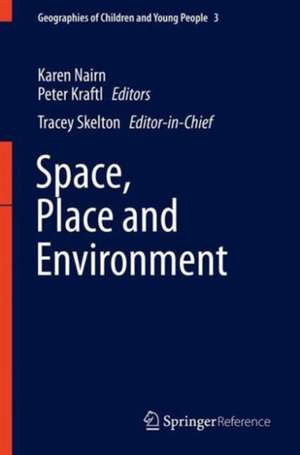
Space, Place, and Environment: Geographies of Children and Young People, cartea 3
Editat de Karen Nairn, Peter Kraftlen Limba Engleză Hardback – 6 iul 2016
Descoperim în această primă ediție a volumului Space, Place, and Environment, publicat sub egida Springer, o analiză riguroasă a modului în care mediul înconjurător și conceptele de spațiu și loc interacționează cu viața tinerilor. Ca parte integrantă a seriei Geographies of Children and Young People, lucrarea se distinge prin extinderea cercetării dincolo de cadrele tradiționale, integrând analize despre spațiile digitale și relațiile postumaniste. Observăm o structură clară, divizată în cinci secțiuni care ghidează cititorul de la realitățile tinerilor indigeni și educația ecologică (cum ar fi grădinile școlare sau traseele de sustenabilitate), până la dinamica complexă a spațiilor urbane și a frontierelor sociale. Această lucrare acoperă aceeași arie tematică precum Rethinking Young People's Lives Through Space and Place de Anuppiriya Sriskandarajah, dar cu o abordare mai extinsă din punct de vedere geografic, incluzând studii de caz din regiuni mai puțin explorate precum Kazahstan sau Indonezia. În timp ce alte titluri se concentrează pe sociologia generală a copilăriei, volumul editat de Karen Nairn, Peter Kraftl și Tracey Skelton pune accentul pe producția relațională a granițelor dintre urban și rural, respectiv dintre copilărie și maturitate. Găsim aici o explorare detaliată a „culturii dormitorului” și a geografiei somnului în rândul tinerilor străzii din Brazilia, oferind o perspectivă nuanțată asupra modului în care identitatea este performată atât în spațiul fizic, cât și pe platforme precum Facebook. Progresia capitolelor reflectă o trecere de la micro-spații (dormitor, grădină) la macro-spații (frontiere, mișcări globale de mediu), susținând necesitatea recunoașterii drepturilor spațiale ale noilor generații.


Preț: 2585.86 lei
Preț vechi: 3153.49 lei
-18%
Carte disponibilă
Livrare economică 10-24 noiembrie
Specificații
ISBN-10: 9812870431
Pagini: 592
Ilustrații: XXIII, 566 p. 44 illus., 41 illus. in color.
Dimensiuni: 160 x 241 x 36 mm
Greutate: 1.1 kg
Ediția:1st ed. 2016
Editura: Springer
Colecția Geographies of Children and Young People
Seria Geographies of Children and Young People
Locul publicării:Singapore, Singapore
V-ar putea interesa
-
 KithJay GriffithsPreț: 124.56 lei
 -
 -32%Preț: 532.72 lei788.27 lei
 -
 Cultural Geographies: An IntroductionJohn Horton-15%Preț: 645.98 lei759.97 lei
 -
 Cool Places: Geographies of Youth CulturesTracey Skelton-18%Preț: 1482.67 lei1808.13 lei
 -
 Great Myths of Child DevelopmentStephen HuppPreț: 149.27 lei
 -
 Preț: 356.32 lei
 -
 Children's Emotions in Policy and PracticeMatej BlazekPreț: 410.29 lei
 -
 Media and the Sexualization of ChildhoodBarrie GunterPreț: 378.50 lei
 -
 -22%Preț: 402.97 lei516.63 lei
 -
 -23%Preț: 686.30 lei891.31 lei
 -
 Preț: 337.63 lei
 -
 Child LawLaura Westra-15%Preț: 663.90 lei781.06 lei
 -
 Konzepte und Methoden der JugendberichterstattungHelmut WillemsPreț: 404.42 lei
 -
 Preț: 262.00 lei
 -
 JungenpolitikReinhard WinterPreț: 117.39 lei
 -
 Preț: 116.82 lei
 -
 Männliche Absolute BeginnerRobin Sprenger-15%Preț: 431.55 lei507.70 lei
 -
 Das Bildungssystem und seine strukturellen KopplungenElmar DrieschnerPreț: 447.53 lei
 -
 Sexueller Missbrauch von Kindern und JugendlichenJörg M. Fegert-5%Preț: 552.31 lei581.38 lei
Public țintă
ResearchDe ce să citești această carte
Această resursă academică este esențială pentru cercetătorii din domeniul geografiei umane și al sociologiei educației. Cititorul câștigă o înțelegere profundă a modului în care tinerii își revendică dreptul la spațiu în contexte globale variate. Este o recomandare certă pentru cei interesați de impactul mediului construit și digital asupra formării identității, oferind instrumente teoretice de ultimă oră și exemple practice din peste 15 țări.
Despre autor
Volumul este coordonat de o echipă de experți recunoscuți în geografia socială. Karen Nairn este profesor la Universitatea din Otago, Noua Zeelandă, specializată în geografiile tineretului și activismul politic al acestora. Peter Kraftl deține o catedră la Universitatea din Birmingham, fiind cunoscut pentru cercetările sale despre arhitecturile educaționale și geografiile copilăriei. Tracey Skelton, în calitate de editor-șef al seriei, este profesor la Universitatea Națională din Singapore, având o carieră dedicată studiilor despre tineret, gen și dezvoltare urbană în context global.
Cuprins
Recenzii
Notă biografică
Her future research plans revolve around investigating how diverse collectives of young people think about a future threatened by climate change, economic precarity, and political instability. Her new research intends to find out what young people consider the most urgent issues to address, how hope influences their collective actions for change, and how their identities are shaped in the process.
Tracey Skelton is Associate Professor of Human Geography in the Department of Geography at the National University of Singapore. She was previously Professor of Critical Geographies at the University of Loughborough in the UK. The essential elements of her research career focus on people who are socially, politically, and intellectually excluded. Her early work focused on the Caribbean and issues of gender and racial inequality, feminist geographies, and methodological analysis. She has contributed to culture and development debates, particularly through her longitudinal research on the island of Montserrat. Recently, A/P Skelton returned to this field of scholarship through research with volunteers and host organizations in Cambodia as part of a major comparative and collaborative project on development partnerships. She was the principal investigator of a major comparative urbanism research project on the livability, sustainability, and diversity of four Asian cities: Busan in South Korea, Hyderabad in India, Kunming in China, and Singapore.
A/P Skelton is a recognized international leader in the subdiscipline of children’s and young people’s geographies. In particular, her work has served to challenge the invisibility and marginalization of young people from geographic academic research at the same time as it has demonstrated the rich and varied ways in which young people live their lives both spatially and temporally alongside, but differently from, adults. Her research work has been funded by key research institutions such as the Economic and Social Research Council and the Arts and Humanities Research Council of the UK; the Faculty of Arts and Social Science Academic Research Fund and the Global Asia Institute, both of the National University of Singapore; the Australian Research Council; and the Social Science and Humanities Research Council of Canada.
A/P Skelton was a founding editorial board member of the international journal Children’s Geographies and has been the Viewpoints Editor since 2005 and became the Commissioning Editor for Asia in 2010. She is on the editorial boards of the following journals: Geoforum, the Singapore Journal of Tropical Geography, Geography Compass, and ACME: International Journal of Critical Geographies (open access). She has coauthored 2 books, edited 3 collections, guest-edited 2 special journal issues, and published more than 70 journal articles and chapters. She is a passionate teacher and graduate supervisor. She is committed to the politics of research dissemination in accessible formats, in particular to enable the participants in her research projects to understand and recognize their coproduction of knowledge whether through specialized small-scale workshops, translation of reportsinto local languages, or production of audiovisual materials.
Textul de pe ultima copertă
The volume is organised into five sections: Indigenous Youth: Space and Place; Children, Nature and Environmental Education; Urban Spaces; Home/less Spaces; and Border Spaces. These themes signal the major issues in cutting-edge children’s geographies scholarship. Diverse geographical contexts are covered in this volume – including Australia, Brazil, Canada, Cyprus, Ecuador, India, Indonesia, Kazakhstan, Mexico, Morocco, New Zealand, Peru, Slovenia, Spain, the United Kingdom and the United States.
All of the contributors advocate greater recognition of children and young people’s spatial rights, whether in the home, outdoors, at school, crossing borders, in public and digital spaces, or simply looking for a safe place to sleep. Children and young people’s perspectives on space, place and the environment, and their desire for places to call their own, tie the volume together. The volume is a testament to the politics of the spaces and places of childhood, highlighting how many children and young people face obstacles to living well and to living where they desire.