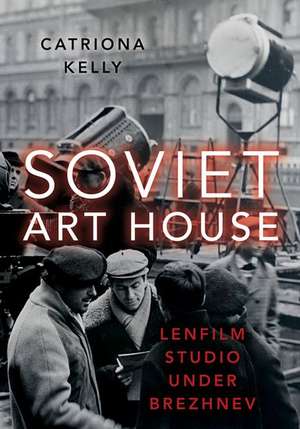
Soviet Art House: Lenfilm Studio under Brezhnev
Autor Catriona Kellyen Limba Engleză Hardback – 31 mar 2021
Preț: 926.83 lei
Preț vechi: 1338.58 lei
-31%
Puncte Express: 1390
Carte tipărită la comandă
Livrare economică 03-09 decembrie
Livrare prin curier în România Termenul estimat este afișat lângă disponibilitate.
Transport gratuit pentru acest produs Plată online sau ramburs, în funcție de opțiunile comenzii.
Retur gratuit în 14 zile Comandă securizată și suport în română.
Specificații
ISBN-13: 9780197548363
ISBN-10: 0197548369
Pagini: 536
Ilustrații: 90 illustrations and production stills
Dimensiuni: 263 x 183 x 37 mm
Greutate: 1.14 kg
Editura: Oxford University Press
Colecția OUP USA
Locul publicării:New York, United States
ISBN-10: 0197548369
Pagini: 536
Ilustrații: 90 illustrations and production stills
Dimensiuni: 263 x 183 x 37 mm
Greutate: 1.14 kg
Editura: Oxford University Press
Colecția OUP USA
Locul publicării:New York, United States
Recenzii
In Soviet Art House, Kelly takes a studio-centric approach to Soviet film history, looking at the Lenfilm Studio from the mid-1960s to the mid-1980s. This studio view provides an opportunity to look beyond common ways in which film historians viewed the Brezhnev years.
This deeply researched work is an extraordinarily innovative contribution to Soviet film studies. Kelly not only provides us with a comprehensive study of a vitally important film studio, one crucial to Soviet cultural endeavors, or pretensions, she also demonstrates how novel many of their offerings were.
There is nothing more difficult than writing about a past that has yet to become history. This richly-researched and truly outstanding book, written with zest and elegance, tells the story of the Lenfilm studio. Through art house Soviet cinema it immerses us in the Brezhnev era, as it opens up the door to the world of Soviet sensitivity and imagination to allow us to understand how the Soviet era was exhausted and why it ended.
In the years of Stagnation, Lenfilm studio was one of the symbols of artistic freedom in the USSR - with reservations, of course. Yet, there has not been a scholarly monograph dedicated to this seminal page in the history of Soviet culture - neither in Russia, nor outside the country. Catriona Kelly's book fills this deplorable gap. But, as a genuine work of history, it covers much more than that. It is a meticulous and pioneering study of the mechanics of Soviet film production, of the cultural politics in the murky period that would eventually lead to the collapse of the Union. But first and foremost, it is a tribute to some of the best films ever produced in one of the leading filmmaking countries, and to the filmmakers with their inevitably dramatic biographies.
To embark on making an art house movie under Brezhnev, the author shows with the clarity and insight of someone who spent years on studying the Lenfilm studio papers, was tantamount to submitting one's creative will to a variety of whims and whips—institutional and ideological. Every chapter in Kelly's book devoted to this or that art film reads like a perilous journey that ends in a miraculous survival.
This deeply researched work is an extraordinarily innovative contribution to Soviet film studies. Kelly not only provides us with a comprehensive study of a vitally important film studio, one crucial to Soviet cultural endeavors, or pretensions, she also demonstrates how novel many of their offerings were.
There is nothing more difficult than writing about a past that has yet to become history. This richly-researched and truly outstanding book, written with zest and elegance, tells the story of the Lenfilm studio. Through art house Soviet cinema it immerses us in the Brezhnev era, as it opens up the door to the world of Soviet sensitivity and imagination to allow us to understand how the Soviet era was exhausted and why it ended.
In the years of Stagnation, Lenfilm studio was one of the symbols of artistic freedom in the USSR - with reservations, of course. Yet, there has not been a scholarly monograph dedicated to this seminal page in the history of Soviet culture - neither in Russia, nor outside the country. Catriona Kelly's book fills this deplorable gap. But, as a genuine work of history, it covers much more than that. It is a meticulous and pioneering study of the mechanics of Soviet film production, of the cultural politics in the murky period that would eventually lead to the collapse of the Union. But first and foremost, it is a tribute to some of the best films ever produced in one of the leading filmmaking countries, and to the filmmakers with their inevitably dramatic biographies.
To embark on making an art house movie under Brezhnev, the author shows with the clarity and insight of someone who spent years on studying the Lenfilm studio papers, was tantamount to submitting one's creative will to a variety of whims and whips—institutional and ideological. Every chapter in Kelly's book devoted to this or that art film reads like a perilous journey that ends in a miraculous survival.
Notă biografică
Catriona Kelly is Professor of Russian at the University of Oxford and a leading historian of Russian culture and society. She is the author of numerous books on Russian modernism, gender history, the history of childhood, national identity, and the recent history of Leningrad/St Petersburg, some of which have been translated into Russian.
Cuprins
- Preface and Acknowledgments
- Terminology, Abbreviations, and Transliteration
- List of Illustrations
- Introduction: The Art House
- Chapter 1. Big Hopes and Trouble, 1961-1969
- Chapter 2. "Serious" Movies and the Box Office, 1970-1985
- Chapter 3. The Cinema-Centaur: Lenfilm as Film Factory
- Chapter 4. Non-Existent Reality: The Lenfilm Aesthetic
- Chapter 5. Pleasure and Danger: Yuly Fait, A Boy and a Girl (1966)
- Chapter 6. The Indifference of Time: Gennady Shpalikov, A Long Happy Life (1967)
- Chapter 7. Regulated Immediacy: Viktor Sokolov, A Day of Sunshine and Rain (1967)
- Chapter 8. More in Expectation than Hope: Naum Birman, Chronicle of a Divebomber (1968)
- Chapter 9. Cold War Fears: Savva Kulish, The Dead Season (1968)
- Chapter 10. Personal Happiness: Vitaly Melnikov, Mother's Got Married (1969)
- Chapter 11. Trust in Talent: Ilya Averbakh, Monologue (1972)
- Chapter 12. Spontaneous Music: Dinara Asanova, Woodpeckers Don't Get Headaches (1974)
- Chapter 13. Fervor and Tenderness: Gleb Panfilov, May I Speak? (1976)
- Chapter 14. Private Grief, Public Mourning: Sergei Mikaelyan, The Widows (1977)
- Chapter 15. Ludic Love: Kira Muratova, Getting to Know the Wide World (1978)
- Chapter 16. Cast a Cold Eye: Boris Frumin, Errors of Youth (1978)
- Chapter 17. Socialist Embarrassment: Viktor Tregubovich, Go If You're Going (1978)
- Chapter 18. The Powers of Irony: Igor Maslennikov, The Queen of Spades (1982)
- Chapter 19. Hystoria: Aleksei German, My Friend Ivan Lapshin (1984)
- Conclusion: Arthouse Beyond the Art House
- Filmography