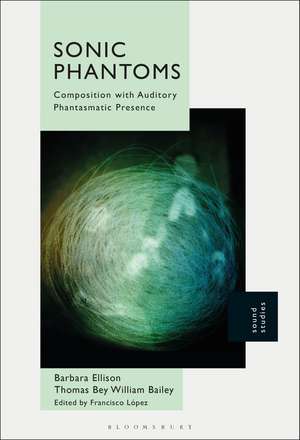
Sonic Phantoms: Composition with Auditory Phantasmatic Presence
Autor Dr Barbara Ellison, Thomas Bey William Bailey Editat de Francisco Lópezen Limba Engleză Hardback – 11 iun 2020
and elevation. We just need to conjure them.
Preț: 709.26 lei
Preț vechi: 937.51 lei
-24%
Puncte Express: 1064
Carte tipărită la comandă
Livrare economică 23 noiembrie-07 decembrie
Livrare prin curier în România Termenul estimat este afișat lângă disponibilitate.
Transport gratuit pentru acest produs Plată online sau ramburs, în funcție de opțiunile comenzii.
Retur gratuit în 14 zile Comandă securizată și suport în română.
Specificații
ISBN-13: 9781501347023
ISBN-10: 1501347020
Pagini: 248
Dimensiuni: 152 x 229 mm
Greutate: 0.51 kg
Editura: Bloomsbury Publishing
Colecția Bloomsbury Academic
Locul publicării:New York, United States
ISBN-10: 1501347020
Pagini: 248
Dimensiuni: 152 x 229 mm
Greutate: 0.51 kg
Editura: Bloomsbury Publishing
Colecția Bloomsbury Academic
Locul publicării:New York, United States
Cuprins
List of Figures
Preface
Acknowledgements
1 Phantasmagenics
1.1 Sonic phantoms as emergent presence
1.2 Presence by apophenia
1.3 Apophenia and creativity
1.4 Creativity with ambiguity
1.5 Ambiguity as intentional practice
2 Inducing the phantasmatic
2.1 Compositional phantasmatic strategies and techniques
2.1.1 Repetition
2.1.2 Persistence
2.1.3 Layering
2.1.4 Noise
2.1.5 Accentuation
2.2 Realms of sonic phantasmatic experience
3 Phantasma Instrumentalis: The Realm of the Instrument
Compositional Series: Harp Phantoms
3.1 Sonic exploration of the instrument
3.2 Instrument preparation & sonic blotscapes
3.3 Ritualization in performance
3.4 Structure and possible variations
3.5 Inherent patterns
3.6 Auditory streaming
3.7 Sonic figure and ground
3.8 Listening modes and perceptual competition
3.9 Accentuation of harp sonic phantoms
3.10 A second life of Harp Phantoms in the studio
4 Phantasma Materialis: The Realm of the Object
Compositional Series: Drawing Phantoms
4.1 Initial material explorations (for a literal 'phono-graphic' performance)
4.2 The Drawing Room
4.3 Transcendent 'boundary loss'
4.4 Automatic drawing - ghosts and dissociation
4.5 Drawing Phantoms performance
4.6 Expanding by narrowing: everyday and induced trance
4.7 Loop multiplicity
4.8 Drawing Phantoms séance
4.9 'EVP' and 'OVP'
5 Phantasma Humana: The Realm of the Voice
Compositional Series: Vocal Phantoms
5.1 Katajjaq
5.2 Vocal Phantoms#18 (for live voices)
5.3 Ancient and recent vocal techniques of illusion
5.4. CyberSongs: Text-to-Speech-to-Song
5.5 Micro-temporal mechanisms
5.6 Semantic satiation and semantization
6 Phantasma Naturalis: The Realm of Nature
Compositional Series: Natural Phantoms
6.1 Listening and recording
6.2 Natural polyphony
6.2.1 Layering
6.2.2 Interlocking
6.2.3 Transitions
6.3 Natural Phantoms
6.4 Beyond composition
7 Coda: Otoacoustic Emissions: The Phantom Within
References
Index
Preface
Acknowledgements
1 Phantasmagenics
1.1 Sonic phantoms as emergent presence
1.2 Presence by apophenia
1.3 Apophenia and creativity
1.4 Creativity with ambiguity
1.5 Ambiguity as intentional practice
2 Inducing the phantasmatic
2.1 Compositional phantasmatic strategies and techniques
2.1.1 Repetition
2.1.2 Persistence
2.1.3 Layering
2.1.4 Noise
2.1.5 Accentuation
2.2 Realms of sonic phantasmatic experience
3 Phantasma Instrumentalis: The Realm of the Instrument
Compositional Series: Harp Phantoms
3.1 Sonic exploration of the instrument
3.2 Instrument preparation & sonic blotscapes
3.3 Ritualization in performance
3.4 Structure and possible variations
3.5 Inherent patterns
3.6 Auditory streaming
3.7 Sonic figure and ground
3.8 Listening modes and perceptual competition
3.9 Accentuation of harp sonic phantoms
3.10 A second life of Harp Phantoms in the studio
4 Phantasma Materialis: The Realm of the Object
Compositional Series: Drawing Phantoms
4.1 Initial material explorations (for a literal 'phono-graphic' performance)
4.2 The Drawing Room
4.3 Transcendent 'boundary loss'
4.4 Automatic drawing - ghosts and dissociation
4.5 Drawing Phantoms performance
4.6 Expanding by narrowing: everyday and induced trance
4.7 Loop multiplicity
4.8 Drawing Phantoms séance
4.9 'EVP' and 'OVP'
5 Phantasma Humana: The Realm of the Voice
Compositional Series: Vocal Phantoms
5.1 Katajjaq
5.2 Vocal Phantoms#18 (for live voices)
5.3 Ancient and recent vocal techniques of illusion
5.4. CyberSongs: Text-to-Speech-to-Song
5.5 Micro-temporal mechanisms
5.6 Semantic satiation and semantization
6 Phantasma Naturalis: The Realm of Nature
Compositional Series: Natural Phantoms
6.1 Listening and recording
6.2 Natural polyphony
6.2.1 Layering
6.2.2 Interlocking
6.2.3 Transitions
6.3 Natural Phantoms
6.4 Beyond composition
7 Coda: Otoacoustic Emissions: The Phantom Within
References
Index
Recenzii
Sonic Phantoms channels the spirits of those artists and theorists who have long understood the instability of our relation to the world while providing its readers with an intensely personal insight into a compositional practice that seeks to enable in others a different form of knowing and being in the world. A vital reminder for our post-truth times that we are active agents in the production of the strange hinterland that lies beyond and between us, and of the critical role of art as an interventionist act.
Sonic Phantoms is full of wonders, describing research and practical matters of great breadth and depth across time and culture. Like one of the sources quoted, the work itself is 'radically inclusive and universalizing,' and a pleasure to read: the book is written in sensible language without compromising scientific accuracy and practical psychological reality. In this book, the 'perceptive' ear finds resources, examples, philosophical techniques, and compositional strategies, discoursing on the real illusions of human perception as it relates to our natural and aesthetic interactions with the world.
In plural voices and with great eloquence, the book takes us on a high-speed trip through the hallucinatory landscape of sonic works, revealing the phantasmic potential and intent of music and its listening, and conjuring from locked grooves, loops, and repetitions the composer as 'revealer of new worlds.'
Sonic Phantoms is full of wonders, describing research and practical matters of great breadth and depth across time and culture. Like one of the sources quoted, the work itself is 'radically inclusive and universalizing,' and a pleasure to read: the book is written in sensible language without compromising scientific accuracy and practical psychological reality. In this book, the 'perceptive' ear finds resources, examples, philosophical techniques, and compositional strategies, discoursing on the real illusions of human perception as it relates to our natural and aesthetic interactions with the world.
In plural voices and with great eloquence, the book takes us on a high-speed trip through the hallucinatory landscape of sonic works, revealing the phantasmic potential and intent of music and its listening, and conjuring from locked grooves, loops, and repetitions the composer as 'revealer of new worlds.'