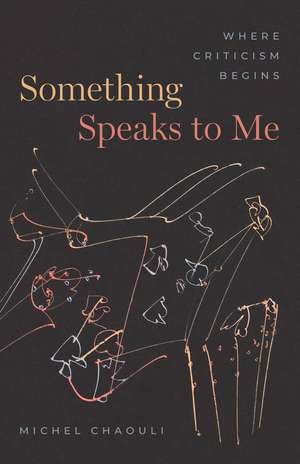
Something Speaks to Me: Where Criticism Begins
Autor Michel Chaoulien Limba Engleză Paperback – 16 feb 2024
În peisajul academic al studiilor literare, Something Speaks to Me ocupă un loc aparte, poziționându-se nu ca un manual tehnic de analiză, ci ca o reflecție filosofică asupra impulsului primar care generează actul critic. Remarcăm modul în care Michel Chaouli plasează geneza criticii în momentul vulnerabil în care lăsăm o carte din mână pentru a împărtăși cuiva impactul ei. Această lucrare extinde cadrul propus de The Character of Criticism de Geoffrey Galt Harpham, trecând de la explorarea criticii ca expresie a caracterului și sensibilității, către o fenomenologie a urgenței comunicării.
Structurată în trei părți fundamentale — Intimitate, Urgență și Opacitate — cartea ghidează cititorul prin procesul prin care un text „ne vorbește”. În prima parte, autorul analizează „pulsul textului” și autoritatea poeticului, în timp ce a doua parte se concentrează pe nevoia imperioasă de a traduce experiența estetică în limbaj. Ultima secțiune abordează dificultatea inerentă a criticii, acea „umbră la vedere” unde tehnica își atinge limitele. Apreciem abordarea lui Chaouli care, spre deosebire de The Theory of Criticism – A Tradition and Its System de Murray Krieger, nu caută să construiască o poetică a prezenței sistematice, ci să valideze incertitudinea și surpriza ca elemente centrale ale lecturii.
Această lucrare reprezintă o evoluție naturală a preocupărilor autorului din Thinking with Kant`s Critique of Judgment. Dacă în volumul anterior Chaouli analiza forța judecății estetice prin prisma kantiană, aici el eliberează critica de constrângerile academice rigide, transformând-o într-o formă de „critică poetică”. Tonul este unul de eseu filosofic, dens dar accesibil, invitând la o reevaluare a modului în care ne raportăm la literatură și artă în general.
Preț: 171.94 lei
Carte disponibilă
Livrare economică 28 octombrie-11 noiembrie
Livrare express 14-20 octombrie pentru 20.71 lei
Specificații
ISBN-10: 022683042X
Pagini: 192
Dimensiuni: 140 x 216 x 15 mm
Greutate: 0.25 kg
Ediția:First Edition
Editura: University of Chicago Press
Colecția University of Chicago Press
De ce să citești această carte
Recomandăm această carte studenților și cercetătorilor din domeniul criticii literare și filosofiei estetice care doresc să redescopere miza personală a lecturii. Cititorul câștigă o perspectivă proaspătă asupra actului critic, înțeles nu ca disecție rece, ci ca un răspuns vital și urgent la frumos. Este o pledoarie pentru sensibilitate în fața textului, oferind argumente teoretice solide pentru validarea reacțiilor subiective în spațiul intelectual.
Despre autor
Michel Chaouli este profesor asistent de studii germanice la Indiana University. Expertiza sa se concentrează pe intersecția dintre literatură și filosofie, cu un interes particular pentru estetica germană. Lucrarea sa anterioară, Thinking with Kant`s Critique of Judgment, a fost apreciată pentru modul în care a făcut accesibilă gândirea kantiană atât pentru novici, cât și pentru experți, investigând relația dintre frumos și sens. În Something Speaks to Me, Chaouli continuă această explorare a experienței estetice, aplicând-o direct actului de a scrie despre artă și literatură.
Descriere scurtă
Criticism begins when we put down a book to tell someone about it. It is what we do when we face a work or event that bowls us over and makes us scramble for a response. As Michel Chaouli argues, criticism involves three moments: Something speaks to me. I must tell you about it. But I don’t know how. The heart of criticism, no matter its form, lies in these surges of thoughts and feelings. Criticism arises from the fundamental need to share what overwhelms us.
We tend to associate criticism with scholarship and journalism. But Chaouli is not describing professional criticism, but what he calls “poetic criticism”—a staging ground for surprise, dread, delight, comprehension, and incomprehension. Written in the mode of a philosophical essay, Something Speaks to Me draws on a wide range of writers, artists, and thinkers, from Kant and Schlegel to Merleau-Ponty, Bachelard, Barthes, and Cavell. Reflecting on these dimensions of poetic experience, Something Speaks to Me is less concerned with joining academic debates than communicating the urgency of criticism.
Notă biografică
Extras
then another—always with the same outcome.
This was unnerving. I had set off on one path—the path of analysis and interpretation, the path I knew, or thought I knew—only to find myself repeatedly led back to my starting point, to Kafka’s words themselves. It was a bit like walking into a Luis Buñuel movie, The Exterminating Angel, for example, or The Discreet Charm of the Bourgeoisie, where every attempt at achieving a simple task—crossing a threshold or sitting down to a meal—is mysteriously foiled.
Or like wandering into a story by Kafka himself, a story like “An Imperial Message.” It’s a simple story: a messenger rushes to get a message from the dying emperor to you—yes, you—yet despite his swiftness, despite his resolve, he never manages to leave the palace, much less cross the vast expanse of the empire to reach you. Like The Trial and so much of Kafka’s writing, the story is pervaded by the feeling that a character’s efforts to move forward, vigorous though they may be, result in nothing but futility and exhaustion. It’s a feeling we know from bad dreams and one I came to know in front of my class. Try as I might, I found no way to deliver the message.
I have often returned to that moment, and not without dread, since the burn of humiliation never quite heals. One reason to revisit it may be that I soon felt, or perhaps hoped, that the scene betrayed something more than my own shortcoming, that being tongue-tied spoke to a shared condition, the condition of criticism, which we encounter in reviews and monographs but whose roots reach deeper and wider. I felt and hoped that my failure to speak was mute testimony to a general difficulty in saying something that could stand up to the experience of reading the passages from The Trial—the difficulty of criticism. This book is a wager that there is something to that feeling and that hope.
Most things I encounter in the world do not impel me to speak about them. When I hold a spoon without saying something about it, I do not feel an absence, a void aching to be filled, a stutter pounding against an invisible barrier, and not because there is nothing to say about it. An inquiry into the spoon need not be less demanding than examining a work by Kafka. When I take the spoon for granted and credit it with indifferent silence, as I do every day, I do lose something: I deprive myself of the knowledge of its place in history and miss out on the pleasure of noticing just how elegant a device this piece of flatware is. But that is not essential to the relationship we have, the spoon and I. Telling its story, singing its praises, or enumerating its flaws, is something I do for my own sake or for the sake of others, not something the spoon asks of me. If it can be said to ask anything of me, it is to use it—to stir the broth or tap the soft-boiled egg; so, I use it. As a rule, the spoon does not call on me to grapple with its significance, which is why as a rule I do not feel the urge to put it down and tell you about it.
Yet when holding a book that speaks to me, that is just what I feel: the urge to put it down and tell you. And when I then fail, my silence feels different from the one with which I greet the spoon. Now my silence consists not in the mere absence of words but has a volume and mass all its own. I feel the pressure of words I am not uttering. These are not words I know and have chosen to hold back, the way I decide to keep a secret. They are words whose surging force I feel yet whose shape and character elude me. Because I require them to give shape to my experience, their remaining out of reach means that my own experience fails me: What just happened to me? Did anything happen? Nor must I remain silent to hear the absence of words: often (in the classroom, for instance, or the scholarly study) it is the very
abundance of discourse, its polish and erudition, that bears witness to what remains unspoken.
It comes down to this:
Something speaks to me.
I must tell you about it.
But I don’t know how.
That is the heart of it—the heart of criticism and its difficulty, no matter its form, no matter its refinement: I read something, and next there is an upsurge of desire to tell you about it. “Desire” is not quite right, since what makes itself felt is something closer to a need, a need so obscure that it remains nameless.
Cuprins
Part 1. Something Speaks to Me (Intimacy)
Feeling the Pulse of the Text
Some Examples
Poetic Criticism, an Essay
Roland Barthes Has Sushi
What Does the Text Want from Me?
The Impersonality of Intimacy
The Texture of Intimacy
Productive Distrust
Learning to Unlearn
Naïveté
Intimacy, Self-Taught
The Call of Significance
The Authority of the Poetic
Being in History
Being in the Same History (Tradition)
A Bastard of History
Part 2. I Must Tell You about It (Urgency)
Understanding and Making
Making the New by Remaking the Old
Learning Not to Conclude
Tact
Playing It by Ear
Poetic Making Conserves as It Renews
Poetic Power
Philological Disarmament
Hearing That We May Speak
Second Thoughts
Self-Reference versus Urgency
Epiphanies
The Intense Life of Language
What and How
The Knot of Experience
Making Freedom
Part 3. But I Don’t Know How (Opacity)
Shadow in Plain Sight
The Difficulty of Criticism
The Strange Voice
Aristotle versus Plato
What in Technique Is More Than Technique
What Kind of Thing Is the Poetic Thing?
The Work of Art versus the Poetic Work
The Eye of the Work, the Eye of the Beholder
How to Leap Over One’s Own Shadow
Why Non-Knowing Is the Primal Condition of Poetry
Genius
Criticism Is Making
The Poet of the Poet
Falling
The Difficulty, and the Ecstasy, of Reality
Is Poetry a Deflection from Life?
In Poetry, Non-Knowing Is a Primal Condition
The Social Force of the Impersonal
To Be Continued . . .
Acknowledgments
Notes
Index