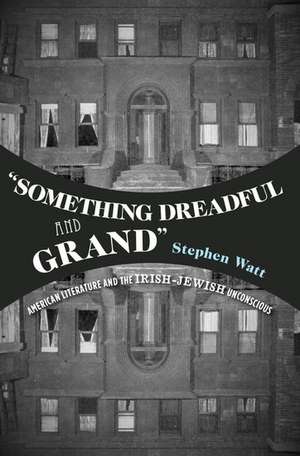
"Something Dreadful and Grand": American Literature and The Irish-Jewish Unconscious
Autor Stephen Watten Limba Engleză Hardback – 6 aug 2015
Preț: 499.38 lei
Preț vechi: 697.12 lei
-28%
Puncte Express: 749
Carte tipărită la comandă
Livrare economică 26 noiembrie-02 decembrie
Livrare prin curier în România Termenul estimat este afișat lângă disponibilitate.
Transport gratuit pentru acest produs Plată online sau ramburs, în funcție de opțiunile comenzii.
Retur gratuit în 14 zile Comandă securizată și suport în română.
Specificații
ISBN-13: 9780190227951
ISBN-10: 0190227958
Pagini: 272
Ilustrații: 12 halftones
Dimensiuni: 234 x 160 x 23 mm
Greutate: 0.54 kg
Editura: Oxford University Press
Colecția OUP USA
Locul publicării:New York, United States
ISBN-10: 0190227958
Pagini: 272
Ilustrații: 12 halftones
Dimensiuni: 234 x 160 x 23 mm
Greutate: 0.54 kg
Editura: Oxford University Press
Colecția OUP USA
Locul publicării:New York, United States
V-ar putea interesa
-
 Behind the MaskMatthew DennisonPreț: 92.40 lei
 -
 Critical Studies: The Great GatsbyKathleen ParkinsonPreț: 32.57 lei
 -
 -22%Preț: 195.93 lei252.11 lei
 -
 Ezra Pound, Wyndham Lewis, and Radical ModernismVincent Sherry-28%Preț: 396.15 lei549.33 lei
 -
 -31%Preț: 770.82 lei1121.74 lei
 -
 Maxine Hong Kingston's The Woman Warrior: A CasebookSau-ling Cynthia Wong-31%Preț: 739.43 lei1075.56 lei
 -
 Christine Brooke-Rose and Contemporary FictionSarah Birch-33%Preț: 755.62 lei1123.72 lei
 -
 Thomas Mann: The Uses of TraditionT. J. Reed-28%Preț: 468.89 lei652.10 lei
 -
 Mikhail Bakhtin: An Aesthetic for DemocracyKen Hirschkop-28%Preț: 420.22 lei585.58 lei
 -
 The Strange Short Fiction of Joseph Conrad: Writing, Culture, and SubjectivityDaphna Erdinast-Vulcan-30%Preț: 391.25 lei559.10 lei
 -
 -31%Preț: 679.63 lei984.99 lei
 -
 -23%Preț: 392.90 lei507.48 lei
 -
 Literature and the Great War 1914-1918Randall Stevenson-13%Preț: 286.36 lei329.24 lei
 -
 Preț: 402.60 lei
 -
 Office Hours: Activism and Change in the AcademyCary NelsonPreț: 406.60 lei
 -
 Yet One More SpringDon W. KingPreț: 204.43 lei
 -
 When They Weren't Doing ShakespeareJudith L FisherPreț: 266.12 lei
 -
 Beckett and Contemporary Irish WritingStephen WattPreț: 353.72 lei
 -
 -16%Preț: 276.49 lei328.74 lei
 -
 Translation and the Making of Modern Russian LiteratureProfessor Brian James BaerPreț: 296.18 lei
 -
 Intelligent Computer MathematicsJacques Carette-20%Preț: 333.24 lei416.55 lei
Descriere
"Something Dreadful and Grand": American Literature and the Irish-Jewish Unconscious takes its title from an essay that introduces John Patrick Shanley's Outside Mullingar, a text that marks over 150 years of the so-called "Irish play" on the New York stage. This book traces the often uncanny relationships between Irish- and Jewish-America, arguing for the centrality of these two diasporic groups to the development of American popular music, fiction, and especially drama. But more than this, the book reads such cultural forms as tenement fiction, Tin Pan Alley music, and melodrama as part of a larger "circum-North Atlantic" world in which texts and performers from Ireland, Europe, and America were and still are involved in a continuous cultural exchange within which stereotypes and performances of Jewishness and Irishness took center stage. For this reason, such Irish writers as James Joyce, Bernard Shaw, and Sean O'Casey played pivotal roles in the development of modern American culture, particularly as they influenced and interacted with writers like Elmer Rice, Clifford Odets, Henry Roth, and many others. Such Irish-American writers as Eugene O'Neill were similarly influenced by their interactions with Jewish-American writers like Michael Gold and Edward Dahlberg.While focusing on the modern period, this project traces a genealogy of modern drama and fiction to the nineteenth century stage in which Irish and Jewish melodrama-and the appearances of international stars in such roles as Shylock and Leah, the Forsaken-shaped the often contradictory and excessive dimensions of ethnicity that are both allosemitic and allohibernian. Borrowing a term from psychoanalytic theory, I also explore the larger dimensions of an Irish-Jewish unconscious underlying cultural production in America. The closing chapter considers more recent representations of Irish-Jewish interactions by John Banville, Brendan Behan, Norman Mailer, and Harold Pinter; and examples from a newer immigrant literature bring this discussion into the present.
Recenzii
This book does more than track the significance of Irish and Jewish themes and characters on the American stage
Notă biografică
Stephen Watt is Professor of English, Theater, and Drama at Indiana University. His previous books include Beckett and Contemporary Irish Writing (Cambridge UP, 2009) and Ian Fleming and James Bond: The Cultural Politics of 007 (Indiana University Press, 2005).