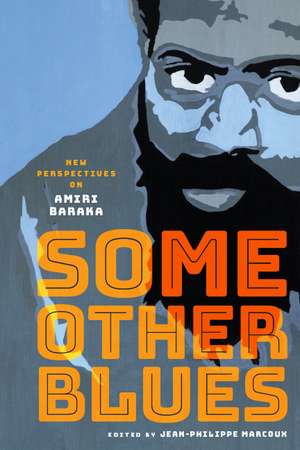
Some Other Blues: New Perspectives on Amiri Baraka
Editat de Jean-Philippe Marcouxen Limba Engleză Paperback – 11 feb 2021
This collection of original essays brings together some of the most important critics and scholars of Amiri Baraka’s oeuvre. Some Other Blues consists of career-spanning conversations on the many trajectories, bifurcations, and intersections in and of Baraka’s black art. Every chapter is grounded in the desire to illuminate Baraka’s multilayered creative output—whether through critical analyses, literary historiographies, or musicological and biographical reassessments of his work. Every contributor attempts, in their own unique ways, to delineate how the contours of poems, short stories, essays, and editorials reveal the poetics and politics of Amiri Baraka. At the same time, every chapter looks outward at what Baraka saw as the fractures and fissures of our society—moments in the history of African America that have needed repair and relief. For the first time in one book, two generations of scholars and friends of the Baraka family converge to assess the legacy and the imprint of the writer, activist, and cultural worker who has reshaped and redefined what is means to be a black public intellectual and poet. (Include contributors if space allows) Contributors: Tony Bolden, Jeremy Glick, William J. Harris, Benjamin Lee, Aidan Levy, John Lowney, Jean-Philippe Marcoux, Kim McMillon, Fred Moten, Michael New, Aldon Lynn Nielsen, Amy Abugo Ongiri, Gregory Pierrot, Howard Rambsy II, Emily Ruth Rutter, Anthony Reed, Lauri Scheyer, Kathy Lou Schultz, Michael Simanga, James Smethurst, Laura Vrana, Tyrone Williams, Kalamu ya Salaam.
| Toate formatele și edițiile | Preț | Express |
|---|---|---|
| Paperback (1) | 252.74 lei 6-8 săpt. | |
| Ohio State University Press – 11 feb 2021 | 252.74 lei 6-8 săpt. | |
| Hardback (1) | 566.81 lei 6-8 săpt. | |
| Ohio State University Press – 11 feb 2021 | 566.81 lei 6-8 săpt. |
Preț: 252.74 lei
Puncte Express: 379
Preț estimativ în valută:
44.71€ • 52.41$ • 38.89£
44.71€ • 52.41$ • 38.89£
Carte tipărită la comandă
Livrare economică 05-19 martie
Preluare comenzi: 021 569.72.76
Specificații
ISBN-13: 9780814257845
ISBN-10: 0814257844
Pagini: 302
Dimensiuni: 152 x 229 x 20 mm
Greutate: 0.43 kg
Ediția:1
Editura: Ohio State University Press
Colecția Ohio State University Press
ISBN-10: 0814257844
Pagini: 302
Dimensiuni: 152 x 229 x 20 mm
Greutate: 0.43 kg
Ediția:1
Editura: Ohio State University Press
Colecția Ohio State University Press
V-ar putea interesa
-
 Jazz Griots: Music as History in the 1960s African American PoemJean-Philippe Marcoux-34%Preț: 603.45 lei910.13 lei
 -
 Poems from the HeartMS Kristal Annamarie LaraPreț: 89.03 lei
 -
 955 Questions of Charles DickensRichesin, L. DalePreț: 100.01 lei
 -
 Far from HomeJerry AyersPreț: 37.50 lei
 -
 Vorschule Der Asthetik (Grossdruck)Jean PaulPreț: 303.30 lei
 -
 Your DarknessM. K. HensleyPreț: 35.82 lei
 -
 Keys to HemingwayProf Ernest H. Lockridge PhdPreț: 39.06 lei
 -
 Modernity CrazeMR Ronald Walter AdubangoPreț: 88.67 lei
 -
 Wipe My Tears!Majid Al Suleimany MbaPreț: 235.03 lei
 -
 Donne Sex and GodJohn HoylesPreț: 78.45 lei
 -
 Preț: 84.63 lei
 -
 Robert J. Conley?s Mountain WindsongPamela Carmelle FoxPreț: 51.46 lei
 -
 Briefe Zur Beforderung Der Humanitat (Grossdruck)Johann Gottfried HerderPreț: 302.87 lei
 -
 Making New WorldsJohn C. WoodcockPreț: 87.15 lei
 -
 My Kind of ComedyRufel F. RamosPreț: 69.18 lei
 -
 Radiance and Secrecy in Marilynne Robinson's GileadRobert E. KohnPreț: 49.25 lei
Recenzii
“This is a most timely and long-overdue collection that not only enriches our understanding of Baraka’s work but also points to new avenues of scholarly inquiry.” —Jürgen E. Grandt, author of Gettin’ Around: Jazz, Script, Transnationalism
“Some Other Blues will situate Baraka rightly as a model of intellectual and artistic innovation, adventure, and integrity, and it will locate him at the intersection of the some of the most important ideas of black cultural radicalism, the avant-garde, and artistic activism. It is a collection worthy of the man himself.” —Keith D. Leonard, author of Fettered Genius: The African American Bardic Poet from Slavery to Civil Rights
“Some Other Blues will situate Baraka rightly as a model of intellectual and artistic innovation, adventure, and integrity, and it will locate him at the intersection of the some of the most important ideas of black cultural radicalism, the avant-garde, and artistic activism. It is a collection worthy of the man himself.” —Keith D. Leonard, author of Fettered Genius: The African American Bardic Poet from Slavery to Civil Rights
Notă biografică
Jean-Philippe Marcoux is Professor of American Literature at Laval University. He is also Vice President of the Amiri Baraka Society.
Extras
Some Other Blues is not only the first attempt to present the results of two decades of innovative research on Baraka, but it is also the product of many ongoing conversations between the scholars gathered to honor, celebrate, and assess the work Baraka bequeathed to his readers. It certainly feels like the time is right to have new critical insights into Baraka’s oeuvre, as he not only would have had a lot to say about the current political climate, but he would also be proud to see how he continues to influence generations of African American poets trying to negotiate mainstream society.
Some Other Blues is modeled after the call-response pattern of black vernacular music—it is, after all, the “mode of (musical) expression” (Black Music 181) that has remained central to Baraka’s idea of black expressive traditions and to his translation of the black cultural memory into verse and text, what in “New Music/New Poetry” he calls “speech musicked” (The Music 243). Structurally and thematically, each part and each chapter of this collection is antiphonally connected; for instance, the first essay of each “side” of Some Other Blues issues a call in the form of a shorter Harris essay, which is responded to by the ensuing chapters. Part II responds to the idea of legacy mapped out critically in Part I. And Fred Moten provides us with the core riff on Baraka’s impact and centrality. In Part 1 Side A, William J. Harris proposes a poetics of place—27 Cooper Square—that becomes a space Baraka uses to experiment with traditions, forms, and aesthetics at the same time as he fashions an identity that anticipates a deep immersion in black vernacular culture (in Side B). The first response comes from Aldon Nielsen, who studied under Baraka and shared a friendship with him. Nielsen tackles the significance of the Winter 1963 issue of Kulchur in fashioning the new direction of black poetics in the context of the early ’60s. Kathy Lou Schultz engages Baraka’s experimentalism and vanguard aesthetics, this time through 6 Persons, a multivocalic experimental memoir that, she argues, constructs black subjectivity. Tyrone Williams riffs on the idea of tradition by drawing links and establishing thematic correspondences between Countee Cullen, Baraka, and Natasha Trethewey. Emily Ruth Rutter focuses on Baraka’s less-explored writings about sports, which become opportunities to address issues related to resistance, appropriation, and co-optation. In the last essay of the first part, Jeremy Matthew Glick provides a transition between Sides: He places Hegel’s short essay entitled “Who Thinks Abstractly?” in conversation with tracks from the 1982 jazz album New Music/New Poetry, especially “Strunza Med,” which allows him to reconsider politics of revolution, nation building, and black internationalism.
In the opening remarks to Part I Side B, Harris highlights the significance of Baraka attending the Five Spot, where he experiences the power of black jazz musicians, especially Thelonious Monk and John Coltrane, creating a black avant-garde music. Harris argues that for Baraka, the club is “a black space, a new cultural space.” In this second call, Harris lays the groundwork for assessing the means of absorption and the resultant work: vernacularized poetics and politics.
Some Other Blues is modeled after the call-response pattern of black vernacular music—it is, after all, the “mode of (musical) expression” (Black Music 181) that has remained central to Baraka’s idea of black expressive traditions and to his translation of the black cultural memory into verse and text, what in “New Music/New Poetry” he calls “speech musicked” (The Music 243). Structurally and thematically, each part and each chapter of this collection is antiphonally connected; for instance, the first essay of each “side” of Some Other Blues issues a call in the form of a shorter Harris essay, which is responded to by the ensuing chapters. Part II responds to the idea of legacy mapped out critically in Part I. And Fred Moten provides us with the core riff on Baraka’s impact and centrality. In Part 1 Side A, William J. Harris proposes a poetics of place—27 Cooper Square—that becomes a space Baraka uses to experiment with traditions, forms, and aesthetics at the same time as he fashions an identity that anticipates a deep immersion in black vernacular culture (in Side B). The first response comes from Aldon Nielsen, who studied under Baraka and shared a friendship with him. Nielsen tackles the significance of the Winter 1963 issue of Kulchur in fashioning the new direction of black poetics in the context of the early ’60s. Kathy Lou Schultz engages Baraka’s experimentalism and vanguard aesthetics, this time through 6 Persons, a multivocalic experimental memoir that, she argues, constructs black subjectivity. Tyrone Williams riffs on the idea of tradition by drawing links and establishing thematic correspondences between Countee Cullen, Baraka, and Natasha Trethewey. Emily Ruth Rutter focuses on Baraka’s less-explored writings about sports, which become opportunities to address issues related to resistance, appropriation, and co-optation. In the last essay of the first part, Jeremy Matthew Glick provides a transition between Sides: He places Hegel’s short essay entitled “Who Thinks Abstractly?” in conversation with tracks from the 1982 jazz album New Music/New Poetry, especially “Strunza Med,” which allows him to reconsider politics of revolution, nation building, and black internationalism.
In the opening remarks to Part I Side B, Harris highlights the significance of Baraka attending the Five Spot, where he experiences the power of black jazz musicians, especially Thelonious Monk and John Coltrane, creating a black avant-garde music. Harris argues that for Baraka, the club is “a black space, a new cultural space.” In this second call, Harris lays the groundwork for assessing the means of absorption and the resultant work: vernacularized poetics and politics.
Cuprins
Foreword “We Seen It, Too” Fred Moten Introduction Jean-Philippe Marcoux Part I Perspectives on Record Side A Home (A Cultural Space of Experiment) 1 Amiri Baraka Among the Bohemians: 27 Cooper Square William J. Harris 2 Kulchur Wars Aldon Lynn Nielsen 3 “Other Autobiographies”: Racial and Spiritual Consciousness and the Prism of Identity in Amiri Baraka’s 6 Persons Kathy Lou Schultz 4 Baraka, Cullen, Trethewey: Incidents Tyrone Williams 5 “Legitimate Black Heroes”: Amiri Baraka’s Prescient Views on the Politics of Sports Emily Ruth Rutter 6 Hegel off the Tracks Jeremy Matthew Glick Side B The Music (Ideations and Renegotiations) 7 The Five Spot Café William J. Harris 8 “Of Langston and Langston Manifestos”: Langston Hughes and the Revolutionary Jazz Poetry of Amiri Baraka John Lowney 9 Amiri Baraka and the Dream of Unity Music Grégory Pierrot 10 “A Marching Song for Some Strange Uncharted Country”: The Black Nation, Black Revolution, and Amiri Baraka’s Liner Notes James Smethurst 11 Baraka’s Speculative Revolutions Benjamin Lee 12 Black and Blues: Amiri Baraka and Gil Scott-Heron’s Political Poetry Michael J. New 13 “Pick Up Them Cliffords”: Amiri Baraka, Clifford Brown, and the Coinage of Currency Aidan Levy 14 We Are the (Rhythm and) Blues Anthony Reed Part II In the Tradition: Reassessments, Recollections, Legacies 15 The Legacy and Place of Amiri Baraka Lauri Scheyer 16 Anthologizing the Poetry of Amiri Baraka, 1960–2018 Howard Rambsy II 17 Black (Feminist) Art: Contemporary Black Female Poets Speak Back to Baraka Laura Vrana 18 Black Magic: Evolving Notions of Gender and Sexuality in the Work of Amiri Baraka Amy Abugo Ongiri 19 Amina Baraka: The Woman Who Guided the Ship Kim McMillon 20 Amiri Baraka: Mentoring as Revolutionary Praxis Michael Simanga 21 The Overlooked Spirit Reach of Amiri Baraka’s Terribleness Kalamu ya Salaam Blues/Funk Outro Amiri Baraka as Cultural Philosopher Tony Bolden Works Cited List of Contributors Index
Descriere
Drawing from both scholars and friends of Amiri Baraka, this collection reassesses Baraka’s multilayered creative output.