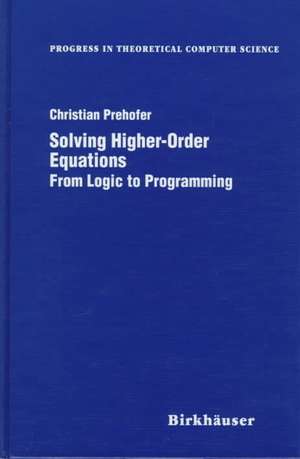
Solving Higher-Order Equations: Progress in Theoretical Computer Science
Autor Christian Prehoferen Limba Engleză Hardback – 18 dec 1997
Din seria Progress in Theoretical Computer Science
- 15%
 Preț: 658.77 lei
 - 15%
 Preț: 659.45 lei
 - 15%
 Preț: 663.36 lei
 - 20%
 Preț: 646.41 lei
 - 18%
 Preț: 987.20 lei
 - 15%
 Preț: 651.13 lei
 - 20%
 Preț: 643.50 lei
 - 20%
 Preț: 676.52 lei
 - 15%
 Preț: 673.39 lei
 - 15%
 Preț: 658.54 lei
 - 15%
 Preț: 665.00 lei
 - 20%
 Preț: 1018.84 lei
 -
 Preț: 367.68 lei
 - 20%
 Preț: 618.14 lei
 - 15%
 Preț: 565.87 lei
 - 15%
 Preț: 566.24 lei
 -
 Preț: 365.99 lei
 -
 Preț: 374.59 lei
Preț: 661.18 lei
Preț vechi: 777.87 lei
-15%
Puncte Express: 992
Carte tipărită la comandă
Livrare economică 28 noiembrie-12 decembrie
Livrare prin curier în România Termenul estimat este afișat lângă disponibilitate.
Transport gratuit pentru acest produs Plată online sau ramburs, în funcție de opțiunile comenzii.
Retur gratuit în 14 zile Comandă securizată și suport în română.
Specificații
ISBN-13: 9780817640323
ISBN-10: 0817640320
Pagini: 204
Ilustrații: IX, 188 p.
Dimensiuni: 160 x 241 x 16 mm
Greutate: 0.43 kg
Ediția:1998
Editura: birkhäuser
Colecția Progress in Theoretical Computer Science
Seria Progress in Theoretical Computer Science
Locul publicării:Boston, MA, United States
ISBN-10: 0817640320
Pagini: 204
Ilustrații: IX, 188 p.
Dimensiuni: 160 x 241 x 16 mm
Greutate: 0.43 kg
Ediția:1998
Editura: birkhäuser
Colecția Progress in Theoretical Computer Science
Seria Progress in Theoretical Computer Science
Locul publicării:Boston, MA, United States
V-ar putea interesa
-
 Head First HTML and CSSElisabeth Robson-20%Preț: 297.40 lei371.75 lei
 -
 Logic of DomainsG. Zhang-15%Preț: 665.00 lei782.35 lei
 -
 Scientific PascalHarley Flanders-20%Preț: 343.53 lei429.41 lei
 -
 Subrecursive Programming SystemsJames S. Royer-20%Preț: 643.50 lei804.37 lei
 -
 Object-Oriented Programming A Unified FoundationGiuseppe Castagna-20%Preț: 676.52 lei845.65 lei
 -
 Comparative Metric Semantics of Programming LanguagesFranck Van Breughel-15%Preț: 663.36 lei780.42 lei
 -
 -20%Preț: 676.98 lei846.22 lei
 -
 KanbanDavid J. Anderson-20%Preț: 264.20 lei330.25 lei
 -
 Preț: 295.88 lei
 -
 Professional GitBrent Laster-20%Preț: 256.78 lei320.97 lei
 -
 Pro ASP.NET Web API SecurityBadrinarayanan Lakshmiraghavan-20%Preț: 525.86 lei657.33 lei
 -
 Android CookbookIan F Darwin-20%Preț: 443.80 lei554.76 lei
 -
 Continuous Delivery with Visual Studio ALM 2015Mathias Olausson-20%Preț: 299.70 lei374.63 lei
 -
 The Enterprise Big Data LakeAlex Gorelik-20%Preț: 378.05 lei472.57 lei
 -
 Feature Engineering for Machine LearningAlice Zheng-20%Preț: 342.12 lei427.66 lei
 -
 Mastering ServiceNow - Second EditionMartin Wood-20%Preț: 368.74 lei460.93 lei
 -
 -15%Preț: 568.96 lei669.36 lei
Public țintă
ResearchCuprins
1 Introduction.- 2 Preview.- 2.1 Term Rewriting.- 2.2 Narrowing.- 2.3 Narrowing and Logic Programming.- 2.4 ?-Calculus and Higher-Order Logic.- 2.5 Higher-Order Term Rewriting.- 2.6 Higher-Order Unification.- 2.7 Decidability of Higher-Order Unification.- 2.8 Narrowing: The Higher-Order Case.- 3 Preliminaries.- 3.1 Abstract Reductions and Termination Orderings.- 3.2 Higher-Order Types and Terms.- 3.3 Positions in ?-Terms.- 3.4 Substitutions.- 3.5 Unification Theory.- 3.6 Higher-Order Patterns.- 4 Higher-Order Equational Reasoning.- 4.1 Higher-Order Unification by Transformation.- 4.2 Unification of Higher-Order Patterns.- 4.3 Higher-Order Term Rewriting.- 5 Decidability of Higher-Order Unification.- 5.1 Elimination Problems.- 5.2 Unification of Second-Order with Linear Terms.- 5.3 Relaxing the Linearity Restrictions.- 5.4 Applications and Open Problems.- 6 Higher-Order Lazy Narrowing.- 6.1 Lazy Narrowing.- 6.2 Lazy Narrowing with Terminating Rules.- 6.3 Lazy Narrowing with Left-Linear Rules.- 6.4 Narrowing with Normal Conditional Rules.- 6.5 Scope and Completeness of Narrowing.- 7 Variations of Higher-Order Narrowing.- 7.1 A General Notion of Higher-Order Narrowing.- 7.2 Narrowing on Patterns with Pattern Rules.- 7.3 Narrowing Beyond Patterns.- 7.4 Narrowing on Patterns with Constraints.- 8 Applications of Higher-Order Narrowing.- 8.1 Functional-Logic Programming.- 8.2 Equational Reasoning by Narrowing.- 9 Concluding Remarks.- 9.1 Related Work.- 9.2 Further Work.